Materials
Reinforcing concrete with 3D printed polymer lattices
Concrete is one of the most widely used man-made building materials and one of the world’s most consumed substances, second only to water. It is cheap, abundant, and capable of heavy loads, but, it is also brittle and tends to…
- 3 min read
- Materials
- Six more stories
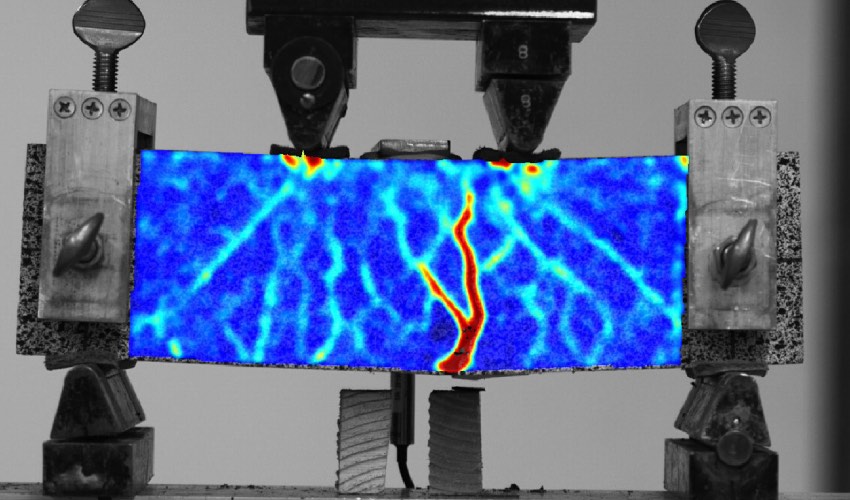
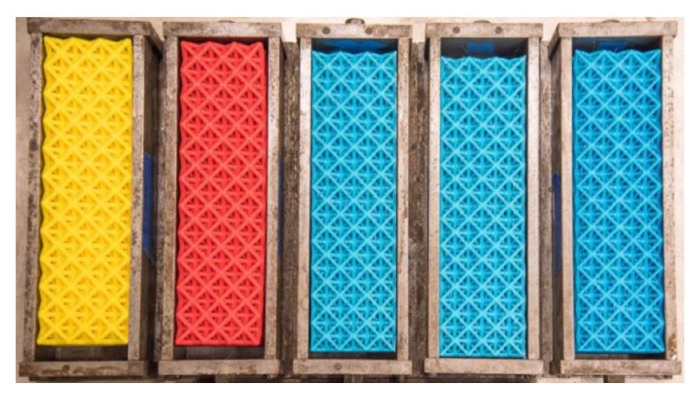
Concrete is one of the most widely used man-made building materials and one of the world’s most consumed substances, second only to water. It is cheap, abundant, and capable of heavy loads, but, it is also brittle and tends to crack. Therefore, concrete needs to be reinforced. Recently, researchers at UC Berkeley have developed a novel way to reinforce concrete with 3D printed polymer lattice structures – a way that improves concrete’s ductility while reducing the material’s carbon emissions.
In fact, engineers have been reinforcing concrete with polymer fibers for six decades, so the concept isn’t new in itself. However, the technique was different: fibers were typically mixed into concrete before it was poured, which meant the fibers were not distributed evenly. As a result, one part of a structure would have a high concentration of fibers, while another had almost none, leaving a path for cracks to form. Enter 3D printing. The benefit of a 3D printed lattice reinforcement is that a series of trusses stops cracks before they grow too large.
All image credits: UC Berkeley
Previous lattice reinforcements were two-dimensional and had a limited capability to support complex concrete designs. So the researchers wanted to manufacture a 3D design that could support heavy loads from all directions. For that purpose they used the octet truss for the lattice structure. Popularized by the architect Buckminster Fuller in the 1950s, the octet truss is known for being strong but also light at the same time.
More from the desk
Six other notes from the rest of the bench.
 ApplicationsNASA to Conduct 3D Printing Experiments Aboard the International Space StationThe realm of space exploration marks the early stages of humanity’s journey, with countless planets and galaxies awaiting discovery. Moreover, significant strides have been made in recent decades, driven by the discovery of innovative technologies. Additive manufacturing st
 NewsNew York Bill Proposes Background Checks on 3D Printer BuyersAfter a raft of busts in New York which led to the discovery of several caches of ghost guns, made of untraceable weapon components made from 3D printers, lawmakers in the empire state have now put forward a piece of…
 NewsBryson DeChambeau Ignites 2024 Masters With 3D Printed IronsBryson DeChambeau, nicknamed ‘The Mad Scientist’ for his unconventional approach to the game of golf, has ignited the 2024 Masters Tournament, capturing the attention of fans and experts alike in the sport. While his stellar performance on the course has…
 NewsA 3D Printed Aerospike Nozzle Rocket Engine Ready to Take FlightSpanish startup Pangea Aerospace and the company Aenium have signed a partnership to develop and industrialize advanced 3D printed combustion devices made from innovative materials. Together, they have designed a 3D printed aerospike nozzle rocket engine that should be 15%&hellip
 News#TOP5 videos of the week: HP 3D prints spare parts and more!We found the TOP 5 videos of the week related to 3D printing and collected the additive manufacturing here. Share your videos and comment on the article below or on the 3Dnatives’ Facebook or Twitter account. Hope you’ll enjoy and…
 Guides3D Printed Houses: A Closer Look at Completed Projects from Around the WorldAs you may know, additive manufacturing is becoming increasingly important in the construction market. The new technologies make it possible to create more complex shapes, build walls faster, and reduce labor costs. Many construction companies have already started to 3D…