Applications
Chevrolet race cars with 3D printed parts cover 80,000 miles
The automaker Chevrolet, a division of General Motors since 1918, announced that its race cars have covered 80,000 miles, or approximately 130,000 km, with 3D printed parts this season. Led by the parent company, the automaker is placing additive manufacturing…
- 3 min read
- Applications
- Six more stories

The automaker Chevrolet, a division of General Motors since 1918, announced that its race cars have covered 80,000 miles, or approximately 130,000 km, with 3D printed parts this season. Led by the parent company, the automaker is placing additive manufacturing at the heart of its developments, whether in the prototyping or end production phases. For instance, in January 2020, two new Corvettes entered the racetrack, each with 75 3D printed parts, including the oil tank, the fuel tank inlet and cap, the driver’s cooling box and the integrated hydration system, etc.
The applications of 3D printing in the automotive industry are increasingly numerous, demonstrating the potential of the technology: manufacturers are designing pistons, brake pedals, and many other components to customize the interior of a vehicle. Nowadays, it is almost rare to see a big name among car manufacturers not interested in 3D printing. General Motors is no exception. It has been investing in additive manufacturing for a few years now – in 2018, the company revealed that it had saved more than $300,000 in two years with 3D printing and wanted to standardize this manufacturing process to design thousands of finished parts. So it’s no surprise that GM’s Chevrolet subsidiary is actively integrating additive manufacturing in its production activities.
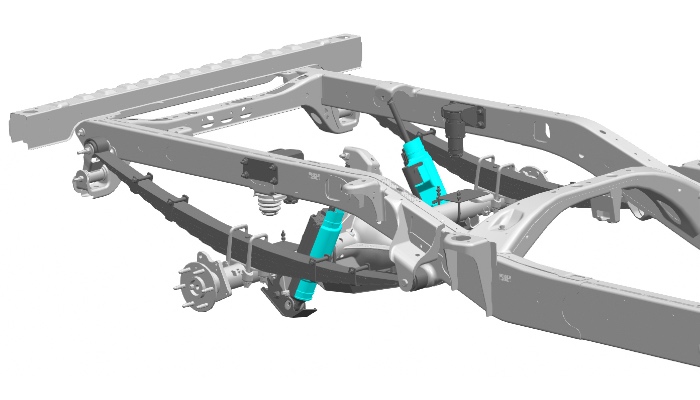
The 3D printed parts were made by GM, including the rear damper shields. (Image credits: General Motors)
Jim Campbell, US Vice President of Performance and Motorsports at General Motors, the parent company of Chevrolet, says, “Chevrolet has a long history of technology transfer between our motorsports and production teams, and this is a perfect example of our approach. GM’s 3D printing capability speeds up our learning cycles and, in turn, these racetrack experiences help our additive manufacturing team move one step closer the using 3D printed parts in production vehicles.”
More from the desk
Six other notes from the rest of the bench.
 MaterialsInterview with Biogelx about its bioinks and the future of bioprintingBiogelx is a spin-out from the University of Strathclyde in Glasgow, engaged in the development and production of synthetic bioinks for 3D cell cultures and bioprinting applications. When we talk about this sector and its progress, we often talk about…
 GuidesNano Dimension on the Future of Electronics in Additive ManufacturingAdditive manufacturing has been growing in importance in a number of different industries in the past few years. The ability to create objects that are customizable, more optimized, and often cheaper than parts created through traditional methods has made AM…
 NewsChris Brown Launches Limited Edition 3D Printed Slides by ZellerfeldZellerfeld, a leading company in the 3D printed footwear industry, has just announced the early release of the NAMI Slide, a collaboration with global superstar Chris Brown, Nos Ailes, and The Auracles, a streetwear and culture company. These limited edition…
 NewsNeutrogena and Nourished Are Creating 3D Printed, Personalized Skincare SupplementsThe search for beauty has been a constant throughout history. Whether through art, including paintings and sculptures like the iconic Adonis or Venus, or cosmetics and jewelry, which allow us to adorn our own skin, human are always seeking and…
 GuidesThe 10 Best STL Files of 2024Here’s the long-awaited moment: an article about the best STL files of 2024 that will make you look great at New Year’s Eve dinner. We have selected some of the most downloaded files in recent months, perfect for practical needs…
 ApplicationsBreakthrough Could Enable At-Home 3D Printed Prosthetic Socket Manufacturing3D printing has shown itself to be one of the most promising technologies in the medical sector thanks to its ability to create customizable solutions. This has made it especially popular for the creation of prosthetics and orthotics, which obviously…