News
What trends will shape the CAD sector during the next 5 years?
A recent report from the international market research firm Business Advantage revealed the global 2018/2019 CAD trends we can expect. The research firm had released a similar report in 2014 – therefore, his new data allows comparison with results from…
- 3 min read
- News
- Six more stories
A recent report from the international market research firm Business Advantage revealed the global 2018/2019 CAD trends we can expect. The research firm had released a similar report in 2014 – therefore, his new data allows comparison with results from the past 4 years. The survey drew on the participation of a sample of 626 CAD users and decision makers across a range of company sizes and industries worldwide. Moreover, 16 topics were addressed relating to the perceived importance, actual and future usage of CAD. The report captures and identifies the key trends in the CAD sector today and for the next five years.
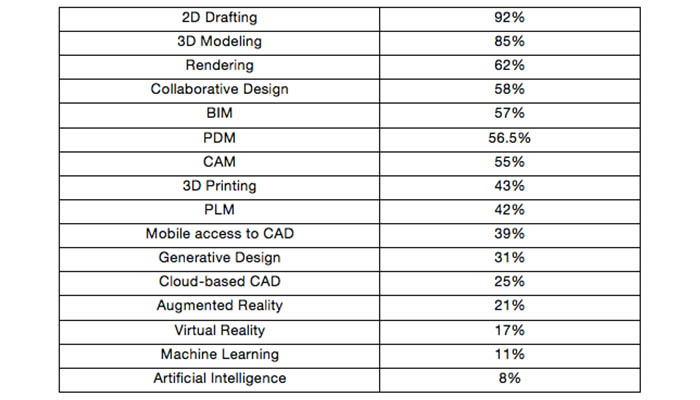
Adoption Ratio of the 16 technologies
The report focused on standard technologies, known by many, such as 3D modeling or 2D drafting but also more novel technologies such as generative design and virtual reality that have the potential of being more transformative for the sector. To understand the evolution of the CAD sector, the report analyses the awareness and usage of these technologies, using a metric they call the ‘adoption ratio’. This ratio refers to the number of respondents who use a given technology compared to the number of respondents that are aware of it. For example, 56% of respondents were aware of CAM (computer-aided manufacturing) but only 31% use CAM – so the adoption ratio is 55%. In terms of novel technologies, CAD users and decision makers were asked about artificial intelligence, virtual reality, augmented reality, cloud-based CAD, generative design and mobile access to CAD. The adoption ratio varied – mobile access to CAD had a 46% adoption ratio whereas artificial intelligence 8%. Nevertheless, the report found that the technologies with the lowest adoption ratio were the ones with the most predicted growth over the next 3 to 5 years.
The list of trends & their adoption ratio:
Importance and Usage of the 16 technologies
Respondents were also asked to rate each technology in terms of importance to their business. Users and decision makers perceived 3D modeling and 2D drafting as the most important technologies. These were also the most used. Artificial intelligence was ranked as the least important technology, followed by the other technologies that had a low adoption ratio – suggesting importance to a business is strongly linked to the adoption ratio. The report also found that BIM, CAM and collaborative design were growing in significance compared to previous years.
More from the desk
Six other notes from the rest of the bench.
 NewsThe Refabricator is transforming plastic into 3D printing material in spaceRefabricator is the new NASA recycling system that is expected to be ready by next year. Created by Tethers Unlimited Inc. (TUI), the system can be used to transform plastic objects and parts into printable materials on board the space…
 PrintersTaking a Closer Look at the POP 3D Scanner, Revopoint’s Affordable Consumer Grade ScannerThere are many 3D scanners on the market, but it can be difficult to decide which one to choose, especially when it comes to low-cost scanners. To combat this, certain companies have started to make themselves stand out thanks to…
 PrintersIs 3D printing in an office space dangerous for your health?New studies have confirmed that particles emitted from 3D printers can negatively impact indoor air quality and have the potential to harm respiratory health. Invented 30 years ago, the unintended adverse impacts of 3D printing on human health are not…
 NewsSQ4D puts first ever 3D printed house on the marketSQ4D, formerly SQ3D, has just put a 3D printed house up for sale for the first time in the United States. Specializing in the construction technology industry, the American company has developed the Autonomous Robotic Construction System (ARCS) capable of…
 NewsThe Sunflower Village: Using 3D Printing to Move Towards More Sustainable CommunitiesAs the construction industry reinvents itself to address growing global environmental issues, 3D printed buildings have been gaining momentum. Whether in the United States, the Netherlands or China, where the first 3D printed retractable bridge was installed, the use of…
 ApplicationsResearchers from Oxford and Bristol 3D print high-resolution tissueAt the University of Oxford, researchers have discovered a new way to 3D print living tissue with lab-grown cells. While there have been other successes of 3D printing tissue, such as in Sweden, this latest development in England could pave…