Materials
BOSK Bioproducts Win $1 Million for Canadian Government Bioplastics Challenge
Recently, in an endeavor to continue to find ways to encourage alternatives to plastic waste, the Government of Canada has launched the Bioplastics Challenge to encourage small businesses to reduce pollution by turning forest-based residue into sustainable plastic materials. The&
- 3 min read
- Materials
- Six more stories
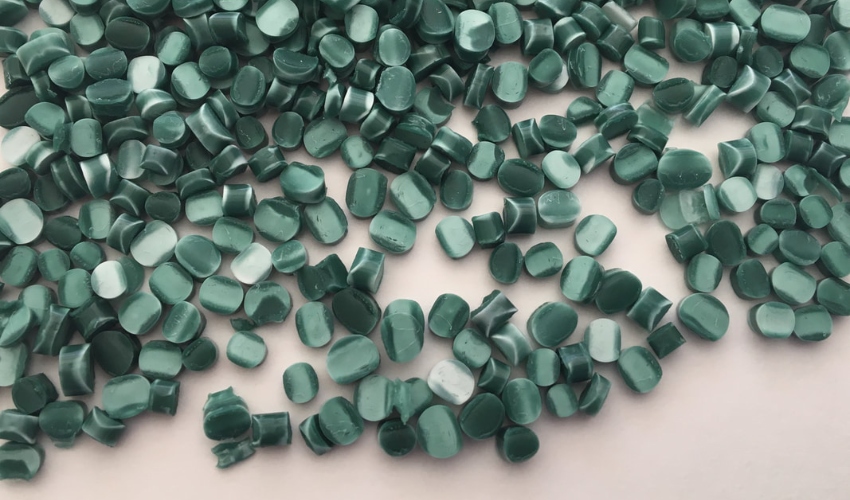
Recently, in an endeavor to continue to find ways to encourage alternatives to plastic waste, the Government of Canada has launched the Bioplastics Challenge to encourage small businesses to reduce pollution by turning forest-based residue into sustainable plastic materials. The government hope that this initiative will function to create jobs and drive innovation. As part of the second phase of the Bioplastics Challenge, the Government of Canada has made a $1-million investment to BOSK Bioproducts Inc which makes bioplastic filaments which among their many uses can be used in 3D printing.
Minister of Innovation, Science and Industry, the Honourable François-Philippe Champagne commented on the investment saying, “The Government of Canada is dedicated to supporting entrepreneurs and small businesses. It is becoming increasingly important to invest in sustainable solutions that will support not only our economy but also our environment. When the Government of Canada invests in innovative and sustainable work from small businesses like BOSK Bioproducts, it supports the economy, helps build Canadian technological leadership and contributes to Canada’s fight against global warming.”
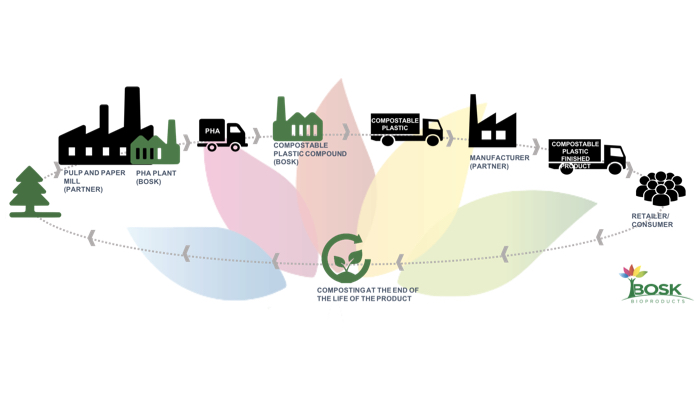
The life cycle of BOSK Bioproducts Inc.’s compostable plastic finished products. (Photo Credit: BOSK Bioproducts Inc.)
The company specialise in bioplastic materials which can be used for a range of applications including thermoforming, injection molding, extrusion blow molding, and, of course, 3D printing. It offers 100% biobased and compostable bioplastics, and develops, manufactures and distributes 100% biobased and compostable PHA-based resins. Their REGEN portfolio includes a range of materials of different grades and colors, making them suitable for a variety of different applications. These materials are compatible with conventional manufacturing equipment and possess excellent physical and mechanical properties, rivalling those of traditional resins deriving from fossil fuels.
More from the desk
Six other notes from the rest of the bench.
 Printers#3Dstartup: ICON re-imagines the approach to constructionIf you follow developments in the 3D printing construction sector, you will have noticed the accelerated growth it has undergone in recent months. With an ever-increasing demand for a new way to deliver more resilient homes at speed, the future…
 Guides#Working3D: Six Questions for an Additive Manufacturing Innovation EngineerWe are back with the #Working3D series in which we get to know first-hand the different professions in the 3D printing sector. On this occasion, we will learn about the day-to-day life of an additive manufacturing innovation engineer. Closely related…
 PrintersHow the Breton Genesi Ecosystem Is Transforming Industries Through Large Additive Manufacturing Combined with AIWhen thinking about the benefits of additive manufacturing, some of the most cited are the ability to create complex geometries, produce prototypes in a short amount of time and customize production batches. However, that does not mean there are not…
 ApplicationsThe Unveiling of Michelin’s 3D printed tire prototypeFrench tire manufacturer, Michelin, has unveiled a concept 3D printed tire that just may revolutionize the way we drive. The tire, which is airless, has a biomimetic structure and could have the ability to reprint its tread, depending on the…
 NewsTop 5 Videos: 3D Printing’s Impact on Military AdvancementsWelcome to our compilation of this week’s top 5 most 3D printing compelling videos. We kick off this week’s edition with a video by Arsenal Insights, exploring the significant technological advancements within the military, made possible by additive manufacturing. Nex
 NewsThe 3D Printed Dress That Responds to Changes in its EnvironmentWe hear more and more about traditionally manufactured applications trying out 3D printing, and little by little, the number of industries embracing this technology is increasing. One such case is the fashion industry, which as we have from previous examples,…