Applications
Could Bioprinted Liver Tissue Become an Alternative to Transplants?
A research team at Carnegie Mellon University in Pittsburgh received $28.5 million in funding from ARPA-H to carry out the LIVE (Liver Immunocompetent Volumetric Engineering) Project. The goal? To manufacture functional liver tissue for patients with acute liver failure using&hel
- 3 min read
- Applications
- Six more stories

A research team at Carnegie Mellon University in Pittsburgh received $28.5 million in funding from ARPA-H to carry out the LIVE (Liver Immunocompetent Volumetric Engineering) Project. The goal? To manufacture functional liver tissue for patients with acute liver failure using 3D bioprinting.
The liver is one of the most resilient organs of the human body. It’s capable of replacing its cells in response to acute and chronic injuries, something known as “liver regeneration.” Current literature tells us that liver regeneration is achieved through various means, such as liver cell activation or metabolic reprogramming. However, these solutions do not always work for everyone. The LIVE Project was created to address this major public health challenge.
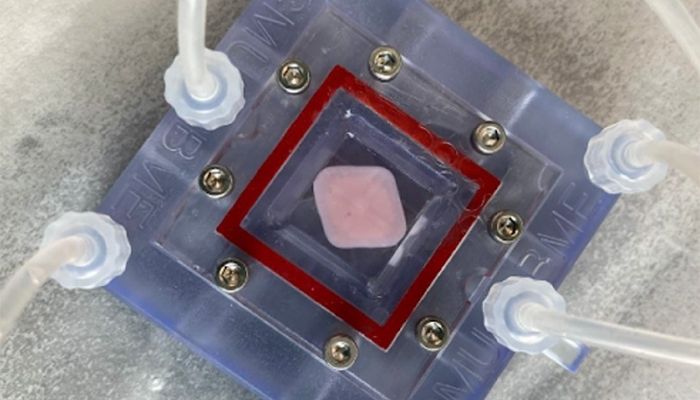
3D bioprinted liver tissue using FRESH technology (photo credit: Carnegie Mellon University).
The LIVE Project does not seek to create a permanent organ right away, but rather a temporary liver tissue that gives the organ time to regenerate. The team, led by Dr. Adam Feinberg, will use two technologies developed at the university. First, there’s FRESH (Freeform Reversible Embedding of Suspended Hydrogels) technology. This is a bioprinting technique that allows soft bioinks, such as collagen, to be extruded into a thermoreversible support hydrogel. This prevents the structures from collapsing under their own weight, allowing complex and precise vascular architectures to be created with structural proteins and human cells.
More from the desk
Six other notes from the rest of the bench.
 GuidesarchiREEF on Saving Coral Reefs With 3D PrintingOne of the greatest ecological problems facing our planet is the devastation that is facing coral reefs worldwide. These eco-systems are crucial to biodiversity of our oceans, yet they are being destroyed at an alarming rate. Already, up to half…
 ApplicationsResearchers 3D print fish-gelatin patches for cancer treatmentNew advances in 3D bioprinting for medical purposes appear as a group of researchers from Nagoya University, Japan has developed 3D printed parts from fish gelatin. More precisely, these parts are actually hydrogel patches implantable in cancer patients. The 3D…
 NewsTop 5 Videos: Transforming Healthcare with Medical 3D PrintingFor this week’s Top 5 Videos, we feature videos on diverse topics, from healthcare to space exploration. First, check out our exclusive interview with Naomi Nathan, Head of Medical at Mobility Goes Additive, to learn how you could take advantage…
 NewsMitsubishi Electric develops a metal additive manufacturing processMitsubishi Electric Corporation is a Japanese electrical equipment manufacturer and one of the world’s largest producers of photovoltaic panels. It is also a player in the additive manufacturing market that has already developed a hybrid machine combining metal sintering an
 ApplicationsFleet Space Has Developed Fully 3D Printed SatellitesFrom building projects on the moon to 3D printed rocket parts, lately there have been many projects mixing additive manufacturing and space. And with good reason. For space companies, the technology is opening up a whole new world of possibilities.…
 NewsTop 5 Videos: See the 3D Printed Electric Wakeboard That Can Go 70 km/h!For this week’s Top 5, dive into a story about how one man 3D printed an electronic wakeboard! It might motivate you to start a project of your own. Then, meet the first family to move into a 3D printed,…