News
A portable bioprinter could heal even the most severe burns
3D printing of skin is really within reach: researchers at the University of Toronto and Sunnybrooke Health Sciences Centre have developed a portable bioprinter capable of creating sheets of skin to accelerate the healing of serious wounds and burns. The…
- 3 min read
- News
- Six more stories
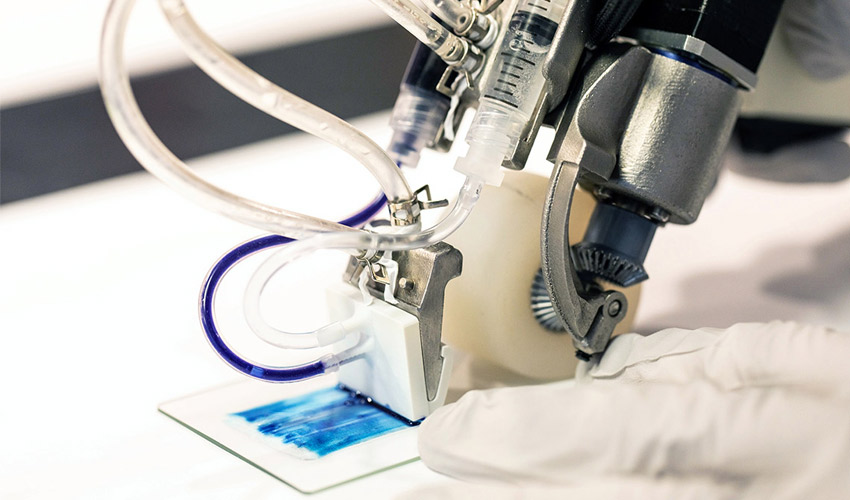
3D printing of skin is really within reach: researchers at the University of Toronto and Sunnybrooke Health Sciences Centre have developed a portable bioprinter capable of creating sheets of skin to accelerate the healing of serious wounds and burns. The device is easy to handle and ultimately resembles a glue gun, also incorporating a roller to spread the material. It could be used in hospitals and health care facilities to treat the most serious skin problems and to meet the challenges posed by transplants.
Richard Cheng and Professor Axel Guenther began their project in 2018 and presented a first prototype, based on the observation that current bioprinters are too bulky, slow, expensive and incompatible with daily use in a hospital. Two years later, the researchers claim that their portable bioprinting solution can heal wounds: they demonstrated that the bioink they developed accelerated the healing process. It would thus provide an alternative to autologous transplants, which are not a viable solution in the case of very severe burns since the doctor cannot remove enough “healthy” skin from the patient.
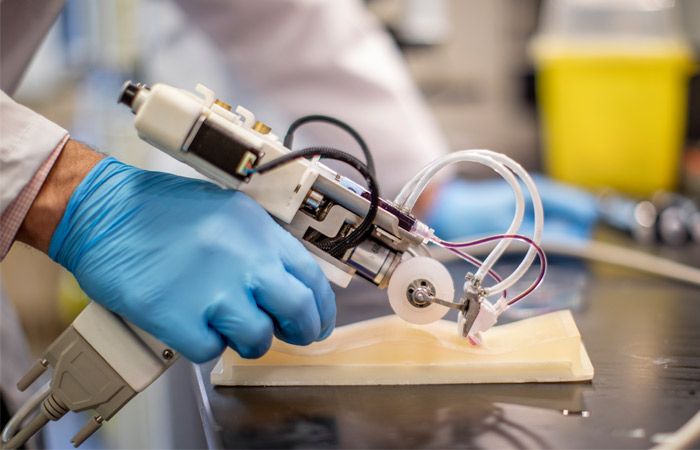
The portable bioprinter has gone through several iterations and is equipped with a roller | Credits: Nick Iwanyshyn
This portable 3D bio-printer is not the first of its kind, but what differentiates it from other “mobile” solutions is the use of a roller that spreads the bio-ink on a sheet that will then be placed on the wound to heal. The material is deposited by a single-use microfluidic print head to ensure sterilization – the flexible roller would finally allow the material to follow the head’s track to better control larger wounds. As for the material itself, the researchers explain that bio-ink is made up of mesenchymal stem cells (MSCs) that promote healing and skin regeneration.
More from the desk
Six other notes from the rest of the bench.
 News#3DExpress: Creality Unveils the New K1C 3D PrinterWhat’s been happening in the additive manufacturing market this week? With our, 3DExpress format, our readers are able to discover and understand the latest announcements, whether in terms of business, product launches or partnerships, through five news snippets that made&h
 NewsHeron Preston & Zellerfeld Create 3D-Printed HERON01 SneakerFor several years now, the footwear industry and additive manufacturing players have been collaborating on innovative shoe projects. You may recall Adidas’ 3D-printed 4DFWD sneakers or Athos’ 3D-printed climbing shoes — 3D-printed footwear is easing its way to the mai
 NewsJackson Pollock Inspires Harvard 3D Printing ResearchOne of the most important American artists of the 20th century, Jackson Pollock has played a decisive role in shaping contemporary art. Known for his abstract expressionism, he was an artist who stood out because of his drip painting technique.…
 MaterialsHow Are Lithoz Ceramic Materials Revolutionizing Aerospace?It is predicted that the ceramic 3D printing market will generate up to $4.8 billion worldwide in 2030. And one large and important customer for ceramic 3D printing is the aerospace industry. A notable player in the sector is Vienna-based…
 MaterialsHow do Laboratories and Research Centers Benefit from Ceramic 3D Printing?In 2018, French company Nanoe launched its additive manufacturing material offering. Called Zetamix, it offers ceramic and metal filaments for extrusion processes (FFF). It facilitates the creation of customized ceramic and metal parts for professionals and manufacturers. Today,
  SoftwareIntuitive, Collaborative, and Creative 3D Modeling with RealityMAX3D modeling is an important step for all those using 3D printing. Especially for users who prefer to create their own designs, implementing each step from A to Z themselves. In addition to additive manufacturing on an industrial scale or…