Software
Newly Developed Algorithm Can Correct 3D Printing Errors in Real Time
Scientists from the University of Cambridge have developed what they claim are intelligent 3D printers capable of quickly detecting and correcting errors, no matter the design nor material. More specifically, the engineers were able to develop a machine learning algorithm…
- 3 min read
- Software
- Six more stories

Scientists from the University of Cambridge have developed what they claim are intelligent 3D printers capable of quickly detecting and correcting errors, no matter the design nor material. More specifically, the engineers were able to develop a machine learning algorithm that can be used with FDM 3D printing to correct printing mistakes in real time. This will not only reduce potential print failures but will also be an accurate and efficient way to automate the 3D printing process.
It goes without saying that monitoring software are becoming a key part of 3D printing processes. Print failures are unfortunately common and are also costly both in terms of money and time. As a result, the ability to control every step of the process is integral when it comes to the continued industrialization of additive manufacturing. And at the same time, users are also looking for greater automation in order to enable 3D printing at scale. This is where algorithms, especially those based on machine learning, come in as outlined in the article Generalisable 3D printing error detection and correction via multi-head neural networks.
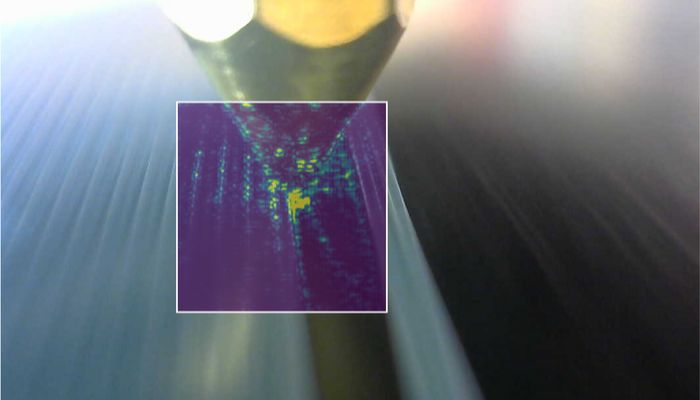
An example image of the 3D printer nozzle with the highlighted images showing where the algorithm is focusing (photo credits: Douglas Brion)
A “Driverless” Algorithm for 3D Printing
The machine learning algorithm was developed by Douglas Brion and Sebastian Pattinson by training a deep learning computer model. This was done by showing it about 950,000 images that had been captured automatically during the production of 192 printed parts. Each image was labelled with the printer settings used during the print, for example speed and temperature of the printing nozzle, as well as how far those were from what the ideal settings would have been. This enabled the algorithm to then learn how to fix these mistakes rather than relying on humans who are not as adept as identifying them.
More from the desk
Six other notes from the rest of the bench.
 MaterialsCombining Ceramics and Metals in a Single Resin 3D Printing ProcessLast week, the city of Hanover, Germany, hosted the annual Hannover Messe, an event dedicated to the manufacturing industry and digital transformation. From robotics to artificial intelligence, the focus is on automation, technology, and digitalization. And among the exhibitors a
 NewsProcess planning for five-axis additive manufacturingXinyi Xiao, PhD in industrial engineering at Penn State, has published a research study in the Journal of Additive Manufacturing on five-axis additive manufacturing to build parts without printing support structures. The project involved designing automated process planning softw
 MaterialsA New Bronze-Steel Alloy Has Been Developed Thanks to 3D PrintingA group of researchers at the Skolkovo Institute of Science and Technology, or Skoltech, say they have developed a new bronze-steel alloy using additive manufacturing. They turned to direct laser deposition to produce different parts composed of these two metals,…
 GuidesThe 3D Printing Books to Read This YearWorld Book Day is celebrated annually on April 23rd (except in the UK and Ireland where a similar event is observed in March). And as it is coming up fast, so we thought there was no better occasion to present…
 ApplicationsFossiLabs creates PEEK implants to promote bone growthFossiLabs, based in the US, is a startup focused on the development of FDM 3D printers to produce PEEK medical implant devices. As you may have noticed, high-performance thermoplastics such as PEEK have gained a lot of attention in the…
 NewsPurmundus 3D Printing Design Award Winners go Beyond 3D Printing!During Formnext, the seventh edition of the Purmundus 3D Printing Design Award took place. This year’s theme was Beyond 3D Printing and 38 projects and companies made it to the finalists’ list. Three winners were named, voted by an international…