Materials
A New Bronze-Steel Alloy Has Been Developed Thanks to 3D Printing
A group of researchers at the Skolkovo Institute of Science and Technology, or Skoltech, say they have developed a new bronze-steel alloy using additive manufacturing. They turned to direct laser deposition to produce different parts composed of these two metals,…
- 3 min read
- Materials
- Six more stories
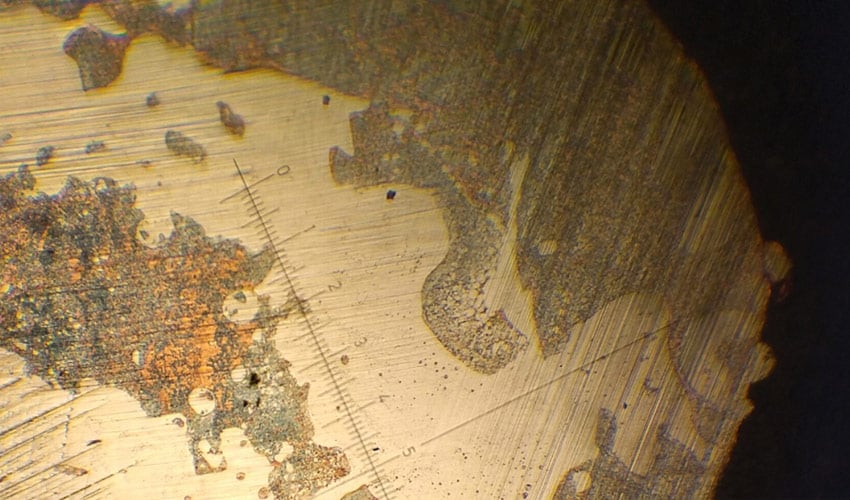
A group of researchers at the Skolkovo Institute of Science and Technology, or Skoltech, say they have developed a new bronze-steel alloy using additive manufacturing. They turned to direct laser deposition to produce different parts composed of these two metals, a first for the market. Two techniques were used: in the first case, a mixture of the two metals was made before depositing the layers; in the second, layers of bronze were deposited alternately with those of steel. According to the researchers, this work could be particularly interesting for the aerospace industry, especially in the construction of combustion chambers for aircraft and rockets.
It is not uncommon to combine two materials to take advantage of the best of their respective properties – for example this is the direction in which composite 3D printing is rapidly developing. In this particular case, the two were chosen thanks to their ability to complement each other. Bronze is known for its corrosion resistance, good electrical conductivity and high wear resistance. Steel, on the other hand, is resistant to breakage and impact, electrical deformation and has high hardness. This project is a first of its kind as it has created a bronze-steel alloy that was previously unknown to material science. And it is all thanks to additive manufacturing.
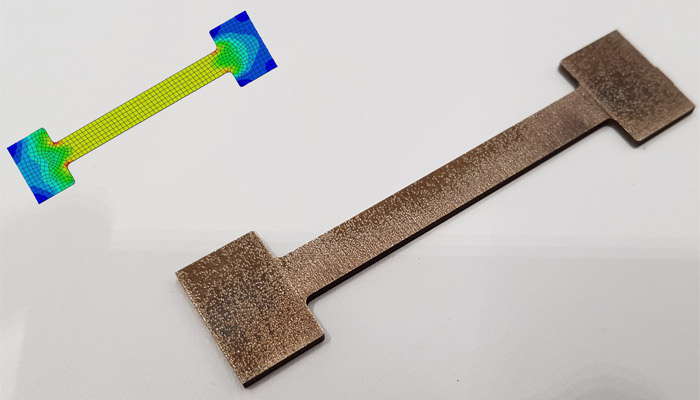
A 3D printed part that was made to test the mechnical properties of the new bronze-steel alloy (photo credits: Konstantin Makarenko/Skoltech
In concrete terms, the researchers used direct laser deposition (which works like directed energy deposition) to develop their project. First, they had to create an almost homogeneous alloy by mixing the two materials in a uniform manner. This alloy was then used by the machine to design several test parts. The other technique was to print “sandwich” parts, i.e. composed of layers of bronze and steel, each 0.25 millimeters thick. The researchers explain that they varied the amount of bronze each time – from 25 to 50% – while the steel content remained the same.
More from the desk
Six other notes from the rest of the bench.
 NewsUniversity Team Proposes New Holistic Standards for 3D PrintingA new study from the University of West Attica argues that the full potential of additive manufacturing will remain unrealized until designers rethink how products are conceived for 3D printing. Published in Advanced Manufacturing, the research introduces a comprehensive design&h
 ApplicationsUniversity of Missouri Researchers 3D Print Artificial Human Brain PhantomResearchers at the University of Missouri College of Engineering have successfully 3D printed an artificial human brain phantom. This has the potential to reshape how scientists study neurological conditions, train medical professionals, and develop personalized treatment tools.
  NewsCoronavirus: which 3D printing events have been postponed?Events around additive manufacturing – trade fairs, conferences, meetups, maker faires – are important events for the sector allowing many players and users to exchange and discover the latest market trends and technologies. With the worldwide spread of the coronaviru
 NewsPrintFoam Announces the Development of New 3D Foam PrinterPrintFoam, a start-up company founded by Alumni of MIT in Cambridge, Massachusetts, recently announced the development of the first printer hardware specializing in the industrial-scale printing of resin foams. Of all the additive manufacturing materials on the market, 3D printin
 NewsOPPO Uses 3D Printing to Create a Crease-Free Foldable SmartphoneAre we seeing a new trend in additive manufacturing? Just last week, we told you about Apple’s new products and their use of this technology. This week, it’s Chinese manufacturer OPPO’s turn, as the company has announced a new foldable…
 PrintersThe Lumia X1 Is Overcoming Limitations in Resin 3D Printing With an Innovative Hybrid ProcessSince stereolithography, the first additive manufacturing technology, was invented in the early 80s, there has always been a place for resin 3D printing in the sector. Currently, a number of different variations exist but the two most common remain DLP…