News
Additive and Subtractive Manufacturing: Complementary or Rivals?
While more and more companies are opting for additive manufacturing, subtractive manufacturing is still the most widely used method in industry. Meanwhile, 3D printing is currently mainly used to complement subtractive manufacturing methods. However, as the name suggests, unlike
- 3 min read
- News
- Six more stories
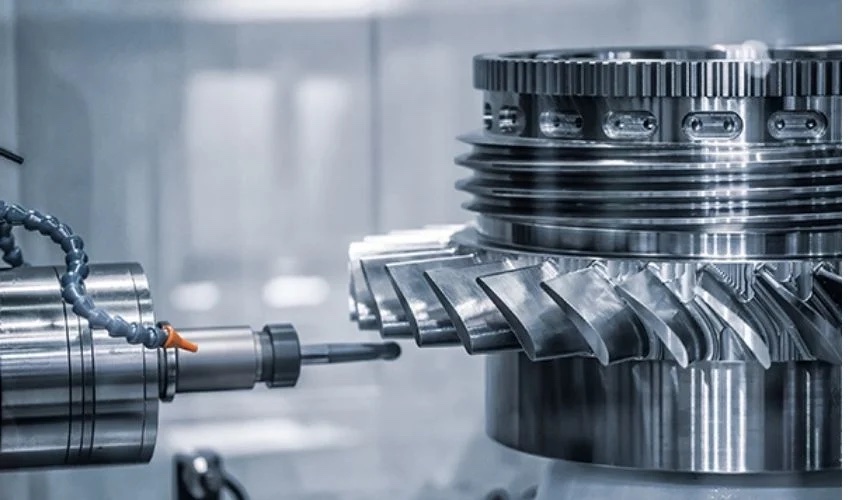
While more and more companies are opting for additive manufacturing, subtractive manufacturing is still the most widely used method in industry. Meanwhile, 3D printing is currently mainly used to complement subtractive manufacturing methods. However, as the name suggests, unlike additive manufacturing, these techniques consist of removing material to produce a part of the desired size. They are now deployed in many industries, such as aeronautics, automotive, metallurgy, etc. We took a closer look at the differences between subtractive and additive manufacturing as well as how they can be used to complement each other.
To start, it is important to know that just like additive manufacturing and its multiple processes, many subtractive manufacturing methods exist – you’ve probably heard for example the term “CNC machining.” An acronym for Computer Numerical Control, it covers material removal techniques based on a digital program that controls the machine tools. We are talking about drilling, turning, milling or boring. CNC machining is now compatible with a wide range of materials, from plastics to metals. That being said, not all subtractive manufacturing techniques use a numerical program, further down we will cover some of the most popular cutting methods as well.
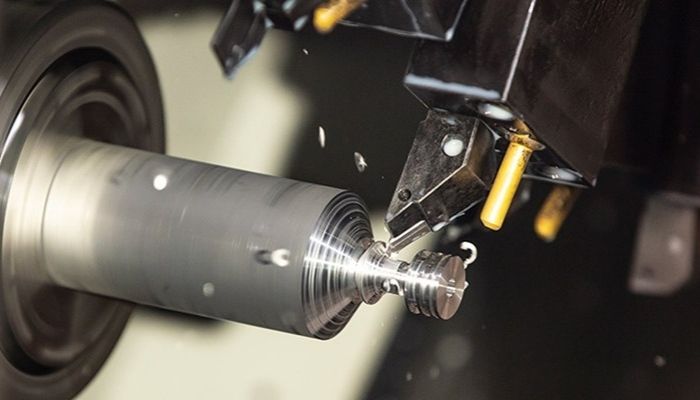
Photo Credits: Protolabs
What is CNC Machining?
CNC machining includes several processes; we will start with turning and boring. These processes use a moving part on a rotating axis. The energy required to machine the part is provided by the movement of the part itself. These methods make it possible to manufacture any parts that are modeled by rotation. In concrete terms, it is a 2D drawing that is replicated ad infinitum along an axis of rotation, thus forming a 3D model. Despite their different names, turning and boring are very similar since they both use the same principle. The main difference is that boring works on the inside of the part while turning works on the outside. Allowing the design of parts from wood, metals and certain plastics, turning and boring machines are now present in many industries, such as the automotive, aerospace, medical or even decor sectors.
More from the desk
Six other notes from the rest of the bench.
 GuidesThe Top Applications of 3D Printing in the Movie IndustrySpecial effects have become a major attraction for moviegoers, and it’s no surprise that additive manufacturing is gaining ground in the film industry. 3D technologies are being widely employed on diverse film sets, ranging from animated movies to Marvel blockbusters&hellip
 NewsWEBINAR: Overcoming AM Design Challenges in Critical SectorsDesigning custom 3D-printable parts – like jigs, fixtures, or product-specific tooling – often requires manual modeling by experienced CAD users. This is a time-consuming process and is difficult to scale, so it often becomes a bottleneck in additive manufacturing workflows.&hell
 ApplicationsCollPlant and United Therapeutics accelerate kidney bioprintingWhat if you could 3D print your kidney? This is what CollPlant Biotechnologies and United Therapeutics Corporation are looking to do: they have just expanded their current partnership to produce and use a human collagen-based bioink to accelerate human kidney…
 ApplicationsSee-Shell: 3D printed transparent skull to ‘see’ how the brain worksAt the University of Minnesota, researchers have developed a unique 3D printed transparent skull implant for mice. The skull named the See-Shell can be used to view real-time activity on the brain surface and could provide new insights for human…
 ApplicationsMIT Has Unveiled 3D Printed Hearts That Look and Act Like the Real ThingHuman technology has advanced so far in the past few centuries, and it is undeniable that one of the sectors where we have seen the most growth is medical. Considering that nothing is scarier than the prospect of facing serious…
 ApplicationsInfographic: 3D Printing in the Maritime IndustryA few weeks ago, we took a look at the applications of additive manufacturing in the railway industry, and now it is time to take a closer look at the impact of 3D technologies on the maritime sector. This sector…