News
Serendix50, the 3D Printed House That Costs Less Than a Car
The incessant inflation of housing prices is a matter of concern for millions of people. It is becoming increasingly expensive both to buy a house and to live in it, so that young and not so young people continue to…
- 3 min read
- News
- Six more stories
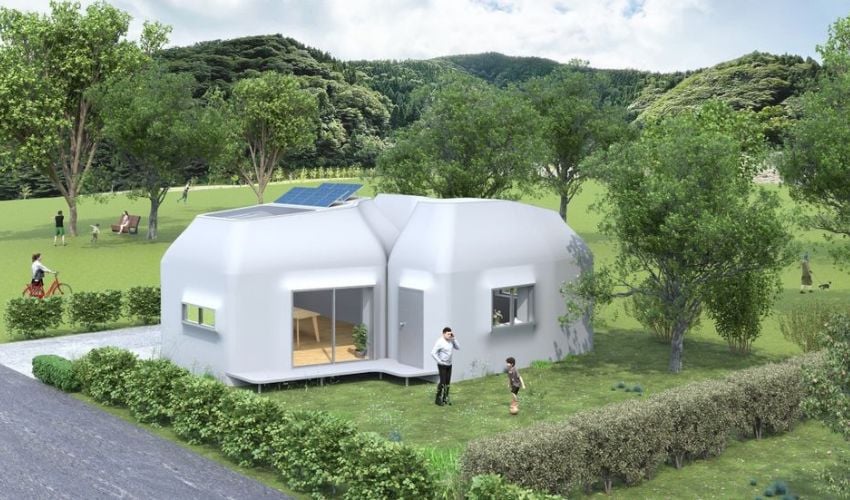
The incessant inflation of housing prices is a matter of concern for millions of people. It is becoming increasingly expensive both to buy a house and to live in it, so that young and not so young people continue to live at home with their parents because they do not have enough money to become independent. Moreover, in Japan something similar is happening among the elderly. In recent years, the number of retired people with low incomes, who are unable to continue living in the big cities for lack of money, has been steadily increasing, prompting a need for many to retire to the countryside.
To solve these problems and many more, Serendix, a Japanese company, has decided to create 3D printed concrete houses with a surface area of 50m2, thus lowering costs enough to make one of these houses cheaper than a car. Masayuki Sono, the architect behind this marvel, won a competition organized by Nasa a few years ago to design a 3D printed home. Last year he launched Sphere, a futuristic 10m2 3D printed house that caused a sensation. We reported on it as well not just for the speed in which he made it but for its earthquake-proof properties, a must in the island nature. And now it has delivered once again with the Serendix50 (also known as Fujitsubo), which will soon be on the market.
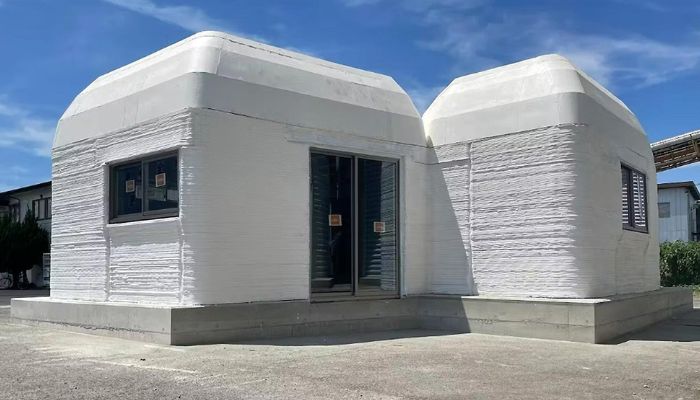
The Serendix50 is made entirely of 3D printed material (photo credits: mikeshouts)
As you may remember, Serendix’s construction process is very fast, evening holding a world record for speed. In less than 45 hours Serendix is able to manufacture one of these houses with a single 3D printer. Many times one thinks that by doing things fast things go wrong, but that is not the case for the Serendix50, because despite its high construction speed it meets all the necessary requirements to be a legal house according to the very rigorous Japanese construction standards. The house is resistant to fire, water and earthquakes, has structural strength and good thermal insulation. A requirement for the Serendix50 to be built is that it must be manufactured outside the cities. As they are not stackable houses, they are rather designed for the outskirts of large cities or the countryside.
More from the desk
Six other notes from the rest of the bench.
 Guides#3DStartup: Unlimited Tomorrow and its 3D Printed Bionic Prosthetic ArmIt is no secret that 3D printing has been making great waves in recent years in the medical sector. One arena in which the technologies have been especially useful is for making prostheses as it allows for lighter, more customized…
 News3DGence showed the evolution of 3D materials at Formnext 2018Poland has become the cradle of many of the current main European manufacturers and key players. Not only when looking to desktop machines, but also for the industry itself. And it is in this sector in which the Polish company 3DGence…
 NewsWhat Can You Expect at ADDITIV Polymers World?The 2nd edition of ADDITIV Polymers World is only a week and a half away! The high-anticipated virtual event delving into the worlds of polymers and 3D printing will be taking place on Thursday, October 10th at 9:00AM – 1:30…
 NewsTOP 5 videos of the week: Boomboxes, Tiny Satellites and more!A new selection of the best 3D printing videos of the week, just for you! Find our TOP 5 videos of the week below and tell us what your favorite video is in a comment or on our Facebook and Twitter page.…
 PrintersRAYSHAPE Talks Mass Manufacturing of High-Performance Parts Using DLP TechnologyNowadays, more and more companies are using 3D printing, not only for prototyping but also for the production of final parts. This is thanks to the numerous benefits of additive manufacturing technology, including cost and manufacturing time reduction, manufacturing locally,&hell
 News#DAMM2020 will be the first global online conference on additive manufacturingEvents around additive manufacturing are crucial for the sector, allowing many players and users of the technology to exchange and discover the latest market trends and developments in additive manufacturing. Given the worldwide spread of COVID-19, 3D printing events have…