News
A 3D-Printed Robot Hand Capable of Playing Famous Video Game Super Mario Bros from Nintendo
Engineers from the University of Maryland have used additive manufacturing to develop a 3D-printed robot hand capable of playing one of the most famous video games from Nintendo. Although it may seem like science fiction, the project is already a…
- 3 min read
- News
- Six more stories
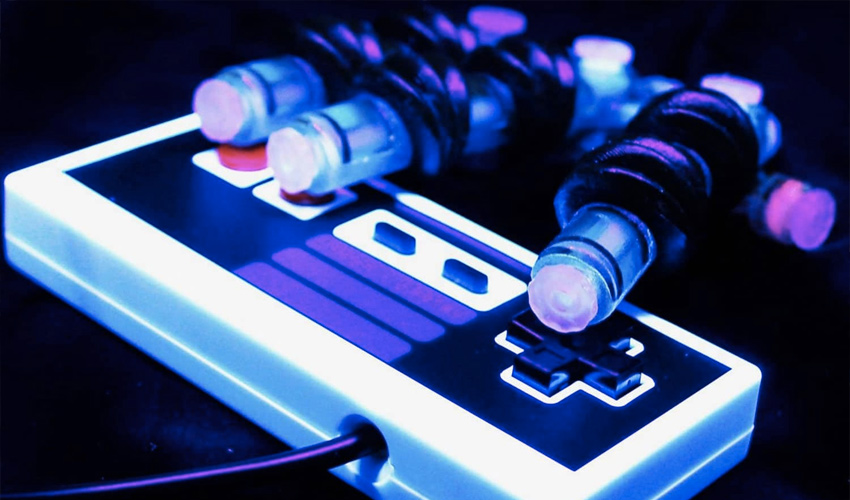
Engineers from the University of Maryland have used additive manufacturing to develop a 3D-printed robot hand capable of playing one of the most famous video games from Nintendo. Although it may seem like science fiction, the project is already a reality and has achieved very successful results. The programming of the finger movements making up the robot hand has enabled the hand to complete the first level of the video game Super Mario Bros. Of course, the team of researchers acknowledges that they could have performed a standard demonstration to evaluate the capabilities and performance of the hand, for example, playing a piano score. However, they found it more interesting to experiment with the precision required by the video game to achieve their goals, and so they did.
There are many initiatives today that combine the advantages of 3D printing and robotics. For example, a Cornell University project, which used additive manufacturing to create a robotic muscle capable of sweating and regulating its own temperature. Seeing the amount of research around this field, it is undeniable the great potential that both technologies have when combined. The authors of this project certainly agreed. As co-author Joshua Hubbard commented, “Previously, each finger of a soft robotic hand would typically need its own control line, which can limit portability and usefulness. But by 3D printing the soft robotic hand with our integrated fluidic transistors, it can play Nintendo based on just one pressure input.”
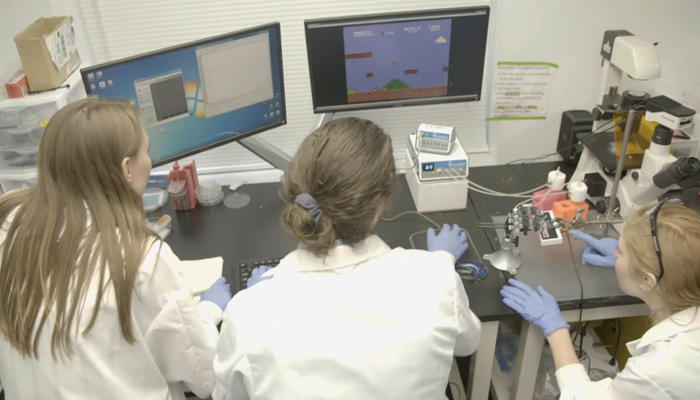
Researchers studying a game from Nintendo to help program the 3D-printed robotic hand (photo credits: University of Maryland)
The 3D-printed robot hand that plays Nintendo
To develop the elements that make up the robot hand, Stratasys’ PolyJet technology was used. Soft robots, like the hand, are characterized by high malleability and morbidity, as they are made from flexible materials such as rubber or silicone. Specifically, the three 3D printed fingers integrate so-called “fluidic circuits”, which are controlled pipes so that the fingers can move simply with air, without the need for additional electricity. Ryan Sochol, co-author of the study, says: “These special types of robots are powered using fluids like water or air. Soft robots can stretch or be inflated or deflated relatively easily. As a result, they have inherent adaptability to reform around complex and sometimes delicate objects. What’s special here is that we made a new type of fluidic circuit that can sense the pressure types of air to decide how it’s going to behave.”
More from the desk
Six other notes from the rest of the bench.
 NewsAmazon buys 3D body scanning start-up Body Labs for $50-70MBody Labs have announced that Amazon have acquired the start-up for an undisclosed amount. TechCrunch however have reported that the figure Amazon paid is between $50-70M. Body Labs are a start-up from New York that incorporate body scanning into 3D…
 NewsFormer Head of the Yeezy-Adidas Innovation Lab Founds FCTRY Lab, a Sneaker Prototyping Lab Using 3D PrintingAdidas is known worldwide for its sports products, shoes and even fashion accessories like sunglasses. And for the past few years, the German company has been using 3D printing to improve the performance of sportsmen and women, such as with…
 NewsMIT has 3D printed shape-shifting pastaMany of you are familiar with the innovations made in 3D printed food, such as with chocolate and cake molds, an exciting innovation for the foodies around the world. But now MIT’S Tangible Media Group is bringing us the next…
 News8 Reasons Why Additive Manufacturing Complements Traditional TechnologiesIn the world of manufacturing, the integration of new technologies has been a pillar to maintain competitiveness in the increasingly demanding and dynamic global market. The adoption of new tools often seeks to improve efficiency, reduce time and costs, and…
 ApplicationsWill the 3D printed bone bricks facilitate the healing of complex fractures?The treatment of an orthopaedic bone fracture can be very complex, and usually requires a metal rod or plate to be placed in the body to stabilize the bone. Scaffolding materials encapsulated in powders or paste are then injected into…
 Printers#3DStartup: Apis Cor, Creators of the 3D Printed HouseIf you’ve been on the internet in the last year, you may have seen the viral clip of a 3D printed house built in just 24 hours. Apis Cor are a Russian company who built a whole, functional house in…