News
The Hidden Role of 3D Printing in the Sagrada Família’s Tower of Jesus Christ
At 172.5 meters, the Tower of Jesus Christ makes the Sagrada Família the tallest Catholic church in the world. Pope Leo XIV blessed it on June 10, 2026, 144 years after the cornerstone was laid. At the top of the…
- 3 min read
- News
- Six more stories
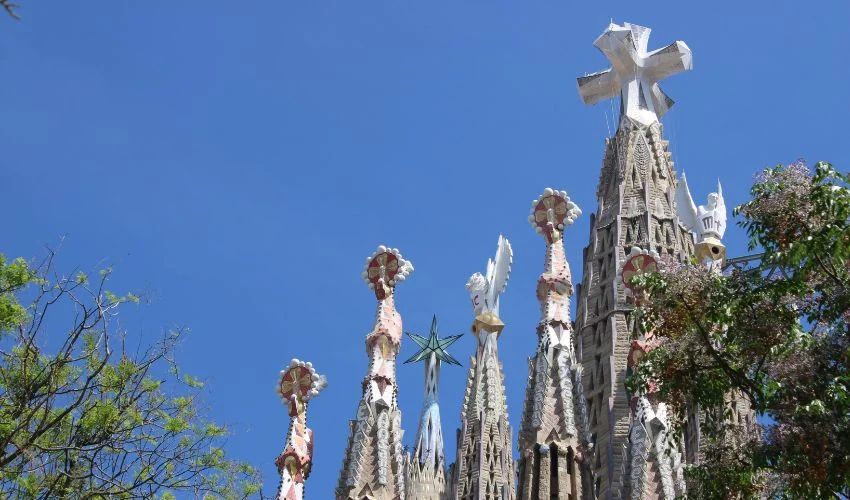
At 172.5 meters, the Tower of Jesus Christ makes the Sagrada Família the tallest Catholic church in the world. Pope Leo XIV blessed it on June 10, 2026, 144 years after the cornerstone was laid. At the top of the tower stands a cross measuring 17 meters tall, 13 meters wide, and weighing more than 12 tons. It is clad in over 13,000 pieces of glazed white ceramic. Though it may not be immediately obvious, 3D printing played a role in its production.
How 3D Printing Helped Build the Sagrada Família Cross
One of the most common misconceptions about digital manufacturing in historic projects is that technology replaces craftsmanship. The Sagrada Família project demonstrates the opposite. Aldo Sollazo, CEO of LAMÁQUINA, the digital manufacturing company that worked on the project alongside Cerámica Cumella, told 3Dnatives that the ceramic pieces covering the cross were not 3D printed. Instead, 3D printing was used to create the molds needed to produce them.
“3D printing was used in a crucial intermediate stage of the process: producing the molds that supported the pieces during firing,” Sollazo explains. These molds were made from a ceramic material compatible with the final pieces. “This allowed us to properly monitor the behavior of the assembly during the thermal process and ensure that each element held its intended geometry before final installation.”
More from the desk
Six other notes from the rest of the bench.
 NewsImplementAM Joins Forces with SPE and 3Dnatives to Elevate Additive Manufacturing EducationImplementAM, a front-runner for educational one-day workshops on 3D printing and additive manufacturing, has officially been acquired by the Society of Plastics Engineers (SPE). This is SPE’s second acquisition in additive manufacturing, following its purchase of 3Dnatives earlie
 GuidesHow Raise3D Simplifies SLS for ProductionAt the TCT Asia trade show, we had the opportunity to meet Raise3D, one of the long-standing manufacturers in the 3D printing market. While it has won over many users with its FDM solutions, the company has expanded into resin…
 NewsWEBINAR: Manage Your Production alongside Shopfloor Data—Maximizing OEE with EOS ConnectivityA successful additive manufacturing operation relies on more than just advanced machines or powerful software—it depends on how seamlessly the two work together. Even with the best hardware and most cutting-edge software, productivity can stall if they aren’t properly integrated.
 PrintersThe Dental Resin 3D Printers Currently on the MarketThe dental industry is one of the sectors that makes the most use of additive manufacturing to provide customized devices tailored to each patient. Using 3D scans or medical imaging data, dental professionals can create precise 3D models and print…
 ApplicationsCan 3D Printing Facilitate Space Exploration?Since the 20th century, humans have been fascinated with exploring space and understanding what lies beyond our planet. Major organizations like NASA and ESA have been at the forefront of space exploration, including with a new significant player in this…
 GuidesThe Use of Additive Manufacturing in the Defense SectorAdditive manufacturing is widely used in many sectors including maritime, aerospace, and automotive. It should come as no surprise then, that it is also being increasingly adopted by the defense sector worldwide. In fact, the military 3D printing sector is…