Applications
Can 3D Printing Facilitate Space Exploration?
Since the 20th century, humans have been fascinated with exploring space and understanding what lies beyond our planet. Major organizations like NASA and ESA have been at the forefront of space exploration, including with a new significant player in this…
- 3 min read
- Applications
- Six more stories

Since the 20th century, humans have been fascinated with exploring space and understanding what lies beyond our planet. Major organizations like NASA and ESA have been at the forefront of space exploration, including with a new significant player in this conquest: 3D printing. This design technique has become increasingly popular among companies due to its ability to produce complex parts quickly and at a low cost. It has enabled the creation of numerous applications such as satellites, spacesuits, and rocket parts. Indeed, according to SmarTech, the market value of additive manufacturing in the private space industry is expected to reach €2.1 billion by 2026. This begs the question: how can 3D printing help humans be more prominent in space?
Initially, 3D printing was mainly used for rapid prototyping in the medical, automotive, and aerospace sectors. However, with the democratization of the technology, it has become increasingly used for end-use parts. Metal additive manufacturing techniques, particularly laser powder bed fusion (L-PBF), have allowed for the production of a wide variety of metals that possess properties and resistance suitable for the extreme conditions of space. Other 3D printing technologies, such as directed energy deposition (DED), binder jetting, and extrusion processes, are also used for manufacturing aerospace components. In recent years, new business models have emerged, with companies like Made in Space and Relativity Space designing aerospace parts using 3D printing technologies.
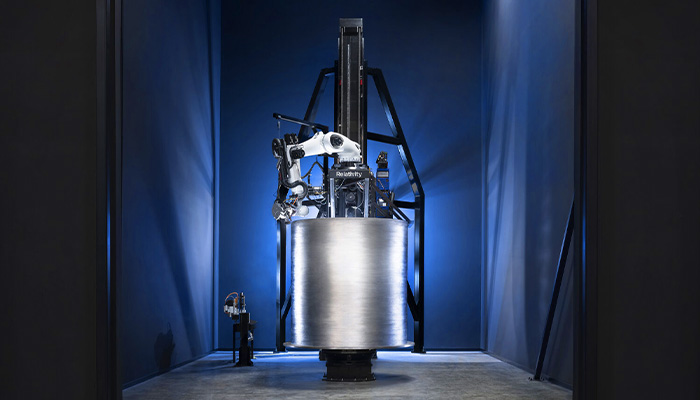
Relativity Space develops 3D printers for the aerospace industry (photo credits: Relativity Space)
3D Technologies in Aerospace
Now that we have introduced them, let us examine the various 3D printing technologies used in the aerospace industry more closely. Firstly, it should be noted that metal additive manufacturing, especially L-PBF, is the most widely used in the sector. This process involves fusing metal powders together layer by layer using a laser energy source. It is particularly useful for producing small, complex, detailed, and customized parts. Aerospace manufacturers can also benefit from DED, which involves depositing a metallic wire or powder and is primarily used for repairing, coating, or producing custom-made metallic or ceramic parts.
More from the desk
Six other notes from the rest of the bench.
 NewsIs the 3D Printing Market Consolidating?Over 2021, we saw a flurry of mergers and acquisitions throughout the additive manufacturing industry. It seemed that the industry was maturing and consolidation would continue, especially into 2022. However, a recent report from IDTechEx suggests this might not actually…
 NewsArevo and Superstrata present 3D printed unibody carbon fiber bikesArevo and Superstrata have just unveiled new 3D printed unibody bicycles, unique in both the design and properties. Last year, Arevo, a California-based additive manufacturing startup, built the first 3D printed carbon fiber unibody bike frame. The e-bikes were called…
 NewsTop 5 Videos: Only Two Workers Needed to Construct World’s Biggest 3D Printed BuildingIt is once again Sunday, which means it is time for the week’s top 5 3D printing videos! This weeks content features the three part Voices AMplified series, the largest 3D printed building known to date being built in Germany,…
 GuidesPrecious Plastic values recycling plastic waste with new technologiesPrecious Plastic is a community that started in the Netherlands with the main goal of fighting “plastic pollution”. For this, they created a network of workspaces where all the tools and machines give a second life to plastics, either directly…
 NewsGeneral Motors relies on additive manufacturing to reduce the weight of their carsUS automaker, General Motors (GM), has announced a new partnership with Autodesk. The goal of GM is to design 3D printed parts for their new electric cars to make them lighter and more efficient, all at a lower cost. The…
 ApplicationsSURGE Aims to Predict Life of Critical Military Parts During ProductionThe Defense Advanced Research Projects Agency (DARPA) works to advance technology for United States national security. Created in 1958 in response to the Soviet Union’s 1957 launch of Sputnik, the agency positions itself as the nation’s commitment “to never agai