News
Mastering the 3D Printed Lenticular Effect: A New Dimension for Makers
What if your 3D printed objects could change their appearance based entirely on the angle from which they are viewed? This fascinating optical illusion is known as the lenticular effect. Often compared to a holographic effect, the lenticular effect allows…
- 3 min read
- News
- Six more stories
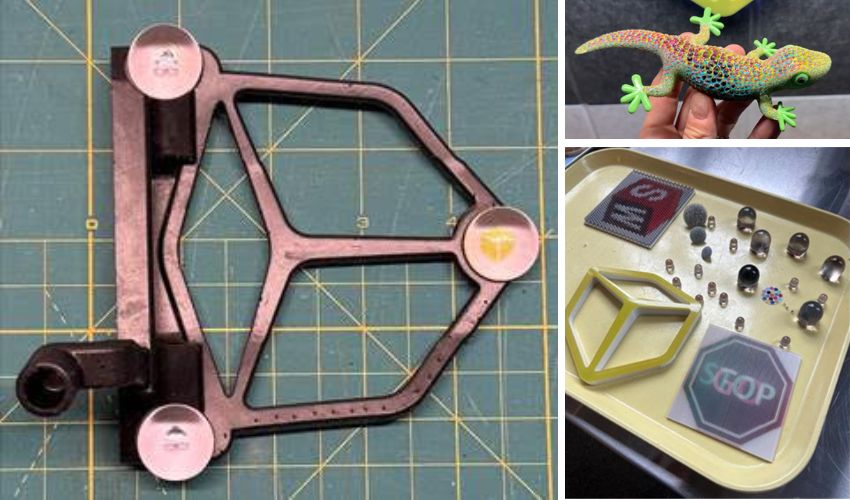
What if your 3D printed objects could change their appearance based entirely on the angle from which they are viewed? This fascinating optical illusion is known as the lenticular effect. Often compared to a holographic effect, the lenticular effect allows an observer to see distinct, shifting images simply by changing their viewing angle. While this visual trick has existed for a long time in 2D formats (such as xenographs, kids’ books with running animals, or classic pull-tab illustrations), modern CAD and additive manufacturing have brought the lenticular effect into the realm of 3D physical objects. Today, 3D printing offers exciting possibilities for designers and engineers wanting to leverage this dynamic visual experience.
The Mechanics Behind the Illusion
At its core, the 3D printed lenticular effect relies on precisely interlaced images that are covered by a specially designed top material. The geometry must be printed with a specific angle of curvature. This careful curvature acts as a visual filter; when you look from one angle, you see one part of the interlaced image, and when you shift your position, that first image is filtered out to reveal the second.
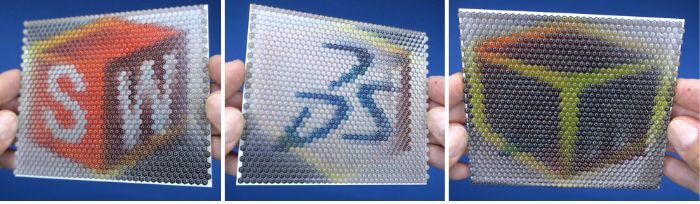
Three views of a single printed part that show the SOLIDWORKS, Dassault Systèmes, and GoEngineer logos.
Achieving this requires highly capable CAD modeling. Because you are directly relating the printed output to the digital model, you must parse and dissect individual strains of the image perfectly. Standard CAD systems like SOLIDWORKS may not always have the tools required for interlacing these complex images. Instead, advanced applications on the 3DEXPERIENCE platform, such as xGenerative Design, provide the software capabilities needed to precisely calculate and generate the required geometry.
More from the desk
Six other notes from the rest of the bench.
 NewsFive Notable Launches From Formnext 2025Formnext always offers a good snapshot of where the AM industry is heading, and this year brought a steady mix of hardware, software, and workflow-focused updates. While not every announcement dominated the conversation, a few stood out as clear indicators…
 NewsHP Puts Innovation and Sustainability at the Heart of Formnext 2023Formnext is in full swing and the entire AM world has its eyes turned towards Frankfurt to get a picture of the most important event of the year. One company that should definitely not be missed is HP Inc. It…
 SoftwareDyeMansion and Stratasys Jointly Create Reference Architecture for Production-Scale Additive ManufacturingThe additive manufacturing industry never sleeps. This has been proven again by Stratasys and DyeMansion, who, after unveiling new machines and solutions within the last two months, have now announced that they are working together on a new project. Leading…
 NewsFabric8Labs Raises $19.3M in Series A Funding and Aims to Commercialize Unique Metal TechnologyFabric8Labs, an additive manufacturing (AM) startup from San Diego, has announced the closing of a $19.3 million Series A financing round. The startup hopes that the money will help to accelerate commercialization of its proprietary AM process, allowing them to…
 MaterialsMIT Uses Artificial Intelligence To Automate 3D Printing Materials Discovery ProcessArtificial Intelligence, and more specifically, machine learning, is finding its way through various applications in the additive manufacturing industry. This time, researchers from MIT have applied the data-driven nature of machine learning to automate the process of discovering
 GuidesBeyond Recruiter Buzzwords: How 20 Years in Additive Manufacturing Shapes Modern HiringIf you’ve been following 3Dnatives, you’ve probably come across Gil Lavi before. We first profiled him and his company, 3D Alliances, back in 2019, and again in 2024 when 3D Alliances launched IMPACT, a program to help additive manufacturing companies optimize their channel netwo