News
In Seoul, 3D Printing Has Been Used to Create a Carbon-Neutral City Model Called Habitat One
3D printing is one of the best allies of our planet to preserve its fauna and flora in many aspects. We have seen how marine ecosystems have been reconstructed to help preserve others as well as the creation of things…
- 3 min read
- News
- Six more stories
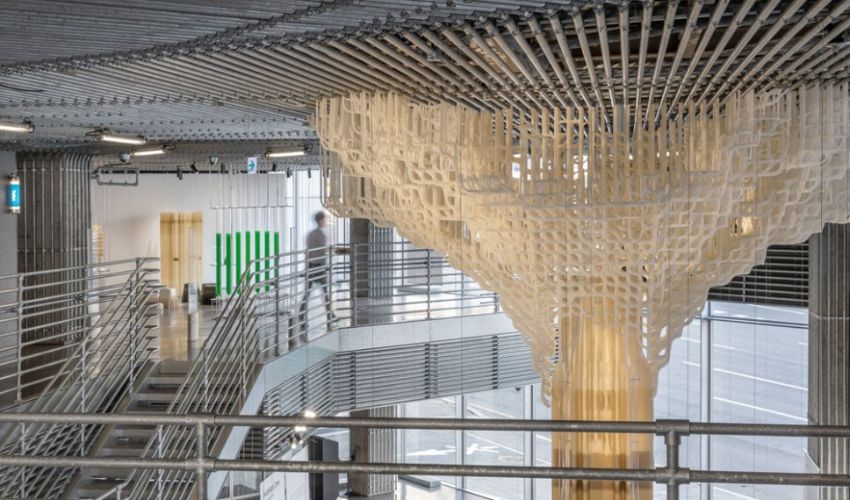
3D printing is one of the best allies of our planet to preserve its fauna and flora in many aspects. We have seen how marine ecosystems have been reconstructed to help preserve others as well as the creation of things like paper using recyclable material. This time, there is yet another new artificial nature project that has been carried out through additive manufacturing in Seoul. More specifically, the creation of a tree made with algae-based biopolymers in an architectural model named Habitat One.
As mentioned, Habitat One is an architectural project that imagines and designs an ecological and carbon-neutral city. It was developed by EcoLogicStudio in collaboration with Hyundai Motor Company and implemented at their headquarters in Seoul, South Korea. The architectural model hopes to push boundaries and show people what it would be like living in a carbon-neutral world. In fact, Habitat One was made by combining three creations: two visionary Artificial Intelligence videos, the Bio Lab and also a 3D printed sculpture named Tree One which is the core of the project.
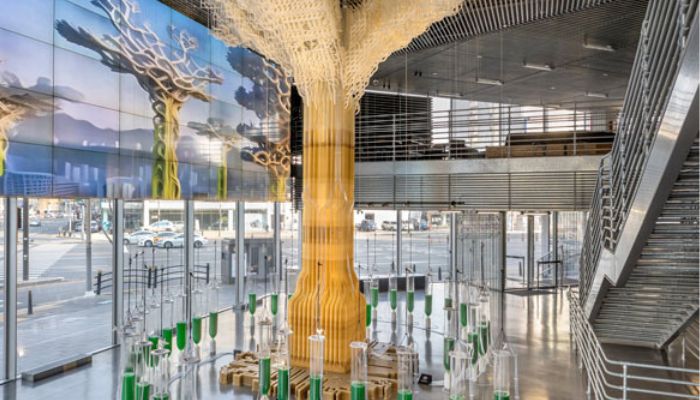
Tree One is in the center of Habitat One
Tree One as the name suggests is a tree created through 3D printing that is even capable of photosynthesis. The main goal of its design and creation is to bring to life the sustainable design concepts promoted at the exhibition, inspiring all those who visit. The main structural design of Tree One is based on a program that recognizes and recreates the tree structure by shaping the column. The trunk is entirely constructed from algae-derived biopolymers and its strength comes from the pleated shape inspired by the fibrous trunks of real trees. It was created through a robotic 3D printing process and the materials used were natural algae, sage algae, nonoilen and eco PLA.
More from the desk
Six other notes from the rest of the bench.
 NewsPrinTracker; A system to identify 3D printers from the created 3D partAt the University of Buffalo in New York, a team of researchers developed a 3D printer identification system. This would be able to identify the machine at the origin of a particular 3D printed piece. The system is called PrinTracker,…
 NewsLawrence Livermore’s AI Vision System Catches Direct Ink Writing Defects Mid-PrintDirect ink writing is one of those 3D printing technologies that has a process that can vary significantly. It’s not very commercialized, and mostly reserved for research labs. Now, a team of scientists and engineers at Lawrence Livermore National Laboratory…
 Materials3D printing materials: suppliers doubled in the last two yearsEvery year, the American firm, Wohlers Associates, Inc. unveils its industry-leading report on additive manufacturing. At the beginning of the week we told you about its 25th edition, containing wide-ranging data on the latest developments and trends in the AM…
 NewsRecovery of 3D printing market driven by China and Desktop 3D Printer ShipmentsThe company CONTEXT recently published its latest market study on the global 3D printing market. It states that the Chinese and Desktop 3D Printer markets are leading the way for a longer U-shaped recovery of the global sector. According to…
 NewsPepsi Turns to Additive Manufacturing to Make its BottlesAt some point or another in our lives, we have definitely heard of and most likely consumed it: Pepsi. The iconic American cult drink can be found in almost every supermarket around the world – stored in plastic bottles. For…
 GuidesHP on the Application and Scaling of MJF TechnologyWe are once again on the road to Frankfurt visiting Formnext in order to bring you the latest news from the additive manufacturing world. Of course, when visiting the halls of the expo, the HP booth is always an interesting…