Materials
3D printing materials: suppliers doubled in the last two years
Every year, the American firm, Wohlers Associates, Inc. unveils its industry-leading report on additive manufacturing. At the beginning of the week we told you about its 25th edition, containing wide-ranging data on the latest developments and trends in the AM…
- 3 min read
- Materials
- Six more stories
Every year, the American firm, Wohlers Associates, Inc. unveils its industry-leading report on additive manufacturing. At the beginning of the week we told you about its 25th edition, containing wide-ranging data on the latest developments and trends in the AM market in a 380-page report. Included in the report is an expanded historical analysis of the developments of 3D printing materials. The data for this part of the analysis was provided by Senvol from the Senvol Database. Moreover, the group made its historical analysis of additive manufacturing materials included within the report publicly available, revealing how AM materials have developed over the years!
Material choice is a key driver of adoption of additive manufacturing by companies. A lack of material choice or closed systems participate in limiting the number of businesses that will invest in 3D printing for their activities. Senvol reveals that the most diverse materials offering is for metal PBF by a large margin, followed by polymer SLA (which they call vat polymerization, VPP), and material extrusion (MEX). Note that MJT stands for material jetting and SHL stands for sheet lamination. In fact, last year’s Wohlers Report (24th edition) reported that the metal segment of additive manufacturing was experiencing a strong growth, mainly due to the strong growth in metal materials. The variety of metals available enables industrial applications of 3D printing, which are increasingly sought after by companies.
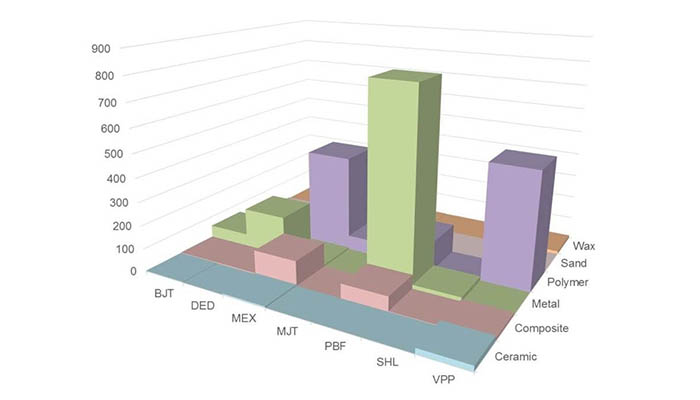
Additionally, Senvol tracks the companies that supply AM materials. They include AM system manufacturers and producers of third-party materials. According to the data, the number of material suppliers doubled in two years (from 2017 to 2019). Most of the materials manufactured are polymers and metals. However, composites are growing. Composite materials also enable higher performance, and offer properties that are very interesting for a number of industries such as aerospace and automotive, enabling manufacturers to create parts that are stronger but not as heavy. Ceramic, sand, and wax represent specialized applications and systems, and are only available from a narrow selection of suppliers.
More from the desk
Six other notes from the rest of the bench.
 ApplicationsEasy to Swallow: Deglumed’s Personalized Medicine Uses 3D PrintingDeglumed is a project that aims to move towards personalized medicine. Through the use of various technologies, including 3D printing, the aim is to create drugs that adapt to the needs of each patient. This initiative could make it easier…
 PrintersThe new Origin One 3D printer for high-volume productionOrigin, the Californian startup that developed its Open Additive Production platform to offer a new manufacturing method based on open materials, expandable software and modular hardware, with the aim of meeting the demand for better quality materials and customisation, just&hell
 NewsWorldwide spending on final part production by AM increasesEvery year, the American firm, Wohlers Associates, Inc. unveils its industry-leading report on additive manufacturing. The Wohlers Report 2020 is therefore its 25th edition and contains wide-ranging data on the latest developments and trends in the AM market. The 380-page…
 GuidesThe 3D Printing Books to Read This YearWorld Book Day is celebrated annually on April 23rd (except in the UK and Ireland where a similar event is observed in March). And as it is coming up fast, so we thought there was no better occasion to present…
 GuidesTOP 10 Game of Thrones 3D Printed ModelsSeason 7 of the hit series Game of Thrones broke audience records, reaching millions of people and even crashing HBO’s website. With winter finally upon us, we decided the best way to celebrate and prepare for what is to come…
 Applications#3DExpress: Aurora Labs Unveils Lighter, Higher-Performance, 3D-Printed TurbineIt has been a busy week for 3D printing! And we are happy to tell you all about it in this;s 3DExpress which highlights some of the tidbits you may have missed from the week. First, learn more about the…