News
3D Printed Robots to Be Used in Search-and-Rescue Operations
In Search-and-Rescue operations, timing and flexibility is often key to successful results. It is often integral not only that rescue efforts happen as quickly as possible to guarantee the maximum number of survivors in a crisis, but that responses be…
- 3 min read
- News
- Six more stories
In Search-and-Rescue operations, timing and flexibility is often key to successful results. It is often integral not only that rescue efforts happen as quickly as possible to guarantee the maximum number of survivors in a crisis, but that responses be specialized for each specific disaster. But this can be difficult to achieve. Thankfully, there may now be a solution. Worcester Polytechnic Institute (WPI) researcher Markus Nemitz has received a $599,815 CAREER Award from the National Science Foundation to develop small and flexible, 3D printed robots that are capable of traversing challenging terrains by swimming, crawling, climbing, and diving through hostile and confined spaces as part of search-and-rescue operations.
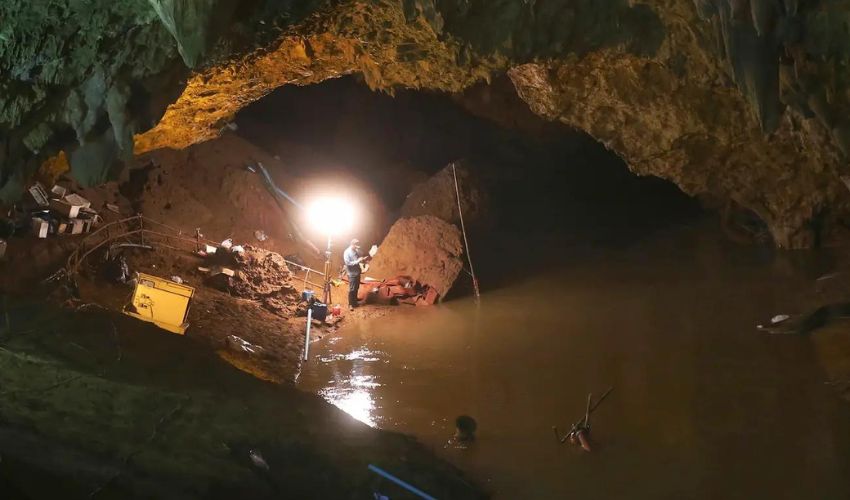
Nemitz’s project was inspired in large part by the Tham Luang cave crisis from 2018. In the incident, 12 members of a youth soccer camp as well as their coach were trapped deep in the Tham Luang cave, a karstic cave system in Thailand, which flooded due to monsoonal flooding caused by sudden, heavy rainfall on June 23rd. The plight of the team received widespread international attention at the time due to the fact that efforts to locate the group were hindered by strong currents and rising water levels. And even after all 13 were found alive on July 2nd, over a week after entering the cave, rescue was difficult due to the narrow passages and muddy waters. Eventually, all were rescued between July 8th and 10th by an international team, with as many 10,000 people including 100 divers involved in the efforts.
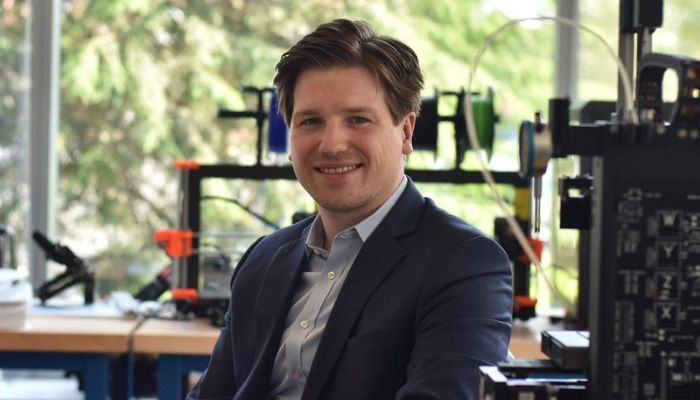
Markus Nemitz has received the grant to develop custom robots for use in search-and-rescue operations (photo credits: WPI)
In order to save all 13 members of the team, innovation was key as many different rescue operation attempt options were considered. This is what has inspired Nemitz. He is working on developing these 3D printed robots with integrated fluidic circuits to see how they can be rapidly made and deployed in disasters such as in Tham Luang cave. Indeed, in the five-year project, he plans to test miniaturized models of the robots in replicated parts of the Thai cave.
More from the desk
Six other notes from the rest of the bench.
 Software3D Slash, The Free Popular 3D Design Software Inspired by Minecraft3D software are an important part of 3D printing as they allow users to perform a number of critical tasks. Among these are modeling software, which are used to design the parts that will be 3D printed. However, many of…
 NewsTop 5 Videos: NASA’s Use of 3D Printing in Space ExplorationWelcome to our compilation of this week’s top 3D printing videos. We kick off this week’s edition with our very own video, highlighting the role of additive manufacturing within space exploration, explained by Paul Gradl, Principal Engineer at NASA. Next,…
 Printers3DGence releases INDUSTRY F420 3D printer for high-performance materialsFor some years now, high-performance thermoplastic materials have become more important in the additive manufacturing industry due to their strength, lightness and cost. This is why the European company, 3DGence, has decided to develop industrial 3D printers capable of producing&
 ApplicationsFather and son 3D print Lamborghini in their garageWhen a few days ago the giant automaker, BMW, presented to the world its new model of its 3D printable at home concept car, a father and a son had already started working on their very own project, making a…
 MaterialsPA11 vs PA12: Which Nylon Should You Choose for 3D Printing?Nylon, also known as polyamide (PA), is a group of thermoplastic polymers or plastics frequently used in 3D printing. Nylon is particularly appreciated for its ability to withstand high mechanical stress, and its resistance to heat, tearing and abrasion. This…
 MaterialsThe Ultimaker Material Alliance Program now counts more than 80 contributorsUltimaker, the leading manufacturer of FDM 3D printers launched the ‘Ultimaker Material Alliance Program’ 12 months ago. Recently, the company revealed that the program has more than 80 contributing companies. It was at the Hannover Messe event that the global…