Applications
3D Printed Parts Used in NASA Artemis Rocket
Another giant leap for mankind! NASA’s most powerful rocket in the world, Artemis 1, was launched on November 16. After several postponements due to technical problems and unfavorable weather conditions, the liftoff took place from Florida in the direction of…
- 3 min read
- Applications
- Six more stories

Another giant leap for mankind! NASA’s most powerful rocket in the world, Artemis 1, was launched on November 16. After several postponements due to technical problems and unfavorable weather conditions, the liftoff took place from Florida in the direction of our natural satellite. This mission marks the beginning of the American program, Artemis, which aims to return to the Moon. Its goal: to verify that NASA’s spacecraft, Orion, is capable of safely transporting a crew there.
In order to lift this space capsule, Aerojet Rocketdyne, an American company specialized in rocket engine design, built four RS-25 engines that were installed on the rocket. They were designed to withstand the most extreme temperatures, but also to give the rocket enough power to go around the Moon and then return to Earth. The particularity of these engines is that they have many 3D printed parts.
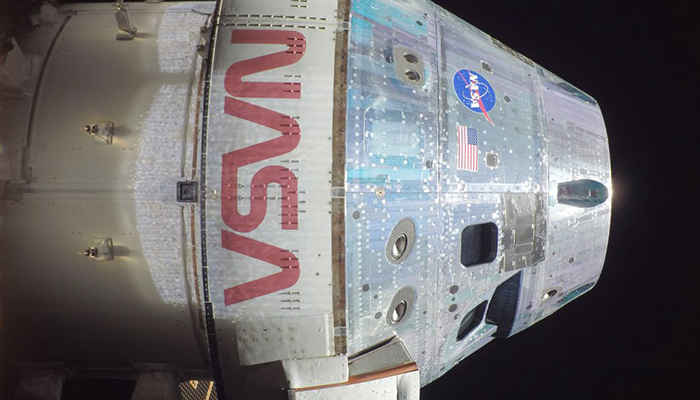
Photo of Orion, NASA’s spacecraft. (Photo credits: NASA)
3D Metal Printing for the Manufacture of 3D Printed Parts
For the design of the rocket, Aerojet Rocketdyne provided 39 propulsion elements, including 38 liquid engines and 1 solid engine. The American company also prepared 14 high-pressure tanks. For the majority of its components, it used 3D metal printing, specifically laser powder bed fusion (LPBF). This technology has reduced the overall production costs of the engines by 35 percent, according to the manufacturer. After years of delays and billions in overruns, additive manufacturing is proving its worth in terms of expense management.
More from the desk
Six other notes from the rest of the bench.
 ApplicationsParis Air Show 2019: additive manufacturing is taking offThe 53rd edition of the International Paris Air Show (SIAE 2019), held at Parc des Expositions du Bourget, came to an end yesterday. Since Monday 17th, it’s thousands of participants that were roaming the aisles of one of the world’s…
 GuidesMecuris creates a digital platform for 3D printing prostheses & orthoses3D printing is increasingly used in the medical field, whether for research work, to create fabrics using bio-printing technology or to design custom prostheses and orthotics. Some players in the sector are developing innovative solutions using 3D technologies, allowing patients&
 GuidesTOP 10 3D Printing & Additive Manufacturing University DegreesAs 3D printing and additive manufacturing become mainstream, an influx of professionals who specialise in this area will be needed. Therefore, a number of universities have already started offering additive manufacturing and 3D printing university degrees. These university degree
 Guides#3DStartup: Act’ble Brings Comfort and Stability with 3D Printed Dance ShoesClassical dance involves very specific techniques and movements, often associated with harmony and grace. Behind this idea, there is obviously a lot of work done by the dancers, efforts that of course can take a toll on the body itself.…
 ApplicationsA 3D Printed Hip Prosthesis Has Been Successfully Implanted in PolandAdditive manufacturing is increasingly known for its many benefits in medicine. Time and again, it has made it possible to produce perfectly fitted parts for every person, a necessity especially when it comes to parts like prostheses. Now, this has…
 Applications3D Printed Scaffold Might Soon Replace Conventional Breast ImplantsAustralian scientists have succeeded in using additive manufacturing to produce scaffolds that could replace conventional silicone breast implants in the future. The scaffold is designed to look like a conventional breast implant and is made of the same material used…