News
How to Build a 3D-Printed Mini TV That Broadcasts Episodes of The Simpsons
Although it may be difficult to believe, this maker project is not science fiction. Reddit user Brandon Withrow, has combined 3D printing and Raspberry Pi to create a 3D printed mini TV capable of playing the first 11 seasons of…
- 3 min read
- News
- Six more stories
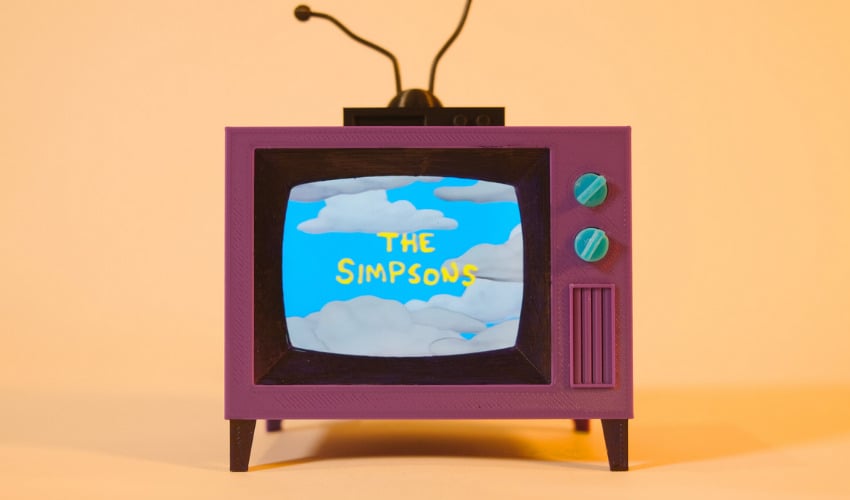
Although it may be difficult to believe, this maker project is not science fiction. Reddit user Brandon Withrow, has combined 3D printing and Raspberry Pi to create a 3D printed mini TV capable of playing the first 11 seasons of The Simpsons cartoon series—without the need for the internet! Fashion after the television that appears in the living room of the animated series, the mini TV has two buttons on the top right side—one to switch the TV on and off, and the other to regulate the volume. The 3D printed mini TV has undoubtedly already revolutionized the maker community, and many users have followed Withrow’s footsteps to create their own monitor.
As we have seen on numerous occasions, pairing a Raspberry Pi with 3D printing is a safe bet. In fact, it is one of the best combinations that is widely used in the maker community today. It allows creative minds to be unleashed by developing original projects that, in most cases, turn out to be the most practical and functional for projects like tablets, telescopes, fans, and even music speakers that users have developed. Let’s now see how both technologies have been integrated into this original maker project.
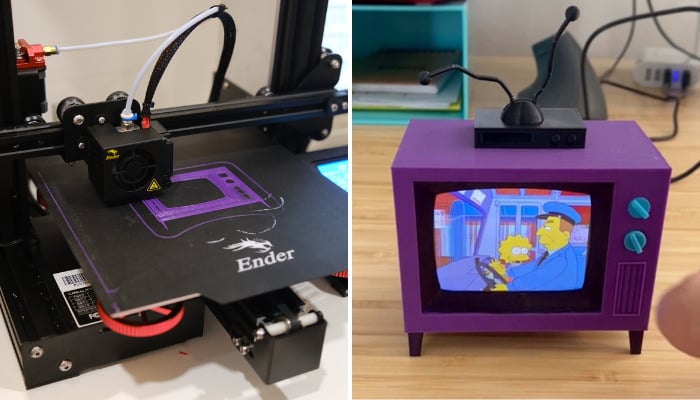
3D Printing the mini TV using the Creality Ender.
Mini 3D-Printed TV
In the manufacturing guide, the author explains the components that he has used, as well as all the steps to follow to create the mini monitor. Specifically, he used a Raspberry Pi Zero, the smallest and cheapest version of this type of device. This board is responsible for running the so-called Raspbian Jessie Lite, the operating system that plays the chapters of the series. The device is connected to a TFT screen with a resolution of 640 x 480 pixels, which is a really amazing size. To create the mini TV, the user-designed the models and parts in 3D using Fusion 360 software. He later used the Creality Ender 3 Pro 3D printer to manufacture each of the TV’s parts. But how is it able to play the episodes non-stop?
More from the desk
Six other notes from the rest of the bench.
 GuidesThink big, print small: Nanofabrica on the benefits and applications of microscale 3D printingOne of the major benefits that additive manufacturing has over traditional manufacturing is its ability to be customized for individual use, no matter how big or small the part may be. Never is this more evident than with microscale 3D…
 ApplicationsVisa Cash App RB Partners With ROBOZE for 3D Printing Innovation in F1Following the emerging trend of increased adoption of additive manufacturing within F1, The Visa Cash App RB Formula One team has forged a strategic alliance with ROBOZE, a leader in advanced 3D printing technology. This collaboration aims to completely overhaul…
 ApplicationsUniversity of Wisconsin-Madison Develops First-Ever Functional 3D Printed Human Brain TissueResearchers at the University of Wisconsin-Madison recently achieved a major milestone by creating the first-ever functional 3D printed human brain tissue. This synthetic tissue, capable of growing and functioning similarly to natural brain tissue, offers new perspectives for und
 ApplicationsBacteria Could Play a Role in 3D Printed Construction on MarsAs NASA puts it, “no other planet has captured our collective imagination quite like Mars.” In recent years focus has turned from travel to the Moon to the space race to Mars. The more ambitious among us aims to colonize…
 GuidesThinking Huts Relies on 3D Printing to Increase Access to EducationThinking Huts is an association that seeks to promote access to education through 3D technologies. By 3D printing schools, it hopes to rapidly multiply the number of available infrastructures, as well as seeking to create jobs locally while promoting more…
 NewsWhy Use Isopropyl Alcohol (IPA) in 3D PrintingWhen just starting out with a resin 3D printer, it is important to be well-informed, not only about the various options available, but also about the tools needed to optimize prints. From material selection to practical advice, our site has…