News
The 3D Printed Humidifier That Uses No Electricity
The Print Clay Humidifier is a 3D printed product capable of operating while consuming no energy. The innovative device, made by designer Jiaming Liu, is inspired by the way trees work. In addition to being the first of its kind,…
- 3 min read
- News
- Six more stories
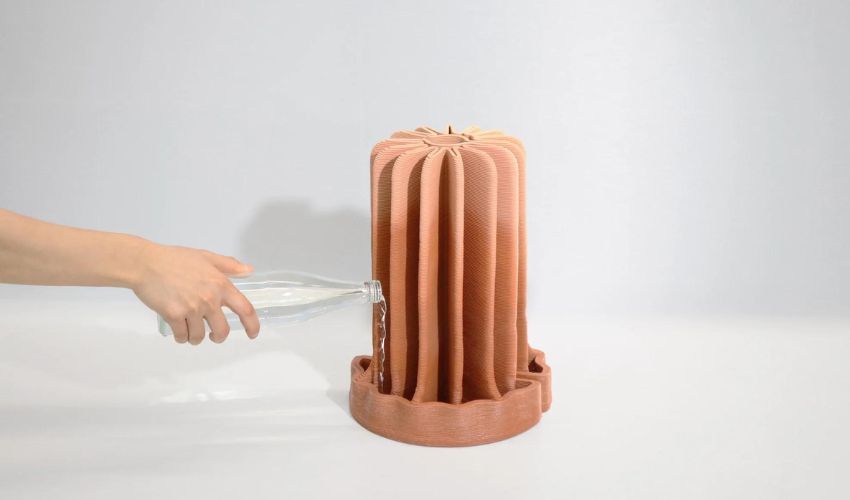
The Print Clay Humidifier is a 3D printed product capable of operating while consuming no energy. The innovative device, made by designer Jiaming Liu, is inspired by the way trees work. In addition to being the first of its kind, this humidifier has a strikingly unique shape and operation, both of which are only possible through the use of additive manufacturing.
An Electricity-Free 3D Printed Humidifier
Jiaming Liu created the 3D printed humidifier as a graduate project at Folkwang University of the Arts in Essen, Germany. It stems from a near-perfect exercise in intelligent, environmentally friendly design that brings value to the user through low-cost traditional materials and high-tech manufacturing techniques. In fact, the device works because of this precise combination.
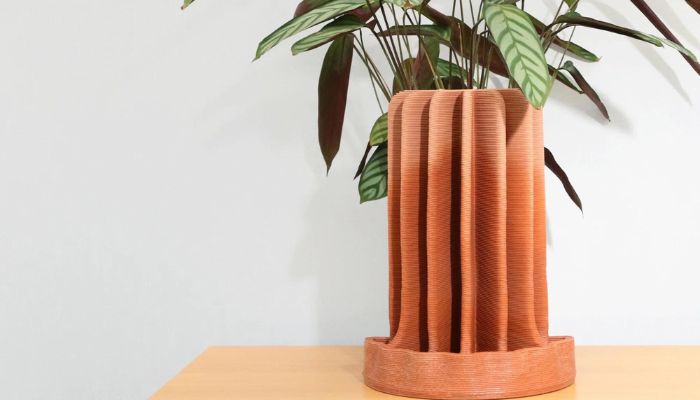
The material makes the humidifier lightweight and placeable on any surface or piece of furniture.
The humidifier is inspired by the way trees function in nature: “The bottom water storage part is like the ground and soil. The extension curves (which are inside the water container) are like the roots of a tree absorbing water. The main part carries the water upward and extends, like tree trunks and branches,” the designer explained. This evaporation process is the same one which earthenware water containers use to cool their contents, a natural process that thus eliminates the need for electricity .
The Creation of the Product
Jiaming Liu created the Print Clay Humidifier by 3D printing using an FDM clay printer. Specifically recycled ceramic powder was added to the clay in a 1:3 ratio. This material not only makes it possible to improve the strength and water absorption of the device but, once the product’s life cycle is over, it will also be easily recyclable and reusable as clinker.
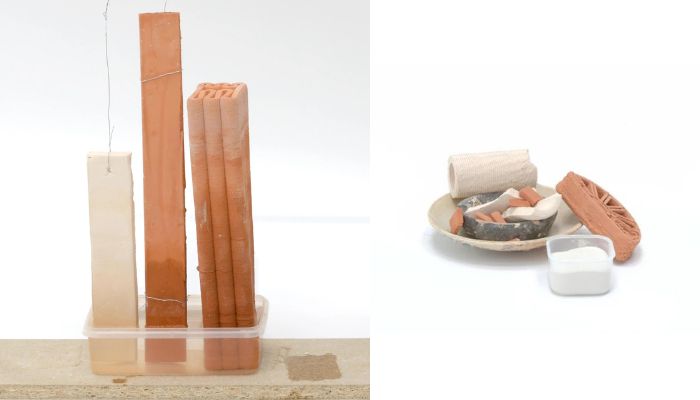
Comparison of water absorption height, from left: 1. Clay without additions; 2. Clay with 30% recycled ceramic powder added; 3. Clay with 30% recycled ceramic powder added and molded with a special texture.
The uniqueness of the 3D printed shape is critical to the humidifier’s operation. According to the designer it would be nearly impossible to make by hand or other injection molding production methods. “Compared to other humidifiers on the market, its unique printing structure allows it to better absorb and evaporate water. In addition, the clay’s micropores are much more effective in releasing water into the atmosphere: the evaporation rate is significantly higher, absorbing more water and evaporating faster,” added Jiaming Liu.
More from the desk
Six other notes from the rest of the bench.
 ApplicationsATU Discovers New Method for Printing on Flexible TextilesResearchers at the Atlantic Technological University (ATU) in Ireland have recently developed a new 3D printing method that could impact the future of wearable technology. Dr. Aswathy Babu, the head of the team, alongside Professor Suresh C. Pillai, has created…
 SoftwareHow MakerOS Helps 3D Printing Service Providers Attract and Retain ClientsService providers play an important role in the additive manufacturing market. EY’s 2019 study on the state of 3D printing (3D printing: hype or game changer?) reported that there had been a significant increase in the percentage of companies using…
 NewsA 3D Printed Microscope Will Be Able to Detect Microplastics on the Sea FloorA group of researchers has made a low-cost 3D printed microscope to detect microplastics in the seafloor. The project was carried out by the Microplastics Detection Assistant (MIDAS) team with the participation of the Polytechnic University of Cartagena, Navantia, S.M.E…
 ApplicationsMaking a facial prosthesis on photogrammetry softwareDenise Vicentin, 53 was diagnosed with a facial tumor 30 years ago. After having it removed twice, it came back 20 years later in a malignant form. Luckily, she was able to benefit from research conducted by scientists at Paulista…
 NewsThe First House Made With 3D Printing and AI Announced In PortugalAs we all know, additive manufacturing is being implemented in a growing number of sectors. One example is construction, where 3D printed housing is booming. In fact, soon we may see the first 3D printed house in Portugal. Not only…
 NewsTop 5: Markforged’s Part Production For Own UseHello everyone and welcome to our top 5 of the week! It is of course Christmas Day, but 3Dnatives is still here with a weekly video round up. Perhaps you’re reading this tucking into your turkey or laying on the…