News
The 3D printed Future Tree
The use of concrete in 3D printing is revolutionizing the construction industry. From houses to pedestrian bridges, additive manufacturing provides a great deal of design freedom that goes beyond the limits of the imaginable. In fact, it may well be…
- 3 min read
- News
- Six more stories
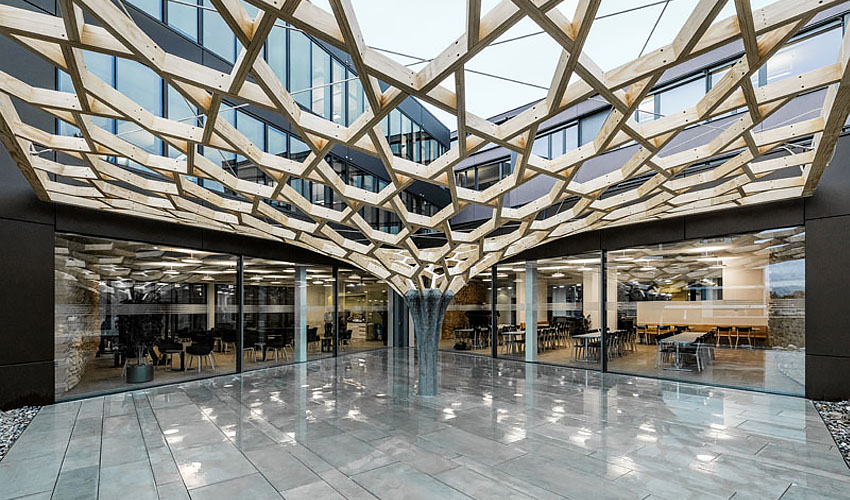
The use of concrete in 3D printing is revolutionizing the construction industry. From houses to pedestrian bridges, additive manufacturing provides a great deal of design freedom that goes beyond the limits of the imaginable. In fact, it may well be the leading solution for structural construction in the future, thanks to its speed of production and low cost. To better understand the possibilities of concrete additive manufacturing, let’s take a closer look at the 3D printed Future Tree project, a canopy structure that extends over the courtyard of the Basler & Hofmann building, a consulting firm based in Switzerland.
We have previously covered some projects realized by ETH Zurich, such as Fast Complexity, for instance. The research group, led by Fabio Gramazio and Matthias Kohler, has been focusing on the development of computational and robotic tools for architecture. From complete installations to prototype buildings, they have inspired many industry actors to explore the capabilities of design in the digital age. In their latest project called Future Tree, the team wanted to combine cutting-edge design techniques with new materials and robotic additive manufacturing, all in one striking architectural project. How was the team able to build such an innovative and complex 3D printed structure?
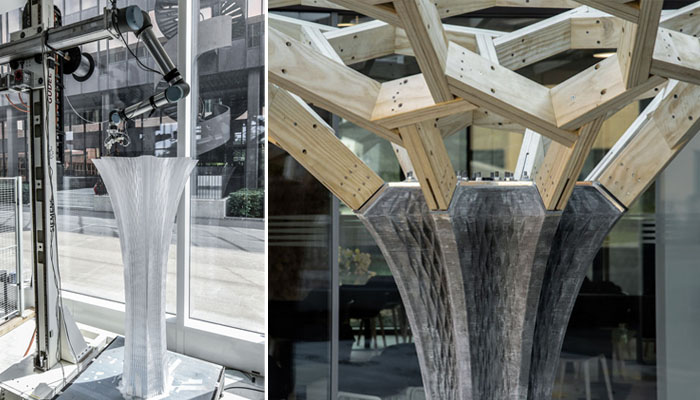
Image credits: ETH Zurich
The design and development of the structure
The Future Tree consists of two elements. The first is the column that supports the structure; to build the column, the team used a six-axis robotic arm, so that the concrete could be produced on a large scale. The ultra-thin formwork, which comprises slightly over 2 meters in height, was built in one piece and filled with a fast hardening custom concrete. As for the design of the column, manufacturing data was generated from the parametric design model, allowing rapid iterations of physical prototypes. The team used the “Eggshell” technique – using the FDM technology, the process allows to design optimized novel structures and to minimize waste.
More from the desk
Six other notes from the rest of the bench.
 News‘Tactile Tours’: How Can 3D Printing Facilitate Access to Art and Culture For the Visually Impaired?Valentin Haüy is a voluntary association dedicated to the support of visually impaired people in France. Created in 1889, it deploys a large number of actions throughout the country to allow the visually impaired easier access to education, to the…
 MaterialsAll You Need to Know About POM for 3D PrintingPolyoxymethylene, better known as POM, is a thermoplastic used that is considered to be engineer-grade due to its properties. Discovered in 1920, it is currently one of the most widely used materials for injection molding, after polypropylene (PP) and polyamide…
 MaterialsCould Flame-Retardant Bioplastics Soon Be Used in AM?Materials used in electrical engineering or electronics must conform to high demands. This is especially the case since these materials must have properties such as flame resistance. It is well known that in this case plastics meet the necessary flame…
 Applications3D Printing Optimizes Surgical Planning at a Hospital in MexicoThe Hospital Regional de Alta Especialidad “Ciudad Salud”, in Mexico, is using 3D printing as a tool to improve surgical planning in patients. This adoption by the health center, in addition to making interventions more efficient, also is expected to…
 MaterialsTop 5 Videos: Mimaki & Open BionicsThis week’s Top 5 Videos showcases some of the most unbelievable 3D printing updates we’ve seen in recent times. These include incredibly detailed full-color 3D prints by Mimaki, amazing 3D printed prosthetics by Open Bionics, and Qlone’s 3D scanning app…
 NewsVoronoi 3D printed bicycle helmet, safer and lighter?Different kinds of protective helmets are used for various physical activities and sports games. Invented for the first time many decades ago, this type of protective gear is re-developed whenever there is a new technology that is disruptive enough to…