Materials
Exoskeletal Assisted Rehabilitation uses 3D Printing
According to the Centre for Disease Control and Prevention, almost 800,000 people suffer from a stroke each year in the US. During a stroke, blood supply to part of the brain is cut off. In 85% of cases, it is…
- 3 min read
- Materials
- Six more stories
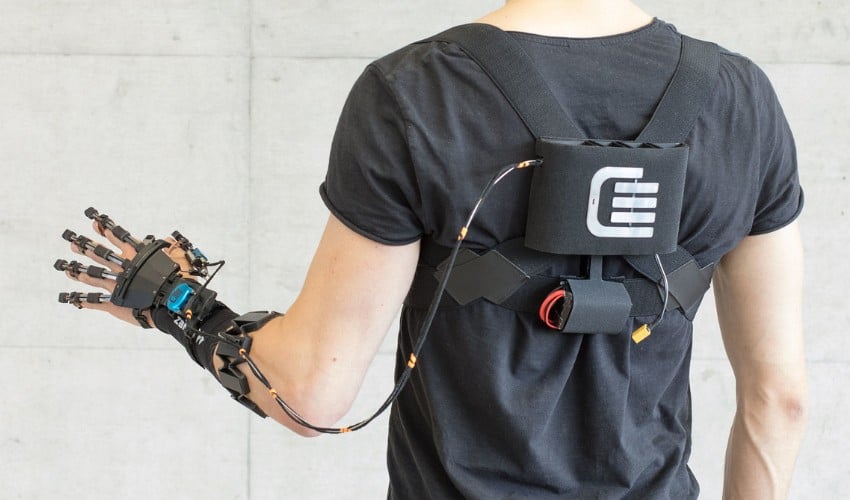
According to the Centre for Disease Control and Prevention, almost 800,000 people suffer from a stroke each year in the US. During a stroke, blood supply to part of the brain is cut off. In 85% of cases, it is caused by a blood clot somewhere in the body; it can also happen when a blood vessel that supplies to the brain bursts. Unfortunately, those that recover from a stroke may experience paralysis, disturbances in movement and speech long after the episode. Patients are typically supported by physiotherapists during rehabilitation in order to relearn movements. At ETH Zurich, researchers are supporting hand movement rehabilitation by developing exoskeleton (i.e. an external frame that can be worn to support the body, either to help a person overcome an injury or to enhance their biological capacities). In order to enable optimal force transmission, igus, a Cologne-based company that develops components made of high-performance plastics, is producing 3D printed finger joints for the exoskeleton.
How does the exoskeleton work?
The exoskeleton consists of a hand module, a wristband sensor and a backpack. The hand module is attached to the patient’s hand using leather straps, while the patient wears the wristband and backpack. When the patient initiates a movement, the wristband transmits electromyographic (EMG) signals to a minicomputer located in the backpack with motors, batteries and control electronics. The computer recognizes from the incoming data that the patient wants to perform a grasping movement and activates the motors. The motors stretch and flex the leaf springs, which form the fingers of the exoskeleton. “Per finger, the exoskeleton applies a force of six newtons,” says Jan Dittli, a researcher at ETH Zurich’s Department of Health Sciences and Technology – allowing the exoskeleton to cover 80% of daily movements.
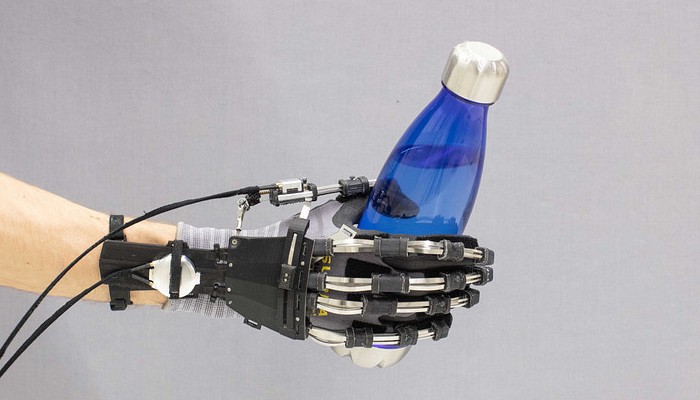
With the exoskeleton, the patient should be able to lift up to 500 grams | Photo Credit: Stefan Schneller (ETH Zurich)
FDM printing was not suitable for all components
To make the exoskeleton suitable for everyday use, the researchers tried to reduce the part’s weight as much as possible thus resorting to additive manufacturing. FDM 3D printing was used in the prototyping stage; it was particularly suitable for rapid prototyping due to its comparatively low cost, ease of use and speed. Both the back of the hand and the finger joints were first printed from ABS. While FDM technology and ABS proved suitable for the back of the hand, both were inadequate for the finger joints due to their challenging functionality. The finger joints hold together the three stacked thin stainless steel leaf springs, and they also have a locking mechanism for the leather straps. Therefore, the 3D printed finger joints made of ABS produced too much friction as Dittli explains: “The friction between the joints and the leaf springs would have been too high with this material. As a result, we would have lost too much energy when moving the fingers.” In addition, the FDM printer could not print the finger joints with the required resolution. For this reason, the ETH Zurich researchers turned to igus.
More from the desk
Six other notes from the rest of the bench.
 NewsTop 5: Choosing A 3D Printing Material With Dassault SystemesHello everyone, and welcome back to our Top 5 of the week! We have an exciting selection of 3D printing video content for you as always, from Dassault Systemes and material choices to the use of additive manufacturing for consumer…
 NewsXJet’s NanoParticle Jetting (NPJ) Technology Is Unlocking Powderless Ceramic and Metal Additive ManufacturingPer the most recent Wohlers Report, the market for additive manufacturing goods and services has seen a growth of about 18.3% over the past year, confirming not only the continued market recovery from the pandemic, but also the increasing importance…
 NewsTop 5 Videos: Automated post-processing, and moreThis week we found the top 5 videos about 3D printing and the way additive manufacturing is changing production. The technology has infiltrated many sectors, from medical to automotive – check our selection of the week to keep up with the innovations! If you enjoy these, you&hell
 MaterialsGroundbreaking 3D Printed Concrete Lowers Carbon Emissions by 31%Concrete is a popular material for 3D printing, especially in the construction sector. It’s a composite material of aggregate—usually geological materials such as gravel, sand and crushed rock—that is bonded by fluid cement and hardened over time. In recent years,…
 NewsInfographic: The Role of 3D Technologies in the Art WorldAdditive manufacturing is increasingly gaining popularity in the worlds of art and cultural heritage. Indeed, the wider art sector, which has always been creative and in search of innovations and new conservation techniques, can benefit from 3D technologies in many…
 NewsTop 5 Videos: ‘Airless’ – Wilson’s 3D Printed Basketball Is a Slam Dunk in InnovationGet ready for the top 5 videos of the week that will take you on an exhilarating journey through the world of 3D printing! First up, we learn about the fascinating story behind the world’s first 3D printed basketball and…