Materials
Groundbreaking 3D Printed Concrete Lowers Carbon Emissions by 31%
Concrete is a popular material for 3D printing, especially in the construction sector. It’s a composite material of aggregate—usually geological materials such as gravel, sand and crushed rock—that is bonded by fluid cement and hardened over time. In recent years,…
- 3 min read
- Materials
- Six more stories

Concrete is a popular material for 3D printing, especially in the construction sector. It’s a composite material of aggregate—usually geological materials such as gravel, sand and crushed rock—that is bonded by fluid cement and hardened over time. In recent years, it has become increasingly easy to use for additive manufacturing. Standard concrete 3D printers are like FDM printers, operating by material extrusion. However, concrete has a huge carbon footprint. According to Statista, manufacturing cement (which is part of concrete) produced 1.6 billion metric tons of carbon dioxide in 2022 alone. So, it’s great news that researchers developed concrete for 3D printing with low carbon emissions.
The concrete material for 3D printing that researchers at the Unviersity of Virginia developed has many promising characteristics: it’s strong, durable and emits significantly lower carbon emissions than traditional printable concrete mixtures. How did they achieve this? The researchers created a unique mix of graphene, limestone and calcined clay cement (LC2).

Osman Ozbulut, professor in the Department of Civil and Environmental Engineering. (Photo credits: Tom Daly via the University of Virginia)
Graphene, a carbon allotrope, is known for its strength and lightness. Osman Ozbulut, a professor at UVA’s Department of Civil and Environmental Engineering, explained, “The addition of graphene to LC2 cement offers a unique opportunity to lower carbon emissions while maintaining the strength and flexibility required for 3D printed construction.”
More from the desk
Six other notes from the rest of the bench.
 NewsSpeaking to RAYSHAPE at RAPID + TCT 2023RAPID + TCT 2023 is now officially over. But if you were not able to attend the largest additive manufacturing trade show, do not free! We at 3Dnatives have prepared a number of videos to give a general idea of…
 Printers3Dnatives Lab: Testing the Isun3D L120 from eSunBest known for its range of filaments for FDM 3D printers, the Chinese company eSun recently entered the resin 3D printing market with the Isun3D L120, a machine at a price below 1,000€ ($1,130)! This is one of the selling…
 News3D printed prosthetics to help in a crisisAs the Number of Refugees fleeing Syria is still going up and has grown from 60.000 to 272.000 civilians over only days, the need for efficient and affordable tools are in high demand now more than ever. 3D printing keeps…
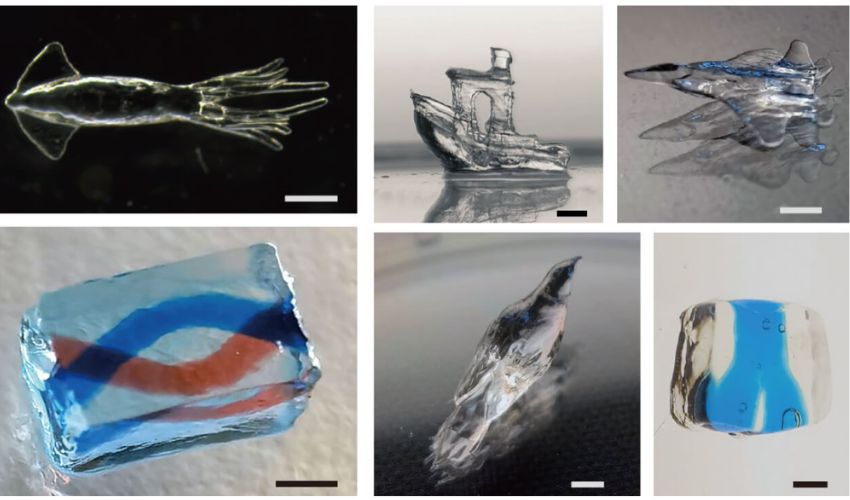 GuidesPrinted in Seconds: Six Volumetric 3D Printing Projects to Know in 2026One of the cornerstones of additive manufacturing is the principle of “layer by layer.” Well, there’s one 3D printing technique that disagrees with that completely: volumetric 3D printing. Instead of building an object slice by slice, it cures an entire…
 News3D printed fashion at the Met Gala 2019!The Met Gala is undoubtedly one of the most famous fashion evenings in the world, bringing together celebrities and young designers to promote innovation and design. This Met Gala 2019 saw some amazing creations combining craftsmanship and 3D printing: designer…
 MaterialsAll You Need to Know About Polycarbonate (PC) for 3D PrintingPolycarbonate (PC) is a family of thermoplastic polymers defined by the carbonate groups in their molecular structure. Engineering-grade PC is prized for its exceptional impact resistance, and certain grades are optically transparent, combining strength, durability and clarity in