Applications
From Print to Load-Bearing in 7 Days: EPFL’s New Bone Scaffold Breakthrough
New research has been published in Advanced Functional Materials regarding the development of 3D printed bone scaffolds to encourage bone growth. A team from the Swiss Federal Technology Institute of Lausanne (EPFL) created a bone-like composite that uses naturally occurring&hell
- 3 min read
- Applications
- Six more stories
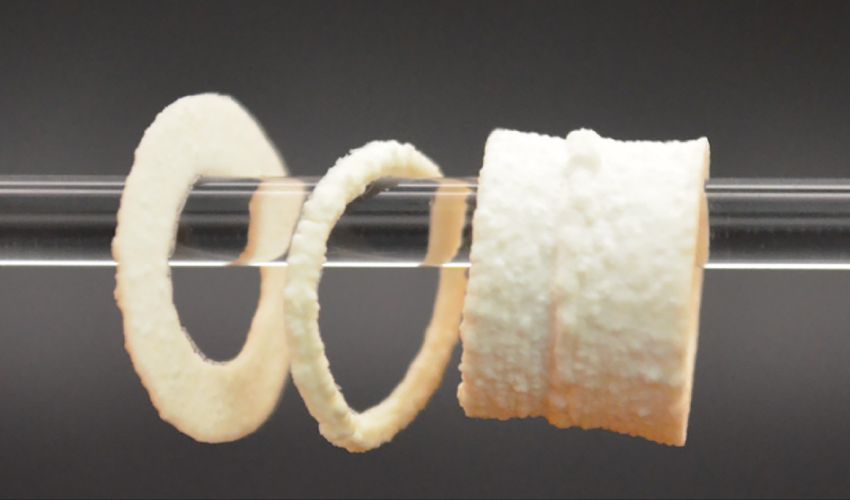
New research has been published in Advanced Functional Materials regarding the development of 3D printed bone scaffolds to encourage bone growth. A team from the Swiss Federal Technology Institute of Lausanne (EPFL) created a bone-like composite that uses naturally occurring enzymes to accelerate mineralization through an energy-efficient, room-temperature process. The researchers hope that this strong, lightweight material will work for bone repair applications.
The scientists used a mineral called hydroxyapatite (HA), which is one of the primary components of bones. Normally, producing HA-based materials requires significant energy and restricts the use of biologically active components, like enzymes that support bone growth. Researchers in the Soft Materials Laboratory (SMaL) in EPFL’s School of Engineering came up with a way to 3D print HA-based scaffolds using a room-temperature process. This method also permits them to utilize enzymes for fast mineralization. Within just seven days, these porous scaffolds can be load-bearing.
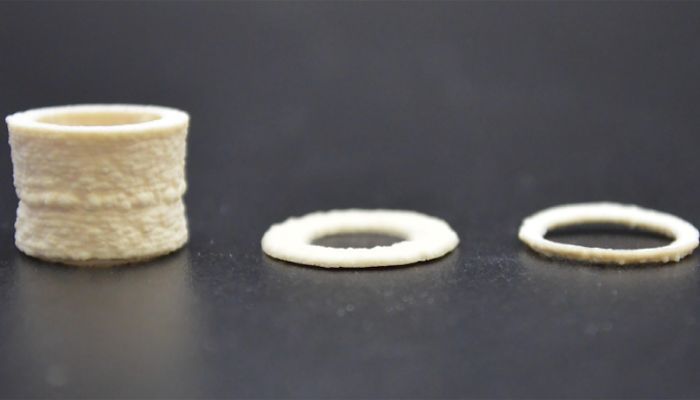
Creating the Bone “Ink”
To create the ink, the EPFL scientists embed alkaline phosphatase (an enzyme) into gelatin microparticles. Then, they incubate them in a calcium and phosphate ion solution. The enzyme triggers HA crystals to form, which stiffen and strengthen the printed scaffolds. After four days of mineralization, the composite can hold the average weight of an adult human on an area as small as 1.5 cm x 1.5 cm.
More from the desk
Six other notes from the rest of the bench.
 Materials#3DStartup: F3nice To Innovate AM With Its Sustainable Powders Made From Metal ScrapsNowadays, sustainability and environmental issues are increasingly topical, given the challenges we face in reducing global warming and consumption of non-renewable resources. This trend impacts every sector, regardless of the activities performed or the industry in which it oper
 NewsNew 3D Printed Shoebox Gifted to Lionel MessiThere have been several interesting and visually striking 3D printed shoes recently making the headlines, from running shoes to golf shoes, and casual sandals. But with all of this additive manufactured footwear, one thing that has come up less often…
 MaterialsWhat is the environmental impact of metal additive manufacturing?Not so long ago, the Additive Manufacturer Green Trade Association (AMGTA) released its report on the environmental impact of metal additive manufacturing. Conducted by Jeremy Faludi of Delft University of Technology and Corrie Van Sice of Dartmouth College, the study…
 NewsHow to Choose Between a Bowden and Direct Extruder for 3D PrintingIn the 3D printing landscape, the extruder configuration you choose can make all the difference between a successful, flawless print and a frustrating trial-and-error process. FDM 3D printing extruders come in a variety of shapes and forms, but despite the…
 PrintersThe Top PEEK and ULTEM FDM 3D Printers on the MarketAdditive manufacturing users are increasingly looking for technical materials that meet their requirements and constraints. As a result, we have seen the materials market grow exponentially in recent years, with the aim of offering higher-performance solutions. This is true, for&
 NewsBoeing protects aeronautical additive manufacturing with AssembrixAeronautical and aerospace builder Boeing recently announced a new partnership with Assembrix, an Israeli company known for their industrial additive manufacturing platform. Their program allows you to oversee the entire digital process, from design to production and verification