Materials
Sunflower Pollen Used as 3D-Printable Bio-ink
At Singapore’s Nanyang Technological University (NTU Singapore), a team of researchers has developed a new 3D-printable ink made from sunflower pollen. More environmentally friendly, durable, and affordable, this bio-ink could be used to manufacture parts for tissue enginee
- 3 min read
- Materials
- Six more stories

At Singapore’s Nanyang Technological University (NTU Singapore), a team of researchers has developed a new 3D-printable ink made from sunflower pollen. More environmentally friendly, durable, and affordable, this bio-ink could be used to manufacture parts for tissue engineering or drug delivery. One of the advantages of this pollen-based bio-ink is its ability to retain its shape once deposited on a bio-printer bed, making it easier to design the final product.
Bioprinting brings together all the techniques that make it possible to manufacture cellular structures with the same properties as natural tissues. Probably the most widely used process is extrusion: like an FDM printer, the bioprinter deposits the ink layer by layer, generally a hydrogel containing the cells. One of the biggest challenges with this technique is retaining the shape of this hydrogel. This is why printing media are needed: ink is traditionally deposited in a sort of matrix, which will be obsolete once the process is complete. Researchers at NTU Singapore, therefore, wanted to find an alternative that would no longer use a matrix and therefore minimize the waste associated with bioprinting.
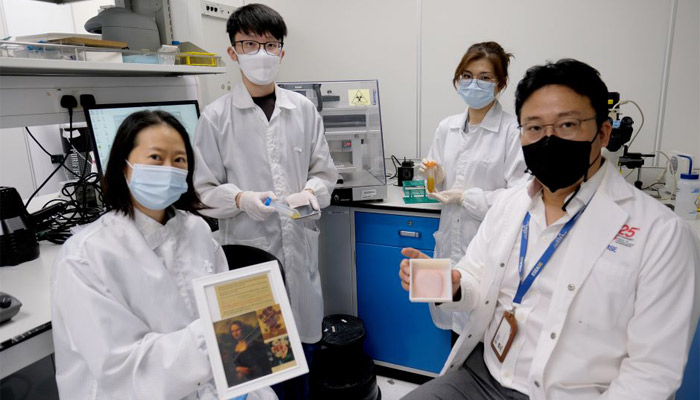
The team behind this study (Photo Credit: NTU Singapore)
Professor Cho Nam-Joon, the co-lead author of the study, explains: “Bioprinting can be a challenge because the material that the inks are made of is usually too soft, which means the structure can collapse during the print. By adjusting the mechanical properties of sunflower pollen, we have developed a pollen-based hybrid ink that can be used to print structures with good structural integrity. This is a significant achievement because the process of making pollen ink is sustainable and affordable. Since there are many types of pollen species with distinct sizes, shapes, and surface properties, pollen microgel suspensions could potentially be used to create a new class of environmentally friendly 3D printing materials.”
More from the desk
Six other notes from the rest of the bench.
 News3D Printed Drone Wins Red Dot AwardThe Tundra® 3D printed Drone for industrial use won the German Red Dot Award. The Red Dot Award has been around since 1955. It brings an opportunity for any individual or business to submit their products to one of the world’s…
 ApplicationsA.D.A.M project develops 3D printed personalizable bone implants platformFounded in 2018 by 3D printing company Kwambio and WeFund Ventures in Ukraine, ADAM develops on-demand 3D printed bone implants. The initial vision of the company was to create a carshop-like infrastructure where any part of the human body could…
 ApplicationsPARI Researchers Use 3D Printed Dark Ceramics to Advance Hypersonic ManufacturingHypersonic manufacturing is one of the most challenging areas of research in modern aerospace applications. Vehicles traveling at more than five times the speed of sound have to withstand extreme conditions, including temperatures of more than 2000°C and enormous mechanical&helli
 ApplicationsWorld’s First 3D Printed Water Taxi Is Also Largest 3D Printed BoatFrom kayaks to super yachts, additive manufacturing has been making waves in the maritime sector. Though 3D printing is often discussed for its usefulness in helping make parts while at sea or for making parts that have been disrupted by…
 ApplicationsArmor Bionics and Shapeways Partner to Make Accurate, 3D-Printed Medical ModelsShapeways has announced that they have entered an agreement to be Armor Bionics’ exclusive 3D printing manufacturer. The leader in digital manufacturing, known for its on-demand manufacturing in industries as vast as medical, robotics, architecture, jewelry and gaming, will
 News#3DStartup: Inkbit, 3D printer powered by machine-vision and AIA startup straight out of MIT, Inkbit, is working towards overcoming traditional constraints to 3D printing by giving its machines ‘eyes’ and a ‘brain’. The industrial 3D printer developed by Inkbit is a multi-material machine capable of printing extremely flexible…