Applications
3D Bioprinting Opens Doors for Brain Injury Treatment
Head trauma is a dangerous and unfortunately common accident of life, with an estimated 70 million people worldwide suffering from some form of traumatic brain injury each year. These can often be debilitating or terminal injuries, which have previously been…
- 3 min read
- Applications
- Six more stories
Head trauma is a dangerous and unfortunately common accident of life, with an estimated 70 million people worldwide suffering from some form of traumatic brain injury each year. These can often be debilitating or terminal injuries, which have previously been extremely limited in the scope of treatment. However, researchers from Oxford University have released the paper of their most recent research project where, through the use of 3D printing, they were able to fabricate brain tissue which appeared to successfully integrate with the host brain tissue in lab tests. This study illustrates the potential that 3D bioprinting could provide in the treatment of brain injuries.
Hot on the heels of a similar breakthrough in 3D printed nerve cells from Monash University, the Oxford study has a long history of bioprinting research behind it, and has presented an extra facet to the study of 3D printing tissue replacements. Through the use of neural stem cells, the bioprinted tissue was able to replicate the biological architecture of a cerebral cortex. The task of consistently and effectively mimicking the desired tissue or organ has been a concern for researchers in the past, but this study shows more clearly that though the use of these guiding components, such as neural stem cells which can be derived from the patient themselves, the 3D printed brain tissue may be more cooperative and accept integration within the body with greater ease.
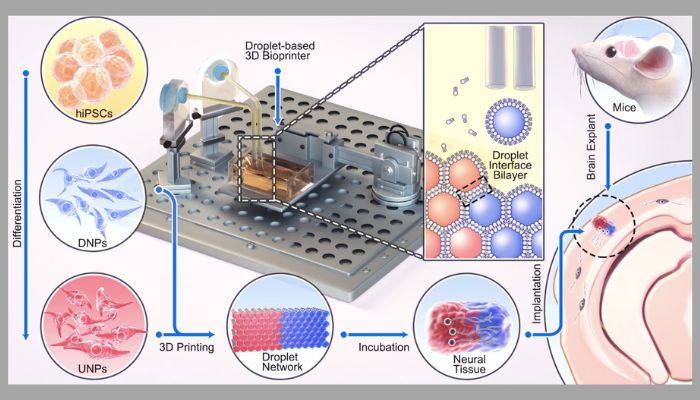
Diagram of the 3D bioprinter and the materials that make up the bioink (Image credits: Jin et al. / University of Oxford
Currently, the process is done via ‘droplet printing’ which is not all too dissimilar to other additive manufacturing processes that utilize an inkjet printhead such as material jetting. The materials, including the human induced pluripotent stem cells (hiPSCs) were combined into two bioinks which were used to create the dual layers that closely resembled a cerebral cortex and were able to hold its form for an extended period of time, even in storage.
More from the desk
Six other notes from the rest of the bench.
 NewsOris Unveils a 3D Printed Watch to Honor FirefightersOris, a Swiss-based brand, has unveiled its new limited edition watch, the ‘Coulson Limited Edition’, in partnership with Coulson Aviation, a Canadian company that specializes in aerial forest fire suppression. The watch was designed to pay tribute to this organizatio
 PrintersThis Made in the USA SLS 3D Printer Is Under $3000As 3D printing technology matures, we have seen a sharp increase in demand for industrial technologies. However, price remains a significant obstacle for many, especially when it comes to technologies with lasers, unlike FDM which has more cheap solutions available.…
 NewsTOP 5 videos of the week: jewelry, Polaroid and a touch screen attachmentA new selection of the best 3D printing videos of the week, just for you! Find our TOP 5 videos of the week below and tell us what your favorite video is in a comment or on our Facebook and Twitter page.…
 MaterialsGravity Industries & Ricoh 3D Partner On Human Flight ProjectRicoh 3D has announced they are partnering once again with Gravity Industries, this time with the goal of producing Gravity’s latest human flight project, the Electric Jet Suit. Having experienced great success with Gravity’s Jet Suit over the past four…
 MaterialsPolyTerra PLA, the Environmentally Friendly 3D Printing FilamentThough additive manufacturing has been posited as a solution to the negative environmental impacts created through traditional manufacturing, experts tell us that there are still many ways in which AM itself needs to become more eco-friendly. One of these is…
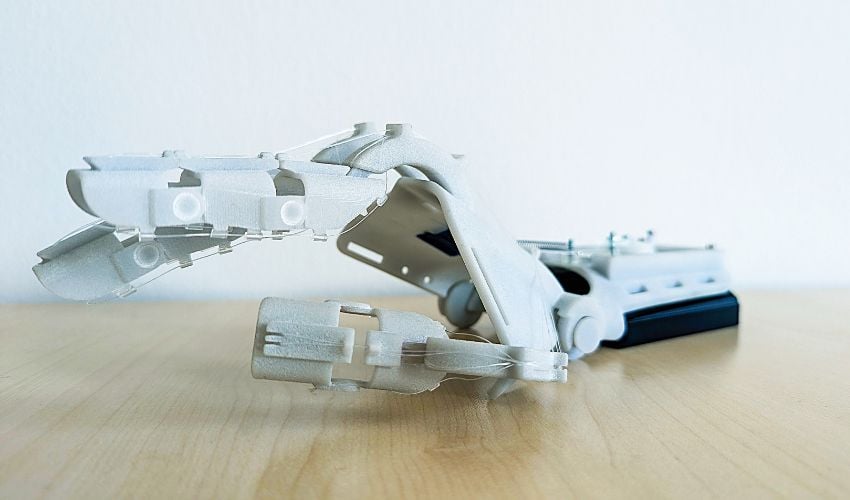 ApplicationsFraunhofer 3D Printed Exoskeleton Helps Patients Return to Daily LifeAfter accidents that damage tendons, a patient’s mobility is often severely limited. Hand injuries, in particular, can take a long time to heal and usually only recover fully through physiotherapy. For therapy, experts are increasingly using so-called exoskeletons, which are&hell