

Revolutionizing Construction: Lib Work Pioneers Mass Production of 3D Printed, Earthquake-Resistant Homes in Japan
The future of construction is rapidly unfolding, driven by an urgent need to reduce building times and costs while enhancing sustainability and resilience. At the forefront of this transformation in Japan is Lib Work, a visionary company based in Kumamoto Prefecture. Their ambitious goal is to complete approximately 10,000 3D-printed homes by 2040, marking a significant leap towards making innovative housing solutions accessible. 3D printing in construction is no longer a futuristic concept confined to research labs; it has firmly established itself as a fundamental, rapidly evolving segment of the global building industry. From large-scale projects like modern office buildings and commercial spaces, such as 3D-printed Starbucks locations, to cutting-edge sustainable biocomposite structures, additive manufacturing offers construction companies an expansive range of innovative possibilities. This technological paradigm shift enables unprecedented design freedom, optimizes material use, and drastically cuts down on construction waste and manual labor. Recognizing this immense potential, Lib Work is now spearheading the mass production of these advanced homes across Japan, aiming to address critical housing challenges with speed, efficiency, and sustainability.
Japan, situated on the Pacific Ring of Fire, is renowned as one of the most earthquake-prone regions globally. This geological reality places an extraordinary burden on construction companies and dictates highly stringent design requirements for all residential and commercial buildings. The devastating events of January 2024 serve as a stark reminder of this vulnerability, when Ishikawa Prefecture was struck by a powerful earthquake of magnitude 7.5, followed by a significant 6.2 aftershock. These intense tremors led to widespread destruction, leveling countless homes and inflicting severe damage upon centuries-old temples and historical structures. Reports from the region described the seismic event as having caused “catastrophic damage,” underscoring the urgent need for more resilient and rapidly deployable housing solutions. In such a volatile environment, the ability to construct homes that can withstand powerful seismic activity, and to rebuild quickly after disaster, is not just a preference but a national imperative.
The Transformative Potential of 3D Printing for Japanese Construction
Lib Work perceives immense and untapped potential in leveraging 3D printing technology for residential construction, especially as an innovative and effective strategy to counteract the potentially devastating effects of Japan’s frequent earthquakes. The company’s cutting-edge model home, proudly showcased in Yamaga, exemplifies a smart, hybrid approach to building. This design ingeniously combines a robust, load-bearing wooden frame with walls meticulously crafted from a special clay mixture, notably eschewing the use of conventional concrete. This hybrid construction method is a deliberate choice, marrying the inherent structural strength and traditional appeal of wood with the sustainable and thermally efficient properties of clay-based 3D printing. While fully 3D-printed buildings, often made from concrete, can be erected in a matter of days, the inclusion of a wooden structure in Lib Work’s models means the initial structural assembly might take a few weeks. However, the targeted average construction time for these homes, inclusive of all interior finishing work, is an impressively swift six weeks. This accelerated timeline is still dramatically faster than traditional Japanese homebuilding methods, making it a game-changer for rapid deployment.
One of the most critical aspects of these innovative homes is their exceptional seismic resilience. The houses are specifically engineered and designed to withstand earthquakes registering up to level 3 on the Shindo scale – this is the highest earthquake resistance level mandated for residential buildings in Japan, ensuring maximum safety for occupants. Lib Work distinguishes itself as one of the pioneering companies in Japan to deploy large-scale 3D printers for residential applications, pushing the boundaries of what’s possible in the construction sector. Beyond addressing the paramount issue of earthquake safety, this groundbreaking project also tackles another significant and pervasive challenge facing Japan: a severe shortage of skilled labor within the construction sector, a problem particularly acute in rural areas. Much like Germany, Japan is grappling with an aging population and declining birth rates, leading to a shrinking workforce. However, unlike Germany, Japan does not benefit from regular, substantial immigration to readily fill these crucial positions. Consequently, the labor shortage in the construction industry has become a chronic issue that threatens future development. Automation technologies, such as advanced 3D printing, offer a powerful and timely solution, capable of at least temporarily mitigating this critical labor deficit by reducing the reliance on manual labor, accelerating project timelines, and increasing overall efficiency.
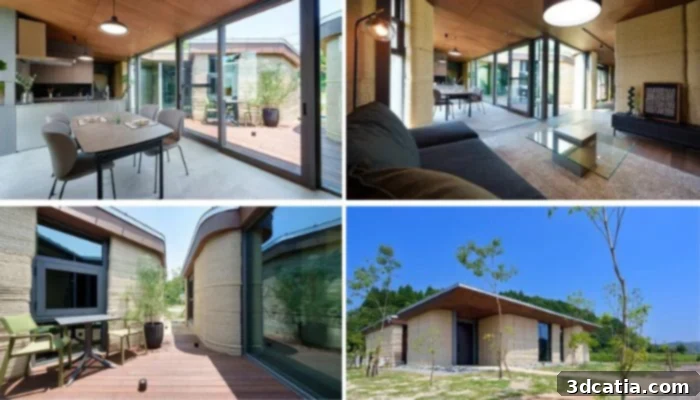
The modern house was built on an area of approximately 100 square meters, showcasing efficient use of space.
An In-Depth Look at Lib Work’s Innovative 3D Printed Homes
Affordability is a key driver behind Lib Work’s initiative. The projected cost of one of these advanced 3D-printed homes is remarkably set around 20 million yen (approximately €116,000 / $135,150). To put this into perspective, a study by Tokyo Kantei indicates that the average price for a modest 70-square-meter apartment in the heart of Tokyo escalates to a staggering 100.9 million yen (about €585,000 / $681,327). While Tokyo represents an extreme outlier in property values, the targeted entry price for these innovative 3D-printed homes is still exceptionally attractive, especially for aspiring homeowners and residents in urban areas across Japan. Even when compared to the national average cost of a single-family home in Japan, which typically ranges between 30 and 50 million yen, Lib Work positions itself as a significantly more affordable and accessible alternative to many traditional construction companies. This cost-effectiveness is largely attributed to the efficiencies of 3D printing, including reduced material waste, optimized construction processes, and a decreased reliance on expensive skilled labor.
Beyond their affordability and structural resilience, these 3D-printed homes by Lib Work are designed with a strong emphasis on environmental sustainability. The house offers an impressive 50 percent reduction in CO2 emissions when compared to conventional concrete structures of the same 100-square-meter size. Furthermore, in specific lifecycle scenarios, the sustainable clay-based material even outperforms traditional wood construction in terms of its overall ecological footprint. The innovative design also integrates advanced smart home technology: sensors are cleverly embedded within the walls to continuously monitor crucial environmental factors such as temperature and humidity. This intelligent monitoring system can detect early signs of condensation and material wear, enabling proactive maintenance and ensuring the long-term integrity and comfort of the home. Additionally, the entire residence is meticulously designed to support a truly sustainable lifestyle through an integrated off-grid power system. This is achieved by combining efficient solar energy generation with Tesla’s cutting-edge “Powerwall” storage battery, providing residents with energy independence, lower utility bills, and crucial resilience during potential power outages, which are particularly valuable in a disaster-prone region. The interior layout is thoughtfully planned for modern living, featuring a combined living, dining, and kitchen area, a separate toilet and bathroom, and a flexible living room. A central courtyard serves as the architectural heart of the home, strategically designed to naturally harness abundant light and optimize wind flow, thereby ensuring excellent ventilation and enhancing overall comfort for its inhabitants. This blend of traditional Japanese design principles with modern sustainable technology creates a harmonious and efficient living space.
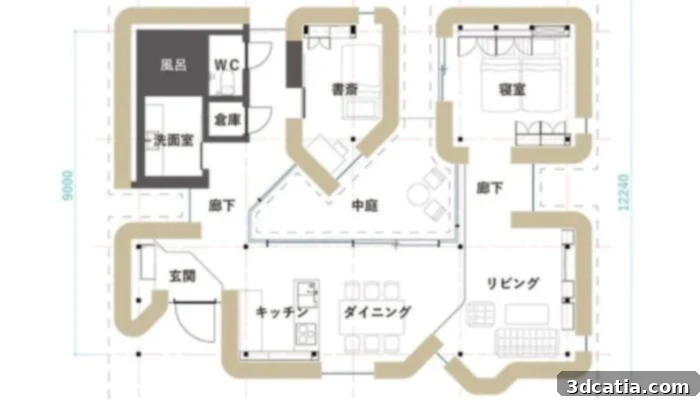
The open design allows for plenty of natural light and incorporates traditional Japanese design elements. (For reference, from bottom right to left: リビング (living room), ダイニング (dining room), キッチン (kitchen), 玄関 (entrance), 中庭 (courtyard), 寝室 (bedroom), 書斎 (study); the bathroom is at the top left.)
Looking ahead, Lib Work has ambitious plans to expand its innovative housing solutions into international markets, showcasing Japan’s pioneering spirit in construction technology to a global audience. Domestically, interested buyers in Japan will have the exciting opportunity to place pre-orders for these revolutionary homes starting as early as August. The success and continued development of Lib Work’s project will undoubtedly be a pivotal moment for the construction industry, not just in Japan but worldwide. This initiative represents a significant step towards a future where housing is more affordable, sustainable, and resilient against natural disasters. We are eagerly anticipating how Lib Work’s vision for mass-produced 3D-printed homes will evolve and impact the global housing landscape.
What are your thoughts on the mass production of 3D-printed houses in Japan and their potential to address critical challenges like earthquake resilience and labor shortages? We encourage you to share your insights and opinions in a comment below or connect with us on our LinkedIn or Facebook pages! Furthermore, don’t miss out on the latest advancements and news in the additive manufacturing sector; be sure to sign up for our free weekly Newsletter to get essential 3D printing news delivered directly to your inbox. You can also explore all our informative videos and engaging content on our dedicated YouTube channel.
*Photo Credits: Lib Work