
Unlocking Innovation: A Deep Dive into Metal 3D Printing and Advanced Additive Manufacturing Technologies
Welcome to this week’s essential compilation of top videos showcasing groundbreaking advancements in the 3D printing industry. Our focus today is squarely on the transformative world of metal 3D printing, exploring its cutting-edge innovations, practical applications, and the strategic considerations for businesses adopting these technologies. From revolutionary support-free metal production solutions to robust composite material printing and the intricate science behind multi-material fabrication, we cover a spectrum of topics designed to inform and inspire. We’ll start with an in-depth look at Velo3D’s game-changing Sapphire system, which promises unprecedented design freedom in metal additive manufacturing. Following that, we bring you an exclusive unboxing and hands-on test of MakerBot’s professional-grade Method X CFE 3D printer, conducted by the experts at the 3Dnatives Lab. Beyond hardware, we’ll delve into critical business aspects, including how to meticulously calculate the profitability of integrating additive manufacturing into your operations. Finally, prepare to be amazed by the competitive advantages offered by sophisticated technologies like those developed by Velo3D, which eliminate the need for traditional support structures. This curated selection offers invaluable insights into the present and future of advanced manufacturing.
Top 1: Revolutionizing Metal Additive Manufacturing Without Supports with Velo3D
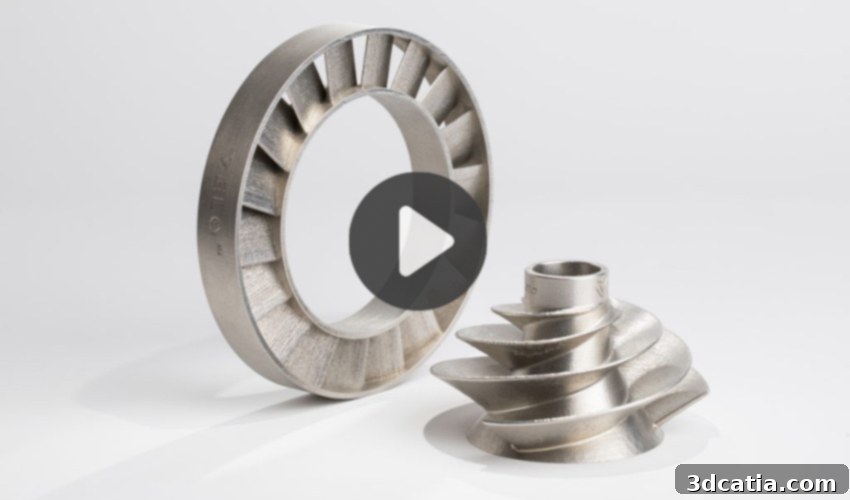
Established in 2014, Velo3D has rapidly emerged as a formidable innovator in the additive manufacturing landscape, distinguishing itself through its truly innovative and disruptive technology. This featured video provides an exclusive opportunity to hear directly from the company’s visionary founder and CEO, Benny Buller. He will guide us through the intricacies of Velo3D’s flagship Sapphire production solution and its accompanying Flow print preparation software. The core innovation lies in its unparalleled ability to create complex metal 3D parts entirely without the necessity for internal support structures. This significant breakthrough liberates designers from previous constraints, enabling limitless design innovation by drastically reducing, and often eliminating, the need for cumbersome and costly support structures commonly associated with metal additive manufacturing processes. Such an advancement not only streamlines the post-processing workflow but also opens up new possibilities for internal geometries, intricate channels, and lightweight designs that were previously impossible or economically unfeasible. By eliminating supports, Velo3D’s technology facilitates the production of parts with smoother internal surfaces, improved functional performance, and a reduced total cost of ownership, making it particularly attractive for demanding industries such as aerospace, energy, and defense. Discover all the technical details and competitive advantages below.
The impact of support-free printing extends beyond mere convenience; it fundamentally alters the economics and design paradigms of metal additive manufacturing. Traditional metal 3D printing often requires extensive post-processing to remove support structures, which is a time-consuming, labor-intensive, and often destructive process that can add significantly to part cost and lead time. Velo3D’s approach, powered by advanced algorithms and precise thermal control, ensures that even complex overhangs and internal channels can be printed with high fidelity and surface quality without needing supports. This capability is critical for applications like high-performance turbomachinery, heat exchangers, and intricate fluidic systems where internal cleanliness and precise geometry are paramount. Furthermore, the ability to print parts with minimal post-processing reduces material waste and allows for a more efficient production cycle, contributing to lower operational costs and faster time-to-market for complex, high-value components. The Sapphire system, combined with Flow software, creates a comprehensive ecosystem that empowers engineers to realize designs that were previously confined to theoretical models, pushing the boundaries of what is achievable with metal additive manufacturing.
Top 2: The Ultimate Test: Unboxing and Performance Review of the MakerBot Method X CFE
MakerBot, a well-known name in the desktop 3D printing market, has significantly elevated its game with its professional Method series. With this line of Method 3D printers, the manufacturer has comprehensively reimagined and redesigned its entire range of professional FDM (Fused Deposition Modeling) technology products. The Method X CFE stands out as a prime example of this industrial-grade evolution. Key differentiating features of the Method series include a meticulously engineered closed and actively heated chamber, which is crucial for printing with advanced engineering materials by ensuring consistent thermal conditions and preventing warping. It also boasts a generous maximum print volume of 190 x 190 x 196 mm, offering ample space for a variety of functional prototypes and end-use parts. The 3Dnatives Lab, renowned for its rigorous testing protocols, had the exclusive opportunity to conduct an in-depth unboxing and comprehensive performance test of the Method X CFE. Their detailed evaluation aimed to highlight the most important features and assess the real-world capabilities of this sophisticated additive manufacturing solution. The review process likely covered aspects such as print quality, reliability, ease of use, material compatibility, and overall value proposition for professional users. Don’t miss their final assessment and grade for this impressive machine in the video provided!
The Method X CFE is specifically designed to print with high-performance composites, including carbon fiber reinforced nylon, which offers an exceptional strength-to-weight ratio and stiffness. This capability makes it an ideal tool for engineers and manufacturers looking to produce strong, lightweight, and durable parts for demanding applications in industries like automotive, aerospace, and robotics. The preheated chamber is particularly critical for these materials, as it helps to manage internal stresses during printing, leading to higher dimensional accuracy and improved mechanical properties. Furthermore, MakerBot’s ecosystem, including its proprietary materials and software, is optimized to work seamlessly with the Method X CFE, ensuring reliable and consistent results. The 3Dnatives Lab’s detailed evaluation provides potential users with an honest and unbiased assessment of the printer’s performance, shedding light on its ability to deliver on its promises of industrial-grade reliability and precision. Understanding these features and their implications for design and production is crucial for businesses considering an investment in advanced FDM technology to create functional prototypes, manufacturing tools, and even low-volume production parts.
Top 3: Achieving Hassle-Free Metal 3D Printing with Markforged’s Innovative Technology
When considering metal 3D printing, one of the first and most widely recognized technologies that often comes to mind is Powder Bed Fusion (PBF). While PBF offers high precision and intricate detail, it also presents several significant challenges. These include the substantial cost of PBF systems and materials, considerable health and safety concerns associated with handling fine metal powders, and often lengthy and complex recalibration times, which can disrupt production schedules. In this insightful video, Daniel Stokes from Markforged introduces an alternative, more accessible, and “hassle-free” approach to metal additive manufacturing. He demonstrates Markforged’s innovative metal filament technology, which utilizes a process similar to Metal Injection Molding (MIM), effectively addressing many of the concerns associated with traditional powder-based systems. This technology, known as Atomic Diffusion Additive Manufacturing (ADAM), streamlines the metal 3D printing workflow, making it safer, simpler, and more cost-effective for a wider range of industrial applications. Markforged’s approach encapsulates metal powder in a plastic binder, forming a safe-to-handle filament that is then printed layer by layer, followed by a debinding and sintering process to create fully dense metal parts. This methodology significantly reduces the barriers to entry for companies looking to leverage the benefits of metal 3D printing without the complexities of traditional PBF.
Markforged’s Metal X system, powered by ADAM technology, differentiates itself by focusing on ease of use and affordability, bringing metal 3D printing closer to a wider user base. The metal filament (often referred to as ‘bound powder’) significantly mitigates the safety risks associated with loose metal powders, as the powder is encapsulated, preventing inhalation hazards and simplifying handling. Furthermore, the post-processing steps, while still necessary (debinding and sintering), are designed to be more automated and less reliant on highly specialized personnel compared to PBF. This process allows for the creation of robust, high-density metal parts in a variety of materials, including 17-4 PH Stainless Steel, H13 Tool Steel, Copper, and Inconel, catering to diverse industrial needs from functional prototyping to tooling and end-use components. The video highlights how this technology enables businesses to produce complex metal parts on demand, reducing lead times and supply chain dependencies, while also providing a pathway to iterate designs rapidly and cost-effectively. Daniel Stokes’ demonstration provides a clear illustration of how Markforged has engineered a solution that bridges the gap between traditional manufacturing methods and advanced additive processes, offering a compelling alternative for those seeking reliable and accessible metal 3D printing.
Top 4: Pioneering Ceramic-Metallic Multi-materials with Selective Laser Sintering
The creation of advanced multi-material components, particularly those combining dissimilar materials like ceramics and metals, has long posed significant challenges for traditional manufacturing methods. These methods often struggle with issues such as material incompatibility, differing thermal expansion rates, and the inability to form complex geometries with integrated functionalities. In this fascinating video, Eren Ozemen, a Ph.D. student in Materials Science Engineering, sheds light on how Selective Laser Sintering (SLS) technology is being innovatively employed to overcome these hurdles. He meticulously explains the process of using SLS to create sophisticated ceramic-metallic multi-materials that would be virtually impossible to produce through conventional means. The video offers a detailed review of how SLS enables the formation of complex shapes and intricate internal structures while simultaneously integrating ceramic materials, which are notoriously difficult to process due to their brittleness and sensitivity to the high-heat exposure inherent in laser sintering. This groundbreaking research demonstrates SLS’s potential to unlock new material combinations and functional capabilities, pushing the boundaries of what advanced manufacturing can achieve.
Selective Laser Sintering works by using a high-powered laser to selectively fuse powdered material layer by layer, based on a 3D digital model. Unlike some other additive processes, SLS typically does not require support structures, as the unsintered powder acts as its own support, allowing for greater design freedom for complex internal geometries. When it comes to multi-materials, especially combining ceramics and metals, the challenge intensifies due to their vastly different melting points, thermal conductivities, and chemical reactivities. Eren Ozemen’s research likely explores novel powder compositions, laser parameters, and strategic layering techniques to manage these disparities effectively. The ability to integrate ceramic properties—such as high hardness, extreme temperature resistance, and electrical insulation—with the ductility and strength of metals opens up a plethora of applications. These include high-performance components for aerospace engines, wear-resistant tooling, advanced medical implants, and components for harsh industrial environments where a combination of extreme properties is required. This video underscores the pivotal role of materials science research in advancing additive manufacturing, showcasing how academic innovation directly translates into practical solutions for producing next-generation materials and components.
Top 5: Ensuring Consistent and Reliable Metal 3D Printing with Layer Metrics’ Optical Inspection Systems
The reliability and consistency of parts produced through metal 3D printing are paramount, especially for critical applications in aerospace, medical, and automotive industries. However, the inherent complexity and numerous variables within the additive manufacturing process can lead to significant challenges, often referred to as the “volatility” of metal 3D printing. This volatility can manifest as defects, inconsistencies in material properties, and ultimately, part failure, leading to costly waste and production delays. This is where Layer Metrics, a New York-based additive manufacturing company, steps in with its innovative solutions. Layer Metrics specializes in the development and manufacture of advanced optical inspection systems specifically designed for metal 3D printers. In this video, CTO Dominic Murphy and CEO Clare Murphy eloquently explain how their pioneering technology works to control and mitigate this inherent volatility. They walk viewers through their sophisticated process of in-situ monitoring and real-time data analysis, which is critical for ensuring the consistent quality and reliability of every printed metal part. Their systems are designed to provide manufacturers with unprecedented insight into the printing process, allowing for immediate detection and potential correction of anomalies, thereby drastically improving yield rates and overall part performance.
Layer Metrics’ optical inspection systems typically employ high-resolution cameras and advanced algorithms to continuously scan each layer as it is being deposited and consolidated. This real-time monitoring allows for the detection of subtle defects such as porosity, spatter, insufficient fusion, or inconsistencies in powder bed leveling, which might otherwise go unnoticed until post-production quality checks, at which point the part might already be scrap. By providing instant feedback, their technology empowers operators to make informed decisions during the print, or it can be integrated into automated systems for closed-loop control. This proactive approach to quality control is a game-changer for metal additive manufacturing, transforming it from a process that often requires extensive trial and error into a more predictable and robust industrial technology. Dominic and Clare Murphy highlight how their systems not only improve the reliability of printed parts but also contribute to significant cost savings by reducing material waste, shortening development cycles, and minimizing the need for destructive testing. For industries where material integrity and performance are non-negotiable, Layer Metrics offers a crucial layer of assurance, helping to push metal 3D printing towards widespread adoption for high-stakes applications.
What are your thoughts on this week’s compelling selection of 3D printing videos and the incredible innovations showcased? We believe these insights offer a comprehensive look into the future of metal additive manufacturing and its profound impact across various industries. Share your comments, opinions, and predictions for the future of this dynamic field below, or engage with us on our vibrant Facebook and Twitter pages. Your feedback is invaluable as we continue to explore the cutting edge of 3D technologies. Furthermore, don’t miss out on staying abreast of the latest developments and breakthroughs: make sure to sign up for our complimentary weekly newsletter. It’s delivered directly to your inbox, packed with all the crucial news, analyses, and exclusive content from the ever-evolving world of 3D printing. Stay informed, stay ahead!