
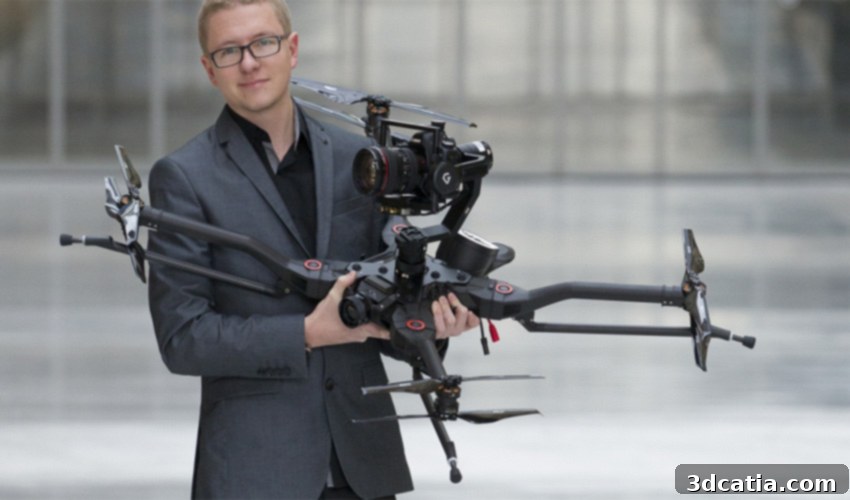
Hexadrone’s Tundra: The Award-Winning 3D Printed Industrial Drone Revolutionizing Robotics
The landscape of industrial technology is constantly evolving, driven by innovation and the relentless pursuit of efficiency. In this dynamic environment, a groundbreaking achievement has captured international attention: Hexadrone’s Tundra® 3D printed drone, specifically designed for robust industrial applications, has been honored with the prestigious German Red Dot Award. This recognition not only celebrates exceptional design but also signifies a pivotal moment for additive manufacturing in the realm of advanced robotics.
The Red Dot Award, a beacon of design excellence since its inception in 1955, stands as one of the world’s largest and most respected design competitions. It offers an unparalleled platform for individuals and businesses globally to showcase their ingenuity. Annually, this diverse competition attracts submissions from over 50 countries, spanning an incredible array of product categories. A panel of 39 distinguished jury members rigorously evaluates the design quality of each entry across 48 distinct participation categories, including specialized groups like drones. Earning a Red Dot Award is a clear testament to a product’s superior design, functionality, and innovation.
This year, the competition for the Red Dot Award: Product Design was particularly fierce, with over 6,300 innovative items vying for evaluation. The discerning jury ultimately bestowed the coveted award upon only a select few – just over 26% of entries, totaling 1,684 products, received this esteemed honor and the invaluable exposure it brings. Among these elite recipients was the remarkable Tundra® drone by Hexadrone, solidifying its position as a frontrunner in industrial drone technology.
The Tundra® Drone: A Paradigm Shift in Industrial Applications
While the concept of 3D printing in aeronautics has been explored before, with examples such as the USA Army’s Perdix Drones demonstrating the potential of additive manufacturing for aerial vehicles, the Tundra® industrial drone introduces a distinctly new and compelling proposition to the market. Developed through a collaborative effort between Hexadrone – a company renowned for its expertise in drone training, bespoke design, and online sales – and Raphaël Chèze, the visionary industrial designer from the DÖT agency, the Tundra stands out as the first of its kind.
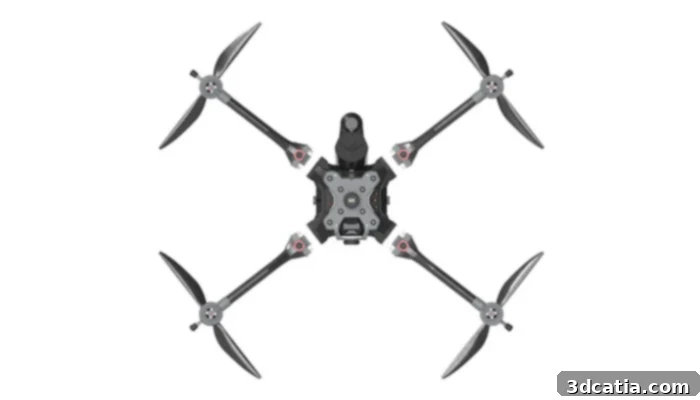
What truly sets the Tundra® drone apart is its pioneering combination of features: it is a fully modular, remarkably easy-to-use, and entirely 3D printed drone, meticulously engineered for diverse industrial use and multi-purpose tasks. This modularity is a game-changer for industrial operators. It enables quick and effortless swapping of payloads, sensors, and components, allowing the drone to adapt seamlessly to a wide range of missions – from inspection and mapping to surveying and data collection. This adaptability translates directly into increased operational flexibility and reduced downtime for businesses.
The emphasis on being “easy to use” further enhances its appeal for industrial integration. In demanding work environments, simplicity of operation means less intensive training for personnel and faster deployment on critical tasks. The intuitive design ensures that operators can focus on the mission at hand rather than wrestling with complex controls. This blend of modularity and user-friendliness, combined with the inherent advantages of 3D printing, positions the Tundra® drone as a transformative tool for various sectors including construction, agriculture, energy, and infrastructure maintenance.
Advanced Manufacturing: The Role of 3D Printing in Tundra’s Success
The successful development and subsequent Red Dot Award for the Tundra® drone underscore the immense potential of additive manufacturing, particularly for complex and high-performance industrial equipment. During the rigorous Red Dot Award evaluation process, the drone underwent a series of static tests and assessments to scrutinize its design quality, functionality, and robustness. It was here that the Tundra® prototype truly shone, a testament to the advanced manufacturing techniques employed.
The prototype for the Tundra® drone was produced by CRP Technology, a leader in professional 3D printing services, utilizing state-of-the-art Laser Sintering (SLS) technology. This sophisticated additive manufacturing process allows for the creation of incredibly intricate and lightweight structures with exceptional mechanical properties. The choice of materials was equally critical: the Tundra® drone was fabricated using CRP Technology’s high-performance Windform SP and Windform XT 2.0 Carbon-composite materials. These cutting-edge composite materials are renowned for their outstanding characteristics:
- **Windform SP:** Known for its excellent resistance to impact, vibration, and extreme temperatures, making it ideal for the harsh conditions often encountered in industrial operations. Its mechanical strength and stiffness are superior, ensuring structural integrity even under stress.
- **Windform XT 2.0:** A carbon fiber reinforced composite material that offers remarkable stiffness-to-weight ratio, high strength, and resistance to high temperatures. This material is crucial for creating lightweight yet incredibly durable components, which is paramount for drone performance, payload capacity, and flight efficiency.
The combination of Laser Sintering technology and these advanced Windform materials allowed Hexadrone and CRP Technology to push the boundaries of drone design and manufacturing. It enabled the creation of a drone structure that is both light enough for extended flight times and robust enough to withstand the rigors of industrial use. This innovative manufacturing approach facilitated rapid prototyping and iteration, accelerating the development cycle and ensuring that the final product met stringent performance and durability requirements, ultimately holding up to the challenge posed by the Red Dot Award jury.
The Impact of the Red Dot Award and Future Vision
Winning the Red Dot Award is far more than just an accolade; it is a powerful validation of the intensive hard work, relentless dedication, and significant innovation poured into the Tundra® project over several years. This recognition rewards not only the brilliant design and engineering but also the strategic efforts involved in bringing such a complex and ambitious project to industrial scale. The company had previously initiated fundraising efforts to secure the financial resources necessary to industrialize the 3D printed drone on a large scale. Their future plans included the creation of a dedicated manufacturing plant and the generation of thirty new jobs by 2020, showcasing a profound commitment to growth and economic contribution.
The international exposure and unparalleled recognition garnered from winning the Red Dot Award will undoubtedly serve as a tremendous catalyst, strongly backing the future plans of Hexadrone. This prestigious award enhances the company’s credibility, attracts potential investors and partners, and solidifies customer trust in the Tundra® drone’s quality and innovation. It sends a clear message to the industrial drone market that Hexadrone is a leader, poised to deliver cutting-edge solutions that genuinely transform operational capabilities.
Moreover, the Tundra® drone’s success highlights the transformative power of additive manufacturing in specialized fields like industrial robotics. It demonstrates that 3D printing is no longer just for prototyping but is a viable and superior method for producing end-use parts, especially for products that require customizability, lightweighting, and high performance. The modular, 3D printed design of the Tundra® is set to redefine expectations for industrial drones, making advanced aerial technology more accessible, adaptable, and efficient for businesses across the globe.
What are your thoughts on the groundbreaking Tundra® Industrial Drone and its Red Dot Award win? We’d love to hear your perspective! Let us know in a comment below or connect with us on our Facebook and Twitter pages. And don’t forget to sign up for our free weekly Newsletter to get all the latest news in 3D printing sent straight to your inbox!