
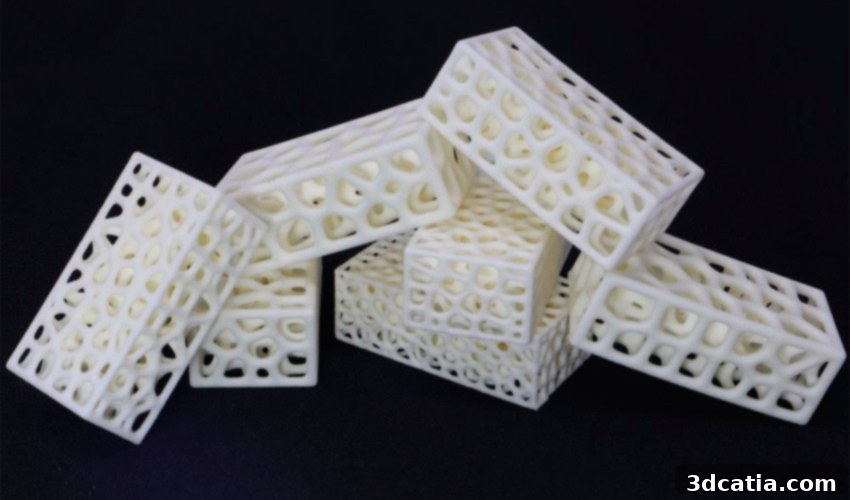
Inkbit’s Visionary Approach: Bringing AI and Machine Learning to Multi-Material 3D Printing
Emerging from the renowned innovation hub of MIT, Inkbit is pioneering a transformative approach to additive manufacturing. This forward-thinking startup is actively overcoming the inherent constraints of traditional 3D printing by uniquely endowing its machines with advanced “eyes” and a “brain.” The industrial-grade 3D printer developed by Inkbit represents a significant leap forward, offering multi-material capabilities that enable the precise printing of exceptionally flexible and high-performance materials. At its core, Inkbit leverages the power of machine learning and artificial intelligence to tackle some of the most persistent challenges in additive manufacturing, particularly when working with demanding substances such as rubber-like silicones or high-temperature epoxies. The system’s innovative design incorporates real-time scanning of each printed layer, allowing for immediate error correction and, crucially, utilizing this collected data to intelligently predict the warping behavior of various materials. To delve deeper into this groundbreaking technology and the company’s ambitious endeavors, we recently engaged in a conversation with Davide Marini, co-founder and CEO of Inkbit.
The Genesis of Inkbit: An Entrepreneur’s Journey into AI-Powered Additive Manufacturing
Davide Marini, co-founder and CEO of Inkbit, shares his unique journey that led to the creation of this revolutionary startup. Originally from Italy, Davide pursued his PhD in mechanical engineering in the United States. His entrepreneurial spirit blossomed after several years as a dedicated scientist at Children’s Hospital Boston. This experience paved the way for co-founding Firefly BioWorks, a successful venture in the life sciences sector. Intriguingly, Firefly’s core technology involved projecting UV light through a mask to polymerize monomers within a microfluidic channel, thereby creating individually encoded and bio-functional microparticles. Davide reflects on this period, noting, “It was essentially micro-scale 3D printing, even though at the time I didn’t think of it in this way.” This early exposure to precise, layer-by-layer fabrication laid foundational insights for his future endeavors.

Davide Marini, co-founder and CEO of Inkbit
Following the acquisition of Firefly, Davide embarked on a new quest, exploring an array of exciting technologies emerging from various academic laboratories, seeking his next innovative adventure. It was at an event hosted by the MIT Deshpande Center for Technological Innovation that he encountered the inventors behind Inkbit’s nascent technology. They were showcasing a compelling prototype printer, an innovation born from the fertile grounds of the MIT Computer Science and Artificial Intelligence Lab (CSAIL) and spearheaded by Professor Wojciech Matusik, a recognized pioneer in the burgeoning field of computational fabrication. Despite his limited prior knowledge of 3D printing, Davide was immediately captivated by the sheer elegance of the underlying concept, eloquently described by Javier Ramos. The notion that a 3D printer could autonomously react and self-correct in real-time during the printing process resonated deeply with him. A serendipitous connection was forged when Javier recognized a quote from a sixteenth-century nun on Davide’s business card, a moment Davide interpreted as a clear sign he was pursuing the right path.
Over the ensuing months, Davide collaborated closely with the inventors, gaining a profound appreciation for the immense potential inherent in their seemingly simple yet revolutionary idea. Recognizing his vision and entrepreneurial acumen, the inventors extended an invitation to Davide to lead the commercialization efforts for their advanced technology. Operations officially commenced in the summer of 2017, and the company was aptly named Inkbit, a moniker carefully chosen to underscore its foundational vision of seamlessly combining physical inks with digital bits – a true fusion of material science and intelligent digital processing for additive manufacturing. This name perfectly encapsulates their mission to bridge the gap between material properties and digital control.
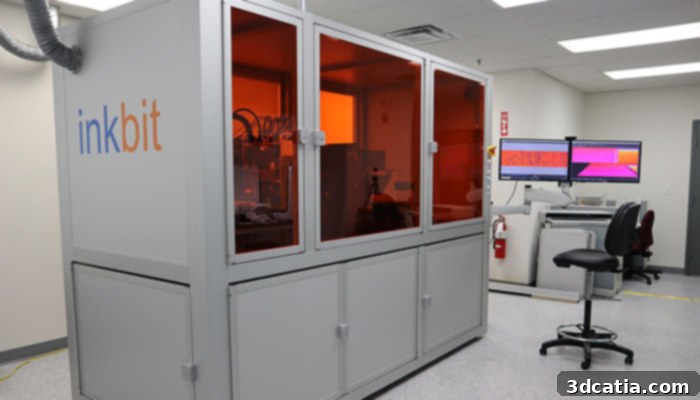
The Inkbit 3D printer
In today’s engineering landscape, multi-material inkjet 3D printers are routinely employed for rapid prototyping. However, a significant limitation prevents their widespread adoption for manufacturing final, functional parts: the restricted range of compatible materials. Many advanced materials, such as highly flexible rubber-like silicones and robust, high-temperature epoxies, present considerable challenges for conventional 3D printing. Issues like uneven material distribution, unpredictable shrinkage, part warping, and common printer failures such as nozzle clogging frequently compromise print quality and reliability. Inkbit directly addresses these critical impediments by equipping its 3D printers with sophisticated “eyes” and intelligent “brains.” This innovative integration allows Inkbit’s machines to not only print but also to dynamically learn the unique properties of specific materials and, crucially, to accurately predict their behavior during the additive manufacturing process. This proactive capability marks a significant milestone: Inkbit’s machine is the first that can learn the properties of a specific material and predict its behavior, paving the way for truly industrial-scale production of complex, multi-material components.
Unveiling Inkbit’s Groundbreaking Technology: AI-Driven Precision in Additive Manufacturing
Inkbit’s additive manufacturing system stands alone as the first to harness the combined power of machine vision and artificial intelligence (AI) to deliver a multi-material jetting platform. This innovative fusion achieves the unprecedented speed, precision, and material versatility demanded by the most rigorous industrial applications. A cornerstone of Inkbit’s process is the revolutionary elimination of mechanical flattening for each printed layer, a technique commonly employed in contemporary inkjet printers. This traditional mechanical flattening method, while widespread, introduces several significant drawbacks: it severely restricts the types of materials that can be successfully printed, detrimentally impacts both process accuracy and precision, and leads to an unfortunate waste of approximately 30% of all printed material due to the need for overfilling and subsequent removal.
In stark contrast to conventional methods, Inkbit’s machine employs a sophisticated 3D scanning system that generates a highly detailed topographical map of each layer immediately after material deposition. This advanced per-layer scanning capability allows the system to detect any discrepancy from the intended geometry with remarkable speed and accuracy. Crucially, any identified inconsistencies are not merely observed but are actively corrected by intelligently remapping the subsequent layers, ensuring geometric fidelity throughout the build process. Beyond real-time correction, these invaluable topographical data points are meticulously collected and used to train a powerful machine learning algorithm. This algorithm empowers the printer to continuously learn the unique properties of each material and accurately anticipate its behavior, including factors like shrinkage and warping, during the printing cycle. This predictive intelligence ensures that parts are built quickly, accurately, and reliably, every single time. Furthermore, the comprehensive per-layer scanning enables Inkbit to generate a complete 3D reconstruction of each part as it is printed, providing an exhaustive digital record of every single print. This unparalleled level of data acquisition facilitates 100% quality control on every produced part, guaranteeing consistent performance and adherence to specifications.
Inkbit’s strategic choice of material jetting for its platform was driven by several compelling advantages: its inherent multi-material capability, scalability, modularity, and its proven track record at an industrial scale across diverse sectors such as graphics, ceramics, and textiles. The adaptive, contactless printing approach developed by Inkbit further expands the horizon of possibilities by enabling the use of novel materials specifically engineered to meet the most stringent performance requirements. For instance, Inkbit possesses the unique ability to develop and process materials tailored to a wide spectrum of customer needs, ranging from ultra-flexible elastomers capable of stretching over 800% to exceptionally strong resins designed to withstand temperatures up to 170°C. This unparalleled material versatility, combined with the precision of its AI-driven system, allows Inkbit’s multi-material 3D printer to reliably manufacture accurate, high-precision final parts at volume, effectively transitioning additive manufacturing from a prototyping tool to a robust production method.
Integrating Inkbit’s Innovation: More Than Just Plug-and-Play
A significant portion of Inkbit’s research and development efforts has been dedicated to perfecting a state-of-the-art, proprietary optical coherence tomography (OCT) scanner. This sophisticated OCT system functions as the primary vision system for Inkbit’s technology. Utilizing light with a long wavelength, the scanner possesses the remarkable ability to “see” through the surface of materials, meticulously scanning each layer of a part at a voxel level. This provides an unprecedented level of detail and is coupled with real-time, closed-loop feedback control. Essentially, this advanced OCT system serves as the “eyes” of Inkbit’s printer, enabling precise corrections in real-time. More profoundly, it forms the foundational layer for building an additional, crucial component: the artificial intelligence, or “the brains,” of the printer. This AI layer empowers the machine to anticipate and compensate for the complex and often challenging behavior of advanced materials, significantly enhancing print reliability and quality.
While Inkbit’s system is highly specialized, in principle, it possesses the architectural flexibility to be ported onto other 3D printing architectures. Indeed, the company has already garnered substantial interest from leading metal 3D printing manufacturers who are keen on integrating Inkbit’s sophisticated vision and AI system into their existing machines. This interest underscores the broad applicability and transformative potential of Inkbit’s core technology across different additive manufacturing modalities. However, it is crucial to understand that integrating Inkbit’s system into another printer is far from a simple plug-and-play operation. Such an integration requires not only deep access to the target machine’s internal controls but also a significant and often extensive rewriting of its entire software stack. This complex undertaking ensures that the advanced capabilities of Inkbit’s vision and AI can be seamlessly and effectively harmonized with the host printer’s operations, unlocking new levels of precision and material handling for a wider range of additive processes.
Driving Innovation: Key Clients and Industry Focus
Inkbit has strategically initiated collaborations with prominent global customers, including industry giants like Johnson & Johnson, through its exclusive early access program. These partnerships are instrumental in the development of an initial suite of high-impact applications, particularly within the demanding medical field. Given CEO Davide Marini’s extensive background and passion, Inkbit maintains a very strong interest in advancing life sciences applications, where precision and material versatility are paramount. Beyond healthcare, the company is actively exploring and targeting opportunities within the robotics sector, where custom, high-performance parts are essential for complex mechanisms, and in prosthetics, where tailored, comfortable, and functional solutions can significantly improve quality of life. The diverse needs of these industries perfectly align with Inkbit’s multi-material, high-precision, and adaptable printing capabilities, allowing them to solve complex manufacturing challenges across various high-value sectors.
The Pivotal Role of AI and Machine Learning in Additive Manufacturing
The integration of machine vision has long been a well-established and indispensable component in conventional manufacturing processes, enabling automation and quality control at scale. Davide Marini firmly believes that machine vision is poised to become an equally essential and transformative aspect of additive manufacturing. Furthermore, he expresses particular enthusiasm for the application of artificial intelligence (AI) within manufacturing, especially considering the intricate complexities involved in processes like multi-material 3D printing. These advanced processes can quickly become computationally intractable for traditional simulation methods, making AI an invaluable tool for optimization and prediction. When combined, machine vision and AI form a powerful synergy that will not only enhance the capabilities of 3D printing but also fundamentally shift its perception and utility. This powerful duo is expected to drive the widespread adoption of 3D printing for true production purposes, moving it beyond its current predominant role as a mere prototyping tool and unleashing its full potential as a robust and reliable manufacturing technology.
The Future of Inkbit: Unveiling New Horizons in 3D Printing
Looking ahead, Inkbit is poised for significant developments. The company anticipates sharing some exciting news in the very near future, promising further advancements and innovations in the field of additive manufacturing. Keep a close watch on Inkbit as they continue to push the boundaries of what’s possible in 3D printing. For more background information and recent updates, you can find additional details HERE.
What are your thoughts on Inkbit’s innovative approach to 3D printing? We invite you to share your perspectives in a comment below or join the conversation on our Facebook and Twitter pages! Don’t miss out on the latest advancements and news in the world of 3D printing—sign up for our free weekly Newsletter, delivered directly to your inbox!