
Hyperganic’s AI-Designed 3D Printed Rocket Engine: Revolutionizing Aerospace Manufacturing
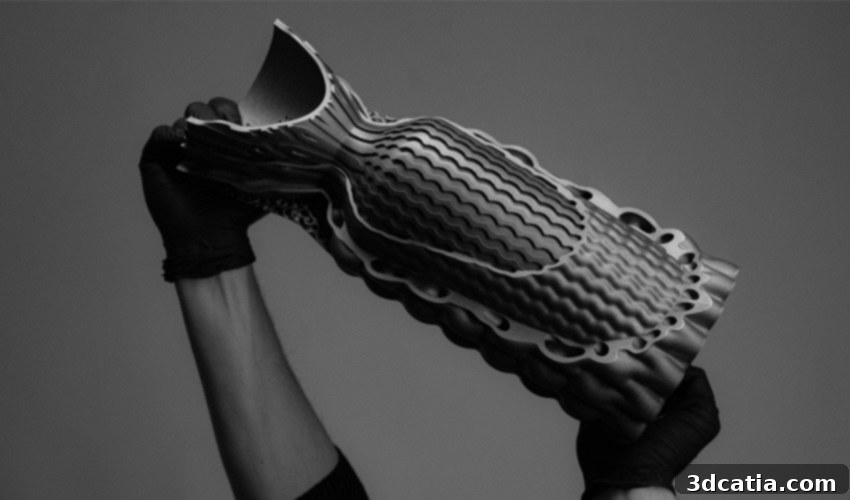
The landscape of aerospace engineering is rapidly evolving, driven by groundbreaking advancements in artificial intelligence and additive manufacturing. At the forefront of this transformation is the German company Hyperganic, an innovative firm that has garnered significant attention for its pioneering work. Last year, Hyperganic unveiled a remarkable achievement: a 3D printed rocket engine prototype, conceived and designed entirely by sophisticated artificial intelligence algorithms. This isn’t just an incremental improvement; it represents a paradigm shift in how complex, high-performance components are engineered and produced. The entire rocket engine, from its intricate combustion chamber to its elaborate surface cooling channels, was designed as a single, monolithic block. This novel approach fundamentally departs from traditional engineering methods, where a CAD file serves as the blueprint. Instead, Hyperganic’s process involves modeling information written in a proprietary language, accessible and interpretable only by its advanced algorithms. This “digital DNA” then guides the creation of the final part, meticulously built layer by layer through additive manufacturing.
The synergistic combination of additive manufacturing and artificial intelligence heralds a new era for industrial production, promising a cascade of benefits for the 3D printing industry and beyond. An AI-driven 3D printing system can dramatically reduce the incidence of design and manufacturing errors, streamline production processes through automation, and unlock unprecedented levels of design complexity and material efficiency. For Hyperganic, artificial intelligence is not merely an optimization tool; it is the core engine for generating object designs as single, integrated entities. Duy-Anh Pham, the esteemed Head of Design at Hyperganic, eloquently explains this revolutionary methodology: “We compare the process to growing rather than designing. You’re telling the algorithm what you need the object to do and then the algorithm is kind of growing the object with the performance you had in mind, with the specifications. So the process doesn’t create a blueprint, but the DNA for an object.” This profound statement underscores a shift from prescriptive design to generative evolution, where an object’s functional requirements are the seeds from which its optimal form organically emerges.
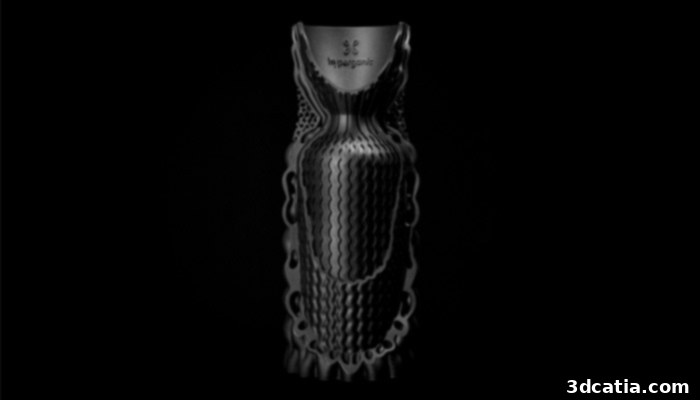
The entire 3D printed rocket engine prototype, designed by AI | Credits: Hyperganic
The Manufacturing Paradigm: A Shift Towards Integrated Design
Rethinking Rocket Engine Architecture
At the heart of Hyperganic’s ambition was a singular, audacious goal: to design and manufacture a rocket engine as a unified structure. This integrated approach sought to achieve two critical objectives simultaneously: minimize overall weight and maximize cooling efficiency. Traditionally, rocket engines are complex assemblies of numerous discrete components. The combustion chamber, nozzle, and various intricate cooling channels are often designed as separate elements and then meticulously welded or brazed together. This conventional fabrication method, while proven, carries inherent risks. Welded joints are potential points of structural weakness, susceptible to fatigue and thermal stress, which can lead to long-term performance degradation or catastrophic failures, including explosions. Furthermore, the multi-component assembly process adds considerable manufacturing complexity, cost, and time.
Hyperganic’s innovative manufacturing method fundamentally bypasses these traditional hurdles. By harnessing the power of generative AI and advanced additive manufacturing, the company is able to design and produce the entire engine as a single, homogenous component. This seamless integration eliminates the need for welds and joints, thereby enhancing the structural integrity, reducing potential failure points, and significantly increasing the final performance and reliability of the engine. The AI algorithm was provided with key design parameters, including the critical functions of the combustion chamber and the precise requirements for the cooling channels. From this foundational data, the algorithm autonomously generated an incredibly complex, yet perfectly optimized geometry that precisely met all the specified operational requirements. This is where the “growing” analogy truly comes to life; the algorithm doesn’t just assemble parts, it sculpts an organically efficient form tailored to its function.
Advanced Materials and Variable Density Printing
Following the AI-driven design phase, Hyperganic proceeded to 3D print a first metal prototype using a high-performance nickel alloy. The choice of material is crucial for rocket engines, which must withstand extreme temperatures, pressures, and corrosive environments. Nickel alloys are renowned for their excellent high-temperature strength, corrosion resistance, and creep resistance, making them ideal for such demanding applications. However, Hyperganic’s innovation extends beyond material selection to the very structure of the printed component. Duy-Anh Pham elaborates on this groundbreaking approach: “We are able to print in different material densities, a method which has not been used in rocket design so far. So the inner part is very solid, while towards the outside the structure becomes more porous to save on weight. Every extra pound counts.” This capability represents a significant leap forward in additive manufacturing and material science.
The ability to vary material density within a single print allows Hyperganic to create functionally graded materials (FGMs). This means the rocket engine isn’t uniformly solid; rather, its internal structure is engineered to optimize performance where strength and integrity are paramount (e.g., the inner combustion chamber walls), while areas requiring less structural load can be made more porous to shed unnecessary weight. This targeted density optimization is a game-changer for aerospace applications. In the fiercely competitive and cost-intensive world of rocket launches, even a seemingly small reduction in overall weight can yield substantial benefits. Lower weight translates directly to reduced fuel consumption, increased payload capacity, or enhanced mission flexibility, all of which contribute to significant cost savings and improved operational efficiency. The integration of variable density printing, guided by AI, pushes the boundaries of design for additive manufacturing (DfAM), enabling previously unattainable levels of performance and resource utilization.

Complex internal structures of the AI-designed rocket engine | Credits: Hyperganic
The Future of Aerospace: AI-Driven Design and Manufacturing
Hyperganic is not merely demonstrating a proof-of-concept; the company is actively collaborating with several prominent aerospace companies to explore how this revolutionary modeling approach can be seamlessly integrated into their existing operations and future projects. The implications of leveraging artificial intelligence in design are profound. It empowers engineers to transcend the limitations of traditional human intuition and CAD software, allowing them to imagine and create entirely new geometries and structural configurations. These AI-generated designs are inherently optimized to reduce part weight while simultaneously enhancing performance – a perpetual and often conflicting challenge in aerospace engineering. From lighter engine components to optimized structural elements for spacecraft, the potential for weight savings and performance gains across the board is immense.
The German company harbors ambitious plans to extend the applicability of its technology far beyond rocket engines. Hyperganic emphasizes that its software solution is inherently modular, offering an expansive array of algorithmic combinations. This modularity means the underlying AI framework can be adapted to design and optimize a vast spectrum of complex components for various industries, from medical implants to automotive parts, energy systems, and consumer goods. By providing a “DNA” for objects rather than fixed blueprints, Hyperganic’s technology facilitates rapid iteration, bespoke customization, and the creation of highly complex parts that are impossible or impractical to design and manufacture using conventional methods. This capability accelerates innovation cycles, reduces development costs, and opens up entirely new possibilities for product design and functionality. For those interested in delving deeper into their transformative work, more comprehensive information can be found on Hyperganic’s official website.
The confluence of 3D printing and artificial intelligence, as championed by Hyperganic, represents more than just a technological advancement; it signifies a fundamental shift in the very methodology of engineering design and manufacturing. This digital-to-physical pipeline, where AI crafts intricate, high-performance designs and additive manufacturing brings them to life, promises to unlock unprecedented levels of efficiency, innovation, and capability across industrial sectors, with aerospace leading the charge into this exciting new frontier.
What are your thoughts on Hyperganic’s groundbreaking integration of 3D printing and AI to model and produce optimized components? Do you believe this approach will fundamentally redefine the future of manufacturing and aerospace? Share your insights in a comment below or join the discussion on our Facebook and Twitter pages! Don’t miss out on the latest advancements and news in the additive manufacturing industry. Sign up for our free weekly Newsletter to get all the essential updates straight to your inbox!