
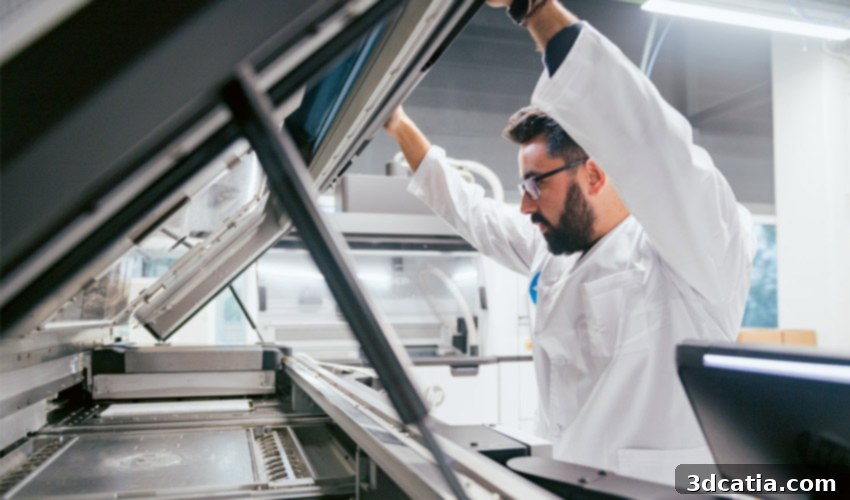
HP Elevates Industrial 3D Printing with High Reusability Polypropylene (PP) and Expands Metal Jet Applications
In a significant stride towards industrializing additive manufacturing, the U.S. additive manufacturing giant, HP, has announced a groundbreaking new material for its Multi Jet Fusion 3D printing solutions. Developed in close collaboration with leading chemical company BASF, this innovative material is a highly reusable polypropylene powder, officially named 3D High Reusability PP. Tailored specifically for HP’s Jet Fusion 5200 series machine range, this material marks a pivotal moment for the industry. It promises to deliver a versatile, durable, and chemically resistant polymer suitable for a vast array of industrial applications, fundamentally changing the landscape of what’s possible with 3D printing.
The introduction of polypropylene (PP) to HP’s material portfolio is exceptionally good news for the additive manufacturing market, primarily because PP is one of the most affordable and widely used polymers globally. Its low cost, combined with its robust performance characteristics, positions this new powder as a testament to HP’s unwavering commitment to industrializing its technology and aggressively widening its range of available materials. This strategic move not only addresses a long-standing demand for industrial-grade PP in 3D printing but also underscores the increasing maturity and capability of additive manufacturing for mass production. Furthermore, HP seized this opportunity to simultaneously announce two notable new users of its Metal Jet 3D printing technology: the U.S. Army and Cobra Golf, showcasing a dual innovation strategy across both polymer and metal additive manufacturing.
Polypropylene: A Strategic Material for Next-Generation Additive Manufacturing
Polypropylene is a semi-crystalline thermoplastic polymer that holds a highly prized position in the traditional injection molding industry due to its unique combination of properties. It is remarkably light, making it ideal for applications where weight reduction is crucial. Beyond its lightweight nature, PP exhibits excellent resistance to a broad spectrum of chemicals, making it suitable for demanding environments. It also boasts superior resistance to fatigue and impact, ensuring long-term durability in strenuous applications. Moreover, its good insulation properties further expand its utility across various sectors. Despite these highly desirable characteristics, polypropylene has historically had a limited presence in the additive manufacturing market. The primary reason for this has been the inherent difficulty in successfully printing with it.
Traditional 3D printing methods, particularly extrusion-based processes, often confront significant challenges when attempting to print PP. Users frequently encounter issues such as considerable material shrinkage during cooling, which can lead to warping and dimensional inaccuracies, and poor adhesion to the build plate, resulting in failed prints. These hurdles have largely prevented PP from transitioning effectively from conventional manufacturing to the agile world of 3D printing. Recognizing this significant gap and unmet industry need, HP strategically leveraged its expertise in materials science and advanced print technology to tackle these challenges head-on. By entering the powder market with its new 3D High Reusability PP, HP has effectively opened the door for this crucial polymer to be adopted in demanding industrial applications across critical sectors such as medical, automotive, and consumer goods, unlocking new possibilities for design and production.
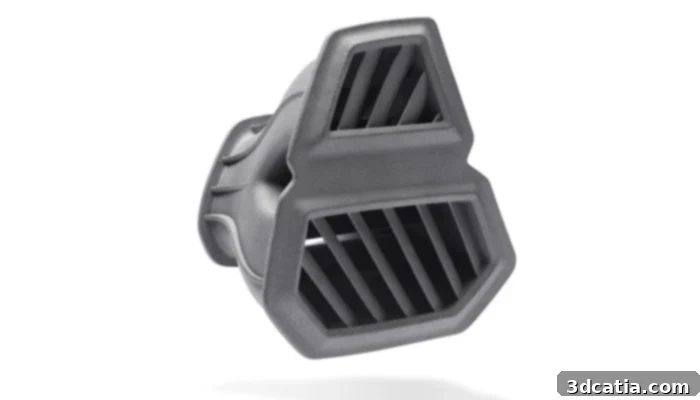
A 3D printed automotive part demonstrates the capabilities of HP’s highly reusable polypropylene | Credits: HP
Unveiling HP 3D High Reusability PP: Features, Sustainability, and Industrial Impact
A Material Engineered for Performance and Economy
The new 3D High Reusability PP material is designed to be fully compatible with the HP Jet Fusion 5200 series, a range of industrial-grade 3D printers known for their high productivity and part quality. This compatibility ensures that businesses can seamlessly integrate the new material into their existing HP workflows, achieving high throughput while significantly minimizing waste. From an economic perspective, HP highlights that 3D High Reusability PP is, on average, approximately 30% less expensive than PA12, which has been the most commonly used material in HP’s Multi Jet Fusion systems. This cost-effectiveness makes PP an even more attractive option for scaling up production and reducing per-part costs, critical factors for industrial adoption.
Beyond its economic advantages, HP’s 3D High Reusability PP boasts a comprehensive set of performance characteristics essential for demanding industrial use. It offers excellent chemical resistance, making it suitable for components exposed to various corrosive substances. The material also exhibits low moisture absorption, which is vital for maintaining dimensional stability and mechanical properties in varying environmental conditions. Furthermore, it delivers long-term durability, ensuring that printed parts maintain their integrity and functionality over extended periods. An exceptional feature of this new PP is its robust welding capabilities with other PP parts, allowing for the creation of complex assemblies or the repair of existing components with high integrity. These combined attributes make HP’s 3D High Reusability PP a truly transformative material for advanced manufacturing.
Sustainable 3D Printing Through Powder Reusability
A cornerstone of the 3D High Reusability PP’s design philosophy is its focus on sustainability and waste reduction. HP proudly states that users will be able to reuse up to 100% of the unused powder from each printing cycle. This remarkable refresh rate is a game-changer for environmental sustainability in additive manufacturing. By enabling such a high degree of powder reuse, HP directly addresses the industry-wide challenge of material waste, which can often be substantial in powder-bed fusion processes. The goal is to dramatically reduce the environmental footprint associated with 3D printing, aligning with global efforts towards a circular economy and more sustainable manufacturing practices. This not only benefits the planet but also offers significant economic advantages by optimizing material consumption and reducing operational costs for manufacturers.
To ensure the robust performance and broad applicability of this new material, HP is actively collaborating hand-in-hand with a consortium of leading partners. These strategic alliances include companies such as Extol, known for advanced manufacturing solutions; Henkel, a global leader in adhesives, sealants, and functional coatings; and prominent service bureaus and manufacturers like GKN/Forecast 3D, Oechsler, and Prototal. Through these collaborations, the full range of characteristics of 3D High Reusability PP is rigorously tested, validated, and optimized. This extensive partnership network is crucial for developing and proving relevant applications across diverse industries, from automotive components to medical devices and consumer products, ensuring the material meets stringent industry standards and delivers tangible value.
Pivotal Industry Developments and Strategic Partnerships
Ramon Pastor, President of HP 3D Printing and Digital Manufacturing, underscored the profound impact of recent global events on the manufacturing sector and the critical role of additive manufacturing. He stated, “The response to the COVID-19 crisis is a watershed moment for the industry. HP and its partners have 3D printed more than 2.3 million parts to bridge supply chain gaps, enable local production, and help healthcare professionals on the front lines. As we navigate this new landscape, we continue to execute on our strategy and push innovative new 3D printing materials, solutions, and partnerships forward to help our customers re-open manufacturing and deliver disruptive innovation for the world’s industries.” This powerful statement highlights HP’s commitment to leveraging 3D printing as a crucial tool for resilience, agility, and innovation in a rapidly changing world, proving its value beyond mere prototyping to essential production.
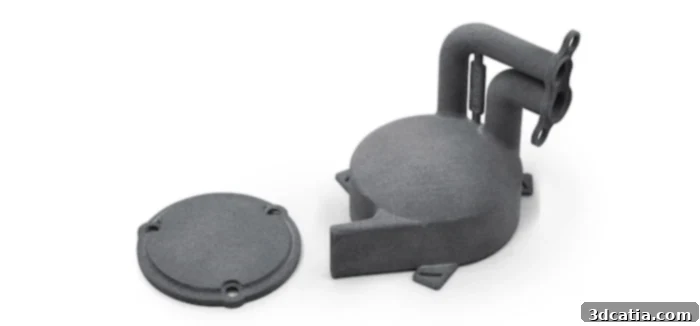
A testament to collaborative innovation, showcasing 3D printed parts | Credits: HP/ Oechsler
Expanding HP’s Metal Jet Footprint: New Adopters Drive Innovation
In tandem with the significant polypropylene material launch, HP further strengthened its position in the additive manufacturing landscape by announcing two compelling new users of its innovative Metal Jet technology: the U.S. Army and Cobra Golf. This expansion into distinct, high-demand sectors demonstrates the versatility and growing adoption of HP’s metal 3D printing capabilities. Metal Jet technology, a binder jetting process, enables the cost-effective production of high-quality metal parts with fine feature detail and excellent mechanical properties, making it ideal for a wide range of industrial applications that require metallic components.
US Army: Strengthening Military Logistics and On-Demand Production
The U.S. Army plans to leverage HP’s Metal Jet technology to produce stainless steel spare parts for its amphibious assault vehicles. This application highlights a critical need within military logistics: the ability to manufacture specific components on demand, especially for aging fleets or specialized equipment where traditional supply chains may be slow or non-existent. For military operations, additive manufacturing offers unprecedented benefits, including rapid prototyping of mission-critical parts, addressing obsolescence issues by recreating components no longer produced, and bolstering supply chain resilience by enabling localized production in forward operating bases or maintenance depots. The ability to print complex stainless steel parts swiftly and reliably can drastically reduce downtime for essential military assets, ensuring operational readiness and enhancing mission effectiveness.
Cobra Golf: Revolutionizing Sports Equipment Design
Cobra Golf, a renowned name in the sports equipment industry, will employ HP’s Metal Jet technology to design and produce more efficient and customized golf equipment. In the highly competitive world of professional and amateur golf, performance gains are continuously sought after. Metal 3D printing allows Cobra Golf to create complex internal geometries, optimize weight distribution with extreme precision, and develop innovative designs that would be impossible or prohibitively expensive with traditional manufacturing methods. This technology facilitates rapid design iteration, enabling engineers to quickly test and refine new club heads, shafts, and other components to enhance player performance. Furthermore, Metal Jet opens doors for greater customization, allowing for golf equipment specifically adapted to the unique needs and playing styles of golfers at all skill levels, pushing the boundaries of athletic performance.
Conclusion
HP’s dual announcement—the introduction of 3D High Reusability PP for its Multi Jet Fusion systems and the expansion of its Metal Jet technology’s user base—solidifies its position as a transformative force in the industrial additive manufacturing sector. The new polypropylene material, developed with BASF, addresses a critical demand for a cost-effective, high-performance, and sustainable polymer, overcoming traditional printing challenges and opening vast application possibilities across automotive, medical, and consumer goods industries. Its exceptional reusability further champions a more environmentally conscious approach to manufacturing. Simultaneously, the adoption of Metal Jet by entities like the U.S. Army and Cobra Golf demonstrates the technology’s readiness and capability to deliver tangible value in highly specialized and demanding fields, from military logistics to elite sports equipment. These innovations collectively signify a pivotal moment for industrial 3D printing, accelerating its integration into mainstream production and reinforcing its role as a key driver of future manufacturing innovation and supply chain resilience.
Have you used polypropylene to make parts before with any 3D printing technology? We’d love to hear about your experiences and insights. Let us know in a comment below or join the conversation on our Facebook and Twitter pages! Don’t forget to sign up for our free weekly Newsletter, with all the latest news and advancements in 3D printing delivered straight to your inbox!