
Revolutionizing 3D Printing: The Dawn of Volumetric Holographic Technology
The landscape of additive manufacturing is on the cusp of a profound transformation, spearheaded by groundbreaking research into holographic 3D printing. A collaborative study, bringing together the expertise of the Lawrence Livermore National Laboratory (LLNL), MIT, the University of Rochester, and UC Berkeley, has unveiled a method that promises to dramatically accelerate the 3D printing process. This innovative approach, often referred to as volumetric 3D printing, stands in stark contrast to traditional light-based additive methods by fundamentally abandoning the conventional “layer-by-layer” fabrication technique. This departure is not merely an incremental improvement but a paradigm shift, positioning holographic volumetric printing as a potential game-changer for speed, complexity, and material efficiency in modern manufacturing.
Prior to this recent breakthrough, the concept of hologram-based 3D printing had already garnered significant attention within the industry. Companies like Daqri were pioneers in developing technology that leveraged holograms and precisely controlled lasers to solidify photosensitive monomers into robust plastic objects. The LLNL-led study meticulously builds upon these foundational efforts, delving deeper into the intricate mechanics and the vast potential of this advanced additive manufacturing process. By moving beyond sequential layer deposition, volumetric 3D printing offers a compelling solution to some of the most persistent challenges in current 3D printing technologies, such as prohibitively slow build times, the extensive need for cumbersome support structures, and the potential for anisotropic mechanical properties in finished parts, which can compromise structural integrity.
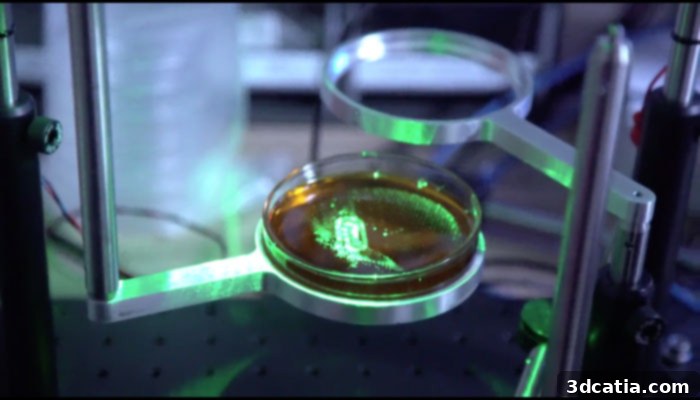
Early demonstrations of 3D printing using advanced holographic techniques, paving the way for future innovations.
Understanding the Mechanics of Volumetric Holographic 3D Printing
At its core, volumetric holographic 3D printing represents a revolutionary method for fabricating objects with unprecedented efficiency. Instead of building a part by incrementally curing thin slices of material one layer at a time, this cutting-edge technology works by directing multiple precisely controlled light beams into a contained volume of photosensitive resin. These individual light rays, on their own, are deliberately designed not to be potent enough to trigger the solidification of the resin. However, the true ingenuity and power of this process lie in their carefully orchestrated convergence. When these light beams intersect at a specific, predetermined point within the resin tank, their combined energy intensity dramatically surpasses the polymerization threshold. This localized surge of energy instantaneously solidifies the material, forming a tiny voxel (a three-dimensional pixel) that constitutes a part of the desired object.
This process is fundamentally different from conventional stereolithography (SLA) or digital light processing (DLP) printers, which typically rely on a single light source or projector to cure an entire layer at once, then move the build plate, and repeat the process for each subsequent layer. In volumetric printing, the entire three-dimensional shape is created quasi-simultaneously through a complex, dynamic interference pattern generated by the converging lasers. For instance, the researchers involved in the seminal LLNL study successfully utilized three lasers to achieve their intricate prints, demonstrating the feasibility of this multi-beam approach. This innovative method allows for the creation of complex internal and external geometries without the inherent restrictions and challenges typically imposed by layer-by-layer deposition, making it a truly ‘instantaneous’ form of additive manufacturing that cures the entire volume of the object almost at once.
Unprecedented Speed and Geometric Freedom in Additive Manufacturing
One of the most compelling and transformative advantages of volumetric holographic 3D printing is its staggering speed, marking a significant leap forward in rapid fabrication. As Chris Spadaccini, a distinguished engineer at LLNL, aptly states, “This is a good proof of what additive manufacturing could become. The potential impact on print throughput could be significant and if we can develop it properly, we can also get a lot of complexity.” The complete elimination of the sequential layer deposition process means that objects, regardless of their vertical dimension or internal intricacy, can theoretically be formed in a matter of seconds or minutes, rather than hours or even days. This exponential increase in speed is a game-changer for rapid prototyping, on-demand manufacturing, and potentially even high-volume production of custom, high-value parts across various industries.
Beyond sheer velocity, this technology offers unparalleled geometric freedom, unlocking new possibilities for design and functionality. Traditional 3D printing methods often struggle with complex overhangs, intricate internal structures, and highly curved surfaces, frequently necessitating the use of cumbersome and wasteful support structures that must be painstakingly removed post-print. Volumetric 3D printing sidesteps these issues entirely because the object is formed directly within the resin volume itself, elegantly supported by the surrounding liquid medium until fully solidified. This inherent capability allows for the creation of previously unachievable designs, including delicate meshes, intricate lattice structures, and smoothly curved surfaces, all without the aid of auxiliary supports. The profound absence of layer lines also results in finished parts with superior surface finishes and, crucially, more isotropic mechanical properties, eliminating the inherent weaknesses often found between layers in traditionally printed objects and leading to stronger, more reliable components.
The implications of such advanced capabilities are vast and far-reaching across numerous sectors. Imagine the ability to print custom medical implants with intricate internal channels optimized for fluid flow, lightweight aerospace components precisely optimized for maximum performance and reduced weight, or consumer products with bespoke, complex designs, all fabricated at unprecedented speeds. Furthermore, the technology holds immense promise for applications in challenging and remote environments, such as space. Its inherent ability to function effectively in weightlessness, combined with its rapid fabrication capabilities, could revolutionize in-space manufacturing, allowing astronauts to produce essential tools, spare parts, or even entire habitats on demand, thereby minimizing the need for costly and heavy shipments from Earth and enhancing mission autonomy.
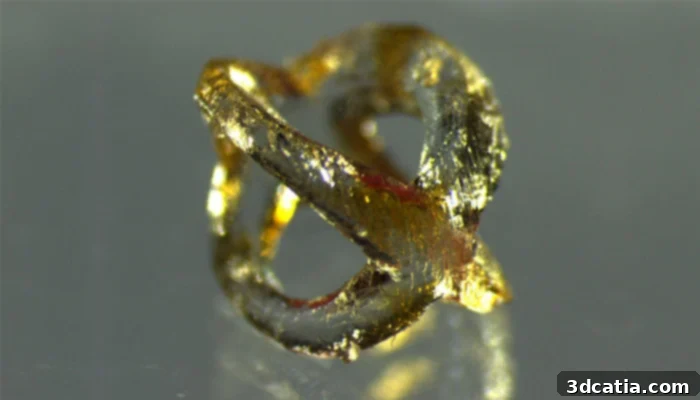
An example of a complex piece successfully 3D printed utilizing advanced holographic techniques, highlighting the potential for intricate designs.
Navigating the Current Limitations and Future Horizons of Volumetric 3D Printing
Despite its tremendous promise and groundbreaking advancements, volumetric holographic 3D printing is still very much in its nascent stages of development, and the researchers openly acknowledge several critical limitations that need to be addressed for its widespread adoption and commercial viability. The primary challenges currently revolve around the achievable geometries, the ultimate resolution of the printed features, and the maximum scale of the finished parts. For instance, fabricating extremely complex and highly detailed structures, such as intricate jewelry pieces with micro-scale features or advanced microfluidic devices, would demand an even greater number of precisely controlled lasers. This increased optical complexity introduces new engineering challenges related to managing heat generation within the resin and ensuring uniform exposure throughout the entire resin volume, both of which are critical for achieving consistent material properties and preventing unwanted, premature polymerization.
Another crucial area for significant improvement lies in the properties of the photosensitive resins themselves. The current range of suitable resins is relatively limited, primarily focusing on acrylics and epoxies, and substantial advancements are needed to enhance their mechanical strength, thermal stability, chemical resistance, and overall long-term durability for diverse applications. Developing resins with finely tailored optical properties—such as specific absorption spectra, optimized refractive indices, and reduced light scattering—will also be absolutely essential to push the boundaries of achievable resolution, expand the material diversity, and improve overall print quality. The research team expresses profound optimism that their pioneering work will serve as a catalyst, inspiring other scientists and engineers globally to explore novel materials and vigorously optimize existing ones specifically for volumetric additive manufacturing applications, driving innovation in material science.
Future research and development efforts will also need to comprehensively tackle the challenges of scaling this groundbreaking technology. While highly promising for smaller, intricate parts, scaling up to produce larger industrial components presents significant hurdles in maintaining consistent light intensity across a much wider volume of resin and ensuring the precise stability and calibration of the complex optical setup. Furthermore, integrating true multi-material printing capabilities, which would allow for the fabrication of parts with varying physical properties or composed of different materials within a single, seamless print, is a significant long-term goal that would undoubtedly unlock even more revolutionary design possibilities and functional applications.
Ultimately, volumetric holographic 3D printing represents a monumental leap forward in the field of additive manufacturing. Its inherent capacity for unprecedented speed and geometric complexity, coupled with its immense potential to overcome many of the fundamental limitations of traditional layer-by-layer methods, positions it as a truly disruptive technology for the 21st century. While significant challenges remain in the refinement of materials, resolution capabilities, and scalability for industrial applications, the foundational research conducted by LLNL and its esteemed partners lays a robust and inspiring groundwork for future innovations. It strongly encourages a new generation of researchers and engineers to push the boundaries of what is physically possible with light and matter, ushering in an exciting era where complex, high-performance objects can be realized almost instantaneously. For more in-depth technical details, you can find the complete study here and explore additional insights into the process in the explanatory video below:
What are your thoughts on the transformative future of 3D printed jewelry, especially with revolutionary advancements like volumetric holographic printing? We’d love to hear your insights and predictions! Share your comments below or connect with us and join the conversation on our Facebook and Twitter pages! Don’t miss out on the very latest innovations and breaking news in the exciting world of additive manufacturing; sign up for our free weekly Newsletter to get all the cutting-edge developments delivered straight to your inbox!