
Revolutionizing 3D Printing: The Breakthrough of Multimaterial Multinozzle (MM3D) Technology
The landscape of additive manufacturing is continuously evolving, yet many commercial extrusion-based 3D printers still face significant limitations. Traditionally, these machines are designed to build objects from a single material at a time, restricting the functional complexity of printed parts. While some advanced systems do permit the use of multiple materials and colors, the process often proves painstakingly slow and inefficient due to necessary pauses for material changes or complex nozzle configurations. This inherent limitation has long presented a bottleneck for creating intricate, multi-functional prototypes and end-use parts that require diverse material properties within a single integrated structure.
Addressing this critical challenge, a groundbreaking innovation has emerged from the collaborative efforts of researchers at the Harvard Wyss Institute for Biologically Inspired Engineering and the John A. Paulson School of Engineering and Applied Sciences (SEAS). They have successfully developed a novel technique known as Multimaterial Multinozzle 3D printing, or MM3D. This revolutionary approach promises to transform the capabilities of additive manufacturing by enabling a single printhead to switch between numerous different materials with unprecedented speed – an astounding rate of up to 50 times per second. This article delves into the intricacies of MM3D, exploring its innovative mechanisms, the significant advantages it offers, and the profound implications this advanced multinozzle 3D printer brings to the entire additive manufacturing (AM) industry, from research to industrial production.
Unlocking Unprecedented Speed and Material Versatility with MM3D
At the core of the MM3D technique lies an ingenious mechanism that facilitates rapid, continuous, and seamless material switching. This is primarily achieved through the integration of high-speed pressure valves. These sophisticated valves are meticulously engineered to precisely control the flow of different ‘inks’ or printing materials, allowing for the astonishing switching frequency of up to 50 times in just one second. To put this into perspective, a conventional multi-material printer might require lengthy pauses, purging cycles, or even manual intervention to change materials, significantly extending print times and often leading to material waste. MM3D effectively eliminates these traditional delays, offering a truly dynamic and uninterrupted printing experience crucial for high-throughput fabrication.
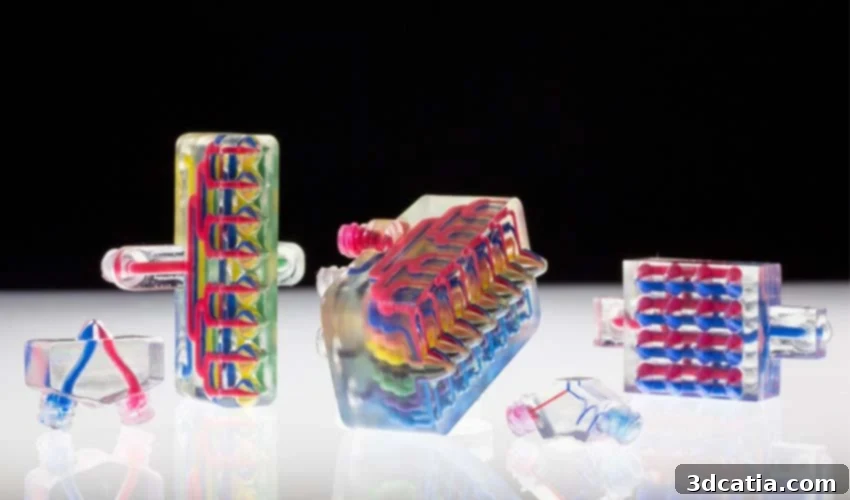
Beyond its remarkable speed, the MM3D printhead demonstrates exceptional versatility in material handling. It is capable of switching between up to eight distinct printing materials concurrently within a single print job. This capacity to process a wide array of materials – each potentially possessing different physical, chemical, or mechanical properties – simultaneously opens up a vast spectrum of possibilities for designers and engineers. Researchers further highlighted that the developed printheads themselves are highly customizable. They can range from single nozzles, tailored for specific precision applications, to large multinozzle arrays designed for high-throughput production of larger components. Crucially, these innovative printheads are also 3D printed, which not only showcases the technology’s self-replicating potential but also allows for their rapid customization and iteration, enabling researchers and manufacturers to quickly adapt the hardware to suit various experimental, prototyping, and industrial requirements with unparalleled agility.
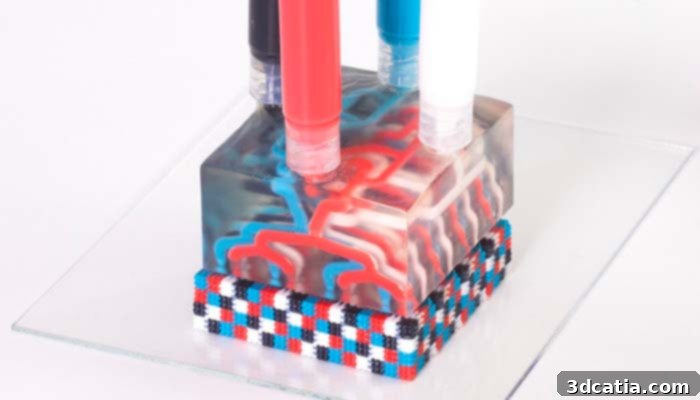
MM3D printing allows to seamlessly switch between multiple different materials up to 50 times per second, greatly streamlining the process of printing complex structures. | Credit: Wyss Institute at Harvard University
Overcoming the Cubic Scaling Challenge in Additive Manufacturing
One of the most profound and significant advantages of the MM3D technique is its ability to fundamentally alter the scaling laws traditionally associated with extrusion-based 3D printing. Mark Skylar-Scott, Ph.D., a Research Associate at the Wyss Institute and co-first author of the study, eloquently elaborates on this transformative benefit: “When printing an object using a conventional extrusion-based 3D printer, the time required to print it scales cubically with the length of the object, because the printing nozzle has to move in three dimensions rather than just one. MM3D’s combination of multinozzle arrays with the ability to switch between multiple inks rapidly effectively eliminates the time lost to switching printheads and helps get the scaling law down from cubic to linear, so you can print multimaterial, periodic 3D objects much more quickly.”
To truly grasp the magnitude of this statement, it’s essential to understand the implications of cubic scaling. In a traditional single-nozzle 3D printer, if you wish to print an object that is, for example, twice as long, twice as wide, and twice as high as an original design, the total volume of the object increases by a factor of eight (2x2x2). Because the single nozzle must meticulously traverse every point in this significantly larger volume, the printing time would increase by a factor related to the cube of the linear dimension. This leads to exponentially longer print times for larger, more complex objects, making industrial-scale additive manufacturing of substantial parts notoriously slow and cost-prohibitive. This cubic scaling law has long been a major limiting factor for industrial adoption and expansion of 3D printing technologies.
The MM3D system, with its rapid material switching capabilities and integrated multinozzle arrays, dramatically mitigates and even largely circumvents this inherent problem. By enabling multiple nozzles to print simultaneously and quickly change materials without interruption or significant overhead, the effective printing speed becomes much closer to a linear relationship with the object’s dimensions. This means that if you double the linear dimensions of a multimaterial object, the printing time might only roughly double, rather than increasing by a factor of eight or more. This monumental shift from cubic to linear scaling represents a breakthrough in manufacturing efficiency. It enables the much faster and more economical production of complex, multimaterial periodic 3D objects, making previously unfeasible projects viable and accelerating the entire design-to-production cycle for intricate components across various industries.
Precision Engineering: Preventing Material Mixing and Ensuring Flow Consistency
The Smart Printhead Design: A Masterclass in Fluid Dynamics
One of the most critical engineering challenges in multimaterial 3D printing is the precise prevention of different ‘inks’ or printing materials from mixing prematurely. Such undesirable mixing would compromise the chemical integrity, mechanical properties, and aesthetic appearance of the printed object. The MM3D printhead addresses this intricate problem with remarkable precision and an elegant solution rooted in advanced fluid dynamics. Inside the printhead, multiple individual ink channels converge at a single, precisely engineered output nozzle. The researchers meticulously calculated and optimized several critical parameters: the optimal internal shape and geometry of this nozzle junction, along with the precise printing pressure to be applied, and the specific rheological properties (ink viscosity) needed to ensure flawless, contamination-free operation.
When pressure is selectively applied to one of the branched arms of the junction, directing a specific ink stream toward the output nozzle, the carefully designed internal geometry and the controlled flow dynamics work in concert to prevent any static ink residing in the other, currently inactive arms from flowing backward. This clever design ensures that the inactive materials remain quiescent and completely separate, preventing them from contaminating the active ink stream. This sophisticated fluidic control mechanism guarantees that different materials remain distinct until they are precisely extruded onto the print bed, thereby eliminating undesirable mixing and preserving the intended material properties at each and every point of the complex 3D structure. This unparalleled level of localized material control is paramount for applications demanding high fidelity, intricate microstructure, and specific material placement, especially in functional components and biomedical devices.
Accommodating Diverse Material Properties with Dynamic Channel Adjustment
Furthermore, the MM3D system intelligently accounts for inherent variations in material properties, such as viscosity, which is a key determinant of flow behavior. Different materials naturally possess different viscosities and, consequently, would flow at different rates under the same applied pressure, leading to timing and deposition inaccuracies in multi-material prints. To overcome this, and ensure that all materials reach the output nozzle simultaneously and maintain synchronized deposition, the length of the individual printing channels can be dynamically adjusted. This ingenious feature allows materials with widely differing viscosities – for instance, a very thick, high-viscosity epoxy used for structural integrity versus a low-viscosity bioink designed for cellular viability – to flow at the same effective pace, maintaining exceptional precision and consistency throughout the entire printing process. This capability is vital for fabricating sophisticated composite structures where multiple materials with distinct rheological properties must be deposited in quick succession without interruption, degradation in quality, or compromise to their specific functions.
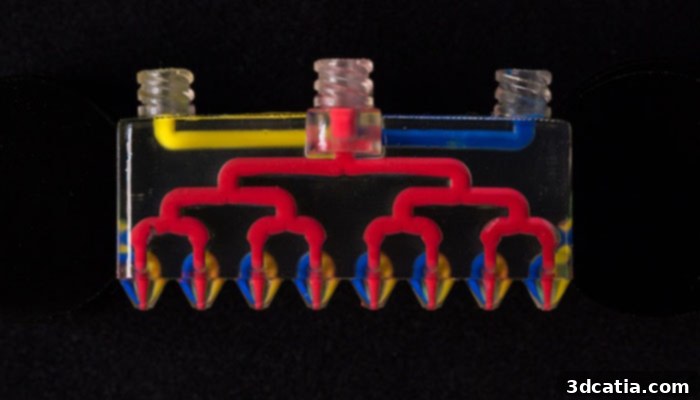
The MM3D printhead can accommodate multiple nozzles, each of which can print up to eight different materials. A series of branched channels distributes the “inks” to the nozzles. | Credit: Lori K. Sanders
Broadening Horizons: New Applications Enabled by MM3D Technology
The unparalleled versatility, precision, and speed of the MM3D printing technique open doors to a myriad of groundbreaking applications, particularly in fields requiring complex material integration and rapid prototyping of functional devices. The system is demonstrably capable of utilizing a wide range of reactive materials, including various epoxies for structural components, silicones for flexible parts, and cutting-edge bioinks for biological and medical applications. The ability to precisely deposit and rapidly switch between these diverse materials means that previously challenging or even impossible designs, especially those requiring graded material properties or complex interfaces, can now be seamlessly realized in a single print run.
From Soft Robotics to Advanced Biomedical Engineering
Jochen Mueller, Ph.D., a Research Fellow at the Wyss Institute and SEAS and co-first author, eloquently emphasizes this vast potential: “One can also readily integrate materials with disparate properties to create origami-like architectures or soft robots that contain both stiff and flexible elements.” This statement highlights a truly crucial capability: the seamless integration of materials with fundamentally different mechanical properties within a single print job. Imagine the possibilities for creating structures that can dynamically fold and unfold (inspired by the ancient art of origami), or highly functional soft robots that mimic biological movements with unprecedented dexterity, all printed in one continuous process without the tedious and error-prone need for assembly of individual components. This is particularly impactful for the burgeoning field of soft robotics, where the precise placement of rigid components for structural support and payload integration alongside flexible, deformable elements for movement, sensing, and actuation is absolutely essential for creating lifelike and adaptable machines.
The research team compellingly demonstrated this capability by 3D printing a sophisticated soft robot patterned after a millipede. This innovative robot was composed of both rigid and soft elastomers, strategically placed to mimic the segmented body and flexible joints of the natural creature. What truly set this demonstration apart was the ingenious integration of embedded pneumatic channels directly within the robot’s structure. These channels, when precisely pressurized, allowed the robot to move autonomously at nearly half an inch per second, demonstrating controlled locomotion without external motors. Impressively, this soft robot was also capable of carrying a load eight times its own weight, showcasing its significant potential for practical applications in delicate manipulation, exploration of confined spaces, or deployment in hazardous environments where traditional rigid robots might be unsuitable or unsafe. Furthermore, the design allowed for modularity, enabling the robot to be connected to other similar robotic units to collectively carry even heavier loads, hinting at exciting possibilities for swarm robotics, distributed task execution, and adaptive robotic systems.
The Future of Manufacturing: Accelerating the Pace of Innovation
Wyss Founding Director Donald Ingber, M.D., Ph.D., eloquently summarizes the broader, transformative impact of this technological advancement: “3D printing is revolutionizing the manufacturing industry by allowing people to create without the need for expensive machinery and raw materials, and this new advance promises to dramatically improve the pace of innovation in this exciting area.” His statement underscores the profound, transformative power of additive manufacturing in general, and MM3D specifically amplifies this power by breaking down critical barriers related to printing speed and the complexity of integrating diverse materials. This innovation signifies a major step towards truly versatile and efficient multi-material fabrication.
The MM3D technique offers a clear path towards more agile product development, significantly faster iteration cycles, and the creation of highly integrated, multi-functional parts in a single, streamlined step. This will undoubtedly accelerate innovation across various critical sectors, from the rapid development of custom medical devices and advanced biomedical research utilizing sophisticated bioinks for tissue engineering, to the fabrication of high-performance aerospace components with optimized material distributions, and the creation of the next generation of soft electronics, sensors, and robotics. By making multimaterial 3D printing significantly faster, more reliable, and more accessible, MM3D is poised to unlock entirely new design paradigms and manufacturing capabilities that were previously confined to theoretical discussions or highly complex, multi-step fabrication processes.
The potential applications are vast and incredibly exciting, spanning a wide array of industries. These include, but are not limited to, the rapid creation of custom orthotics and prosthetics with tailored flexibility and stiffness profiles, the development of multi-sensory devices integrating different conductive and insulating materials, and even advanced tissue engineering scaffolds that precisely mimic the complex hierarchical structures and mechanical gradients of natural biological tissues. This breakthrough promises to democratize the creation of complex, multi-material objects, fostering an era of unprecedented creativity and functionality in additive manufacturing. We eagerly anticipate witnessing the innovative applications that will flourish from this groundbreaking technique and are committed to reporting on them as they emerge and reshape the future of manufacturing!
What are your thoughts on the revolutionary MM3D technique? How do you envision this technology shaping the future of design and manufacturing in your industry or field of interest? We invite you to share your insights and predictions in a comment below or join the conversation on our Facebook and Twitter pages! Don’t miss out on the latest advancements and breaking news in the exciting world of 3D printing – sign up for our free weekly Newsletter and have all the essential updates delivered directly to your inbox!