
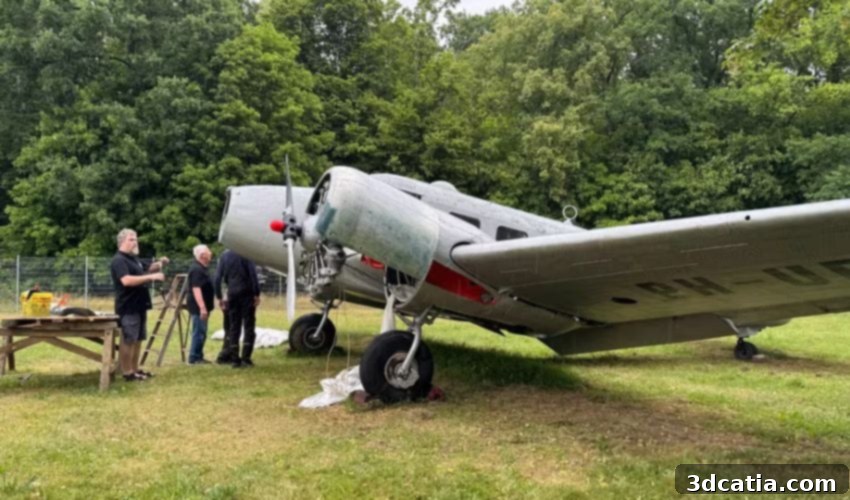
Saving a Legend: 3D Printing Revolutionizes Beechcraft D18S Aircraft Restoration at Flugwelt Altenburg-Nobitz
The Beechcraft 18, affectionately known as the “Twin Beech” or “Beech 18,” stands as an enduring icon of American aviation engineering from the 1930s. Designed as a versatile twin-engine aircraft, its compact size, impressive speed, robust construction, and adaptability quickly earned it a prominent place in both military and civilian applications. During World War II, its inherent qualities made it indispensable for various critical roles, serving as a reliable transport aircraft, an essential navigation and bombing trainer, and a crucial liaison plane. Beyond its wartime contributions, the Beechcraft 18 also saw widespread success in the civilian sector, with numerous variants, including the D18S model, becoming mainstays for corporate travel, cargo delivery, bush flying, and air ambulance services. Today, the legacy of this remarkable aircraft continues, with dedicated enthusiasts undertaking challenging restoration projects. One such endeavor is currently underway at Flugwelt Altenburg-Nobitz in Thuringia, Germany, where a particular D18S model is being meticulously restored and prepared for public display.
The Beechcraft 18’s journey began with its first flight in 1937, marking the start of an extraordinary production run that spanned over three decades, with more than 9,000 units built. Its distinct twin-tail design and radial engines became instantly recognizable, symbolizing a golden era of aviation. For the military, the aircraft proved to be an incredibly flexible platform. It was deployed globally, supporting various Allied forces and fulfilling roles from reconnaissance and photoreconnaissance to target towing and light bombing in specialized versions. The C-45 Expeditor, AT-7 Navigator, and AT-11 Kansan were among its most famous military designations. Its robust airframe and reliable engines meant it could operate from various challenging environments, making it a favorite among pilots and ground crews alike. Post-war, the civilian D18S model flourished, becoming one of the most successful business aircraft of its time. Its ability to carry executives, deliver parcels, and even perform acrobatic displays cemented its reputation as a true workhorse of the skies. This rich history makes every restoration project involving a Beechcraft 18 not just an act of mechanical revival, but a profound preservation of aviation heritage.
Flugwelt Altenburg-Nobitz, a captivating aviation museum nestled in Germany, proudly hosts a collection of 18 airplanes and helicopters, many of which are displayed outdoors, offering visitors an immersive experience. Among its prized exhibits, a dedicated team of club members is now pouring their passion and expertise into their latest, and perhaps most intricate, acquisition: a Beechcraft D18S. This specific aircraft carries a fascinating history, having served as a courier aircraft during World War II. Following its military service, it was sold to the Netherlands, where it continued its operational life at a national aviation school. However, its flying career came to an abrupt halt after a collision, rendering it no longer airworthy. Subsequently, the aircraft changed hands multiple times, eventually finding an unusual, albeit temporary, purpose. Reports suggest that at one point, it was acquired by carnival organizers, who, for ease of transport and perhaps a quirky display, removed the wings from its fuselage. This journey underscores the diverse lives these machines often lead, far beyond their original design intent. Now, thanks to the tireless volunteer members of the Altenburg-Nobitz aviation club, this low-wing aircraft is embarking on a new chapter, undergoing a comprehensive restoration to be exhibited and appreciated by future generations.
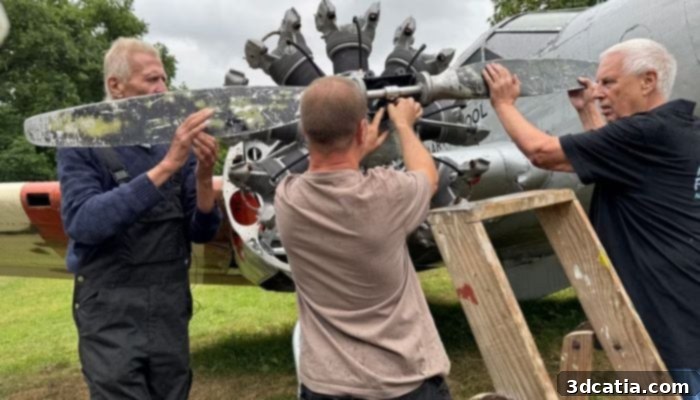
The restoration of such a venerable aircraft, particularly one with a history as varied as this D18S, presents a myriad of significant challenges. The team at Flugwelt Altenburg-Nobitz is confronting a complex array of issues that test their ingenuity and dedication. The improperly removed wings, a relic from its carnival days, are merely one symptom of the deep-seated problems. Layers of old paint need to be painstakingly stripped away to reveal the original surfaces and assess the underlying metal. The engines, after decades of dormancy and wear, are in dire need of extensive repairs, requiring specialized knowledge and sourcing of very specific components. Furthermore, a particularly vexing issue arises from the incompatibility of the aircraft’s American threaded fasteners with the metric system prevalent in Germany. This seemingly small detail creates considerable hurdles for sourcing standard tools and replacement hardware, often necessitating custom solutions or importing specific American-standard equipment. Crucially, many original parts of this particular Beechcraft D18S are either severely damaged, deteriorated, or entirely missing. The quest for authentic replacement parts often leads to dead ends; original components are either prohibitively expensive to acquire on the rare occasion they become available, or they are simply no longer manufactured. This scarcity forces the restoration crew to think beyond conventional methods, pushing the boundaries of traditional restoration techniques and fostering a culture of creative problem-solving.
It is precisely at this juncture that modern technology steps in, offering a revolutionary approach to classic aircraft restoration. 3D printing, or additive manufacturing, is proving to be an indispensable tool in overcoming the seemingly insurmountable obstacles faced by the Altenburg-Nobitz team. This innovative technology allows club members to digitally design and physically produce parts that are otherwise impossible to find or afford. For instance, they have successfully utilized 3D printing to create spark plugs that are visually indistinguishable from the original components. Since the Beechcraft D18S at Flugwelt Altenburg-Nobitz is destined for static display and will never take to the skies again, the primary objective for many of these components is aesthetic accuracy rather than full operational functionality. This distinction is crucial; it means the team can prioritize faithful imitation of appearance, texture, and form, ensuring the aircraft looks authentic without needing to meet stringent aerospace performance specifications for every single reproduced part. This approach significantly reduces the cost and complexity of restoration, allowing historical accuracy to be achieved even when original, functional parts are scarce or economically unfeasible.
The application of 3D printing extends far beyond mere cosmetic components. While the museum’s D18S project focuses on visual authenticity, it is entirely within the realm of possibility to 3D print fully functional replacement parts for vintage vehicles and aircraft. A growing number of successful past projects vividly demonstrate how additive manufacturing can profoundly support and accelerate the restoration of classic conveyances, bridging the gap between historical design and modern engineering capabilities. Consider the meticulous work undertaken by Eagle, a renowned company in England specializing in the restoration of luxury Jaguar E-Type models. They leverage advanced HP Multi Jet Fusion technology to produce intricate, high-quality components, ensuring these automotive masterpieces can be returned to their former glory, often with parts that are stronger or more durable than the originals. Similarly, Porsche Classic, the dedicated division of the iconic German automaker, has embraced 3D printing to supply essential, no-longer-available parts for its vast fleet of vintage models. This proactive approach ensures that cherished Porsches from bygone eras can continue to be maintained and driven for decades to come. Mercedes-Benz has also partnered with additive manufacturing specialists like Renishaw to produce highly specific, certified 3D-printed parts for its classic car collection, demonstrating a commitment to preserving automotive history through cutting-edge technology.
These pioneering examples from the automotive sector, alongside the promising work on the Beechcraft D18S, unequivocally illustrate that additive manufacturing offers an expansive range of possibilities for extending the lifespan, enhancing the authenticity, and ensuring the long-term preservation of vintage vehicles, historical aircraft, and countless other cultural artifacts. By enabling the cost-effective production of bespoke components, from complex engine parts to intricate interior details, 3D printing democratizes restoration efforts, making them accessible to a wider array of enthusiasts and institutions. It minimizes reliance on dwindling stockpiles of original parts and mitigates the environmental impact of manufacturing new tools for limited production runs. This technology not only revives the past but also shapes the future of historical preservation, ensuring that the stories encapsulated within these magnificent machines can continue to inspire and educate new generations. The ongoing restoration of the Beechcraft D18S at Flugwelt Altenburg-Nobitz stands as a testament to this revolutionary potential, breathing new life into a piece of aviation history through the innovative application of modern manufacturing techniques. You can discover more about the fascinating journey of this Beechcraft D18S restoration and the dedicated individuals behind it HERE.
What are your thoughts on this incredible project and the role of 3D printing in preserving our shared heritage? We invite you to share your insights and comments below, or join the conversation on our LinkedIn or Facebook pages! Don’t miss out on the latest advancements in additive manufacturing—sign up for our free weekly Newsletter to receive exclusive 3D printing news directly in your inbox. For a visual dive into the world of 3D printing, explore all our videos on our YouTube channel. And if you’re interested in more groundbreaking 3D printing news within the aerospace and defense sectors, be sure to visit our dedicated page HERE.
*All Photo Credits: MDR/Kathrin Welzel