

Accelerating Motorsport Innovation: Garry Rogers Motorsport Powers Performance with Markforged 3D Printing
In the fiercely competitive world of automotive manufacturing and motorsport, teams and companies frequently encounter a shared set of intricate challenges. The production of complex parts, particularly those required in low volumes or for specialized applications, often comes with prohibitively high costs and unacceptably long lead times. These hurdles can significantly impede innovation and responsiveness, critical factors for success in dynamic industries. For Garry Rogers Motorsport (GRM), arguably the oldest and most respected motorsport team in Australia, these challenges were all too familiar. With a dedicated team of nearly 40 employees, led by owner Garry Rogers – a former motorsport racer with multiple national Supercars championship victories – GRM has always prioritized internal development, construction, and maintenance of its high-performance vehicles. However, a significant paradigm shift occurred when the team strategically embraced additive manufacturing technologies, finding innovative solutions to the persistent difficulties of traditional production methods.
The ability for companies within the automotive industry to manufacture parts on-site and on-demand is rapidly becoming not just a desirable capability, but a strategic imperative. The traditional reliance on external outsourcing inherently introduces significant time delays and escalates costs, creating bottlenecks that can hinder rapid iteration and competitive advantage. Recognizing this critical need, the forward-thinking engineers and designers at Garry Rogers Motorsport embarked on a collaborative journey with Markforged, a pioneer in additive manufacturing technologies. This partnership has unlocked a multitude of benefits, transforming their approach to part production. Stefan Millard, team manager at GRM, eloquently summarizes this impact: “3D printing gives us another option to make parts that would usually be cost-prohibitive.” This sentiment underscores the transformative potential of additive manufacturing, enabling GRM to push the boundaries of what’s possible within their budget and timeframe, ultimately driving performance on the track.
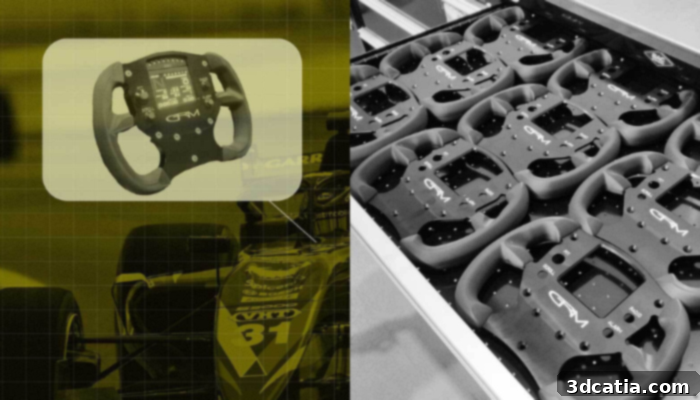
Among other things, steering wheels can be made using additive manufacturing
Pioneering Innovation: Garry Rogers Motorsport’s Embrace of Additive Manufacturing
The strategic decision to integrate advanced manufacturing techniques into their operations wasn’t a recent development for Garry Rogers Motorsport. Nearly a decade ago, Stefan Millard and his innovative team decided to significantly expand their workshop capabilities, not through the acquisition of more conventional machining tools, but through the revolutionary addition of a 3D printer. This bold move was designed to inspire engineers and designers to explore entirely new methodologies for building prototypes and producing critical spare parts. Given GRM’s extensive expertise and deep understanding of advanced materials, particularly carbon fiber composites, the selection of the right 3D printer was paramount. Their choice ultimately fell on a system from Markforged, a decision Millard clarifies: “It seemed like Markforged was the only one focused on making strong end-use parts rather than just prototypes.” This distinction was absolutely crucial for GRM. In the high-stakes environment of motorsport, additively manufactured parts must not only fit precisely but also withstand immense stresses, extreme temperatures, incredible speeds, and powerful forces without fail. Markforged’s unique ability to print with continuous carbon fiber and other robust composite materials offered the durability and performance required for real-world racing applications, making it the ideal partner for GRM’s ambitious goals.
Revolutionizing Race Car Production: From Prototypes to Performance-Critical Components
As one of the pioneering companies in Australia to invest in Markforged technology, Garry Rogers Motorsport has since perfected the implementation of additive manufacturing across their entire vehicle development and production workflow. The team around Garry Rogers now seamlessly integrates 3D printing for a wide array of complex parts, extending far beyond simple prototypes to include actual end-use components directly integrated into their high-performance race cars. This strategic adoption has led to remarkable statistics: nearly 50% of all parts printed by GRM are utilized as final, functional components within their racing vehicles. This category includes diverse elements such as durable covers for door locks, intricate transmission housings designed for optimal performance, ergonomic steering wheel grips custom-tailored for driver comfort and control, and robust camera mounts ensuring precise data acquisition. Each of these parts benefits from the bespoke design freedom, lightweighting potential, and rapid production capabilities afforded by additive manufacturing, contributing directly to the car’s overall efficiency and competitive edge.
However, the utility of additive manufacturing for Garry Rogers Motorsport extends far beyond merely producing end-use parts. The technology has also proven invaluable for the creation of samples and tooling, particularly for molded fiberglass components – a staple in motorsport vehicle construction. A compelling example illustrates this impact vividly: the team needed a sample for a brake duct, a critical aerodynamic component. Through conventional manufacturing processes, producing such a sample would typically consume two weeks of valuable time and incur a substantial cost of approximately $670. Leveraging their Markforged 3D printer, GRM was able to produce an accurate, functional sample of the brake duct in just 24 hours, at an astounding cost of only $50. This dramatic reduction in both lead time and expenditure frees up significant resources, allowing the team to iterate designs faster, test more frequently, and optimize components with unprecedented agility. This rapid prototyping capability ensures that GRM can experiment with novel aerodynamic profiles and structural designs without the previous financial and temporal constraints, translating directly into enhanced vehicle performance and a sharper competitive edge on the racetrack.
Driving the Future: Additive Manufacturing as a Competitive Advantage
At Garry Rogers Motorsports, the outlook for the future is overwhelmingly optimistic, largely fueled by the transformative power of additive manufacturing. The inherent flexibility in design and the unprecedented quick turnaround times offered by 3D printing technology are not just improving production efficiency; they are fundamentally enhancing the performance capabilities of their race cars. This synergy between innovative design and rapid manufacturing allows GRM to continuously refine and optimize every aspect of their vehicles. Stefan Millard emphasizes this crucial link: “That extra time we get by using our Markforged printer goes straight into the designing or making more parts, or finding other areas to make Garry Rogers Motorsport cars go faster — that’s our primary goal.” This statement perfectly encapsulates the strategic advantage additive manufacturing provides: it’s not merely about creating parts, but about accelerating the entire innovation cycle. By compressing design-to-part timelines, GRM can allocate more resources and creative energy towards aerodynamic improvements, chassis tuning, and overall vehicle development, all aimed at achieving their ultimate objective – making their cars faster and more competitive. This agile approach empowers them to stay ahead in a sport where even a fraction of a second can determine victory.
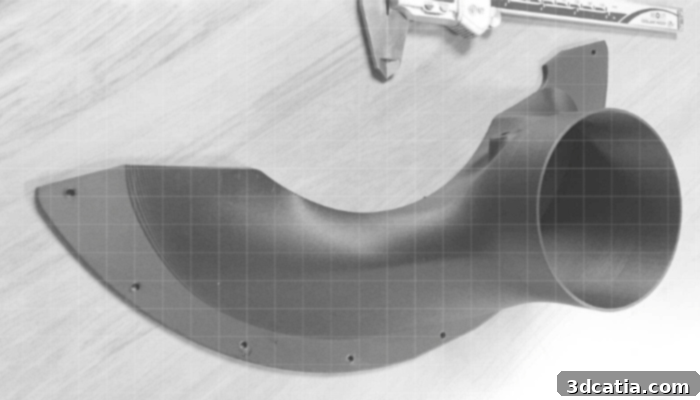
Photo Credits: Markforged
The journey of Garry Rogers Motorsport illustrates a compelling case study of how advanced manufacturing technologies can revolutionize an industry deeply rooted in traditional practices. By strategically adopting Markforged 3D printing, GRM has not only overcome the prevalent challenges of high costs and long lead times associated with complex and low-volume part production but has also fundamentally re-imagined its approach to vehicle design, prototyping, and end-use part manufacturing. This commitment to innovation has allowed them to gain a significant competitive edge, enabling faster iterations, bespoke component creation, and ultimately, enhanced performance on the racetrack. Their success story serves as an inspiring example for other motorsport teams and automotive manufacturers looking to leverage additive manufacturing for strategic advantage and sustained innovation in a rapidly evolving technological landscape.
What are your thoughts on the increasing use of additive manufacturing in motorsports? We’d love to hear your perspective! Let us know in a comment below or join the conversation on our LinkedIn, Facebook, and Twitter pages! Don’t forget to sign up for our free weekly Newsletter here to receive the latest 3D printing news straight to your inbox! You can also find all our compelling videos on our YouTube channel, showcasing even more groundbreaking applications of additive technologies.
*All Photo Credits: Markforged