
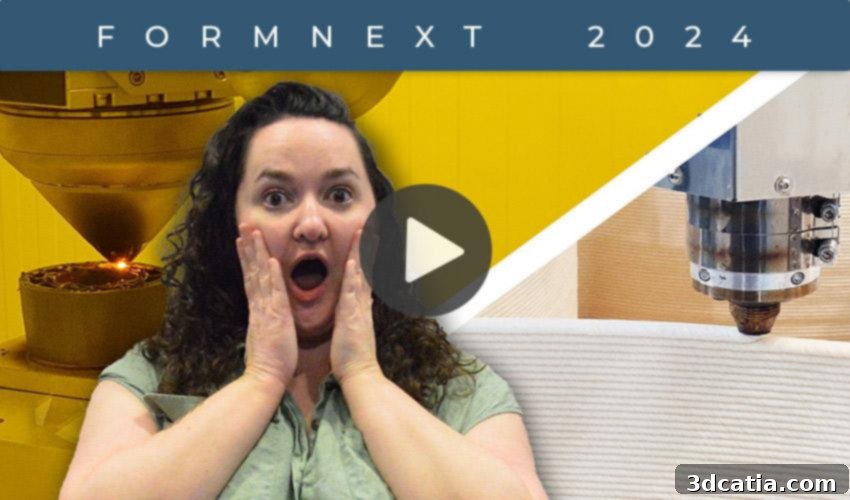
Unveiling the Giants: Top Large-Format 3D Printers Redefining Industrial Additive Manufacturing at Formnext 2024
The landscape of additive manufacturing is continuously evolving, with a clear and undeniable trend towards larger parts and more robust production capabilities. Indeed, size does matter significantly in the realm of 3D printing, especially as industries push the boundaries of innovation and demand for vast, intricate components grows. Over recent years, we have witnessed an exponential surge in demand for large-format additive manufacturing solutions. This pivotal shift is driven by critical sectors such as maritime, aerospace, transportation, automotive, and energy, all of which require the ability to create bigger, stronger, and more complex parts with greater efficiency and speed. The necessity for these expansive 3D printing capabilities was more evident than ever at Formnext 2024, the world’s leading exhibition for additive manufacturing and industrial 3D printing. The event served as a powerful platform, showcasing groundbreaking innovations that are set to redefine how large-scale components are designed and produced. This year, we embarked on a mission to explore and highlight some of the most impressive, innovative, and downright big 3D printers that stole the spotlight at the show, offering a glimpse into the future of industrial manufacturing.
YIZUMI: Robotic Precision on a Grand Scale
Our journey through Formnext 2024 began with a truly eye-catching display from YIZUMI, a company renowned for its sophisticated manufacturing solutions. What immediately captured our attention was not just the sheer size of their robotic arm 3D printing system, but also its cleverly designed raised platform. This configuration allows for unparalleled flexibility and scalability, making it an ideal choice for manufacturing extremely large parts that would be challenging, if not impossible, on conventional systems. The integration of advanced robotics into additive manufacturing represents a significant leap forward, offering not only immense build volumes but also the precision and repeatability crucial for industrial applications. YIZUMI’s solution leverages granular or pellet-based materials, which are significantly more cost-effective than filament, further enhancing the economic viability of large-scale production. This approach is particularly beneficial for creating large molds, tooling, prototypes for heavy machinery, and even structural components for various industries. The ability to manipulate the printing head with such agility and extend the reach across a vast build area positions YIZUMI’s system as a frontrunner in the evolving field of robotic large-format additive manufacturing, promising efficiency and innovation for manufacturers worldwide.
Meltio Robot Cell: Metal Additive Manufacturing Redefined
Next on our exploration of large-format innovations, we delved into Meltio’s latest offering, the groundbreaking Robot Cell. This solution stands out as a pioneering metal additive manufacturing system that promises end-to-end production capabilities within a robust, integrated environment. The Meltio Robot Cell boasts an impressive working build volume of 1.2 meters by 1.2 meters, providing ample space for fabricating sizable metal components or multiple smaller parts in a single run. What makes this system particularly compelling is its reliance on Direct Energy Deposition (DED) technology, which utilizes wire and/or powder as feedstock, offering significant advantages in terms of material cost, process efficiency, and the ability to work with a wide range of industrial metals like stainless steel, titanium, and nickel alloys. This versatility makes the Robot Cell exceptionally well-suited for diverse applications, from repairing high-value components and adding features to existing parts, to producing new, intricate geometries. Its design for end-to-end production means it seamlessly integrates into environments like machine shops, offering hybrid manufacturing capabilities where parts can be built additively and then precisely machined, all within a streamlined workflow. This integration not only reduces lead times but also optimizes material usage and minimizes waste, underscoring Meltio’s commitment to advanced, sustainable manufacturing solutions.
DWS: Large-Scale Stereolithography with Unmatched Precision and Speed
Following our exploration of metal and robotic systems, we paused to admire a solution that, while perhaps not the absolute largest in terms of sheer footprint at Formnext, was undeniably one of the most substantial we have encountered for stereolithography (SLA). DWS showcased a wide solution that redefines the capabilities of resin-based 3D printing for industrial applications. This impressive machine harnesses the company’s patented Smart Coating stereolithography technology to deliver remarkably fast and precise parts. SLA is traditionally known for its exceptional surface finish and accuracy, and DWS elevates this further, making it viable for larger components. A key differentiator for DWS’s system is the integration of three overlapping lasers. This innovative approach ensures that printing speeds are boosted by at least 30% compared to single-laser systems, without compromising the intricate detail and smooth finishes characteristic of SLA. Such a significant increase in speed is crucial for reducing production times and making large-scale resin printing more economically attractive. Applications for this type of large-format SLA include master patterns for casting, large prototypes requiring fine detail, custom tooling, and even medical models, offering industries a powerful tool for rapid development and production of high-quality, large-volume resin parts.
FANUM: Hybrid Manufacturing for XXL Components
Moving forward, we encountered an extraordinary solution from FANUM that truly embodies the concept of multi-functional manufacturing. FANUM presented a system that seamlessly combines XXL 3D printing with advanced 5-axis machining, establishing a new benchmark for industrial production. This hybrid approach is a game-changer, allowing manufacturers to leverage the benefits of both additive and subtractive processes within a single machine. The system features a powerful printing head capable of depositing an astonishing 200kg of material in just one hour, making it one of the fastest large-format polymer extrusion systems on the market. This high deposition rate significantly reduces lead times for massive components, which is critical for industries like construction, marine, and large-scale prototyping. The integration of 5-axis machining then enables precise finishing, drilling, and other subtractive operations on the 3D printed parts, achieving tight tolerances and superior surface quality that purely additive processes might not always deliver on their own. This holistic approach minimizes material waste, reduces the need for multiple machines and setups, and streamlines the entire production workflow. FANUM’s solution demonstrates a clear vision for the future of manufacturing, where the boundaries between different production methods blur to create more efficient, versatile, and capable systems for large-scale industrial applications.
KraussMaffei: Industrial-Grade Pellet Extrusion for Demanding Applications
Last but certainly not least on our tour of Formnext 2024’s impressive large-format offerings, we stopped by KraussMaffei, a name synonymous with advanced plastics and rubber machinery. The company showcased an impressive solution that is not merely big in terms of build volume, but also ingeniously engineered to overcome common challenges associated with large-scale polymer additive manufacturing. KraussMaffei’s system stands out by integrating a heated build plate and a dedicated drying system. These features are absolutely crucial for producing large, high-quality parts from hygroscopic (moisture-absorbing) pellet materials. The heated build plate plays a vital role in ensuring optimal layer adhesion and preventing warping, a common issue when printing large components, especially with engineering-grade thermoplastics. By maintaining a consistent temperature across the entire build area, it minimizes internal stresses and ensures dimensional accuracy. Complementing this, the dedicated drying system guarantees that the polymer pellets, which are the feedstock for this extrusion process, are always at the optimal moisture level. This prevents print defects, ensures consistent material flow, and ultimately contributes to the mechanical integrity and aesthetic quality of the final part. Utilizing industrial-grade pellets rather than expensive filaments significantly lowers material costs, making large-scale production more economical and sustainable. KraussMaffei’s comprehensive approach demonstrates a deep understanding of industrial manufacturing needs, offering a robust and reliable platform for fabricating truly massive, high-performance polymer parts for sectors requiring durability and precision.
The Growing Significance of Large-Format Additive Manufacturing
The innovations highlighted at Formnext 2024 underscore a critical paradigm shift in the manufacturing industry: the increasing viability and necessity of large-format additive manufacturing. For years, 3D printing was largely associated with prototyping or producing small, intricate parts. However, as technologies mature and demand for bespoke, large-scale components rises, the industrial world is embracing the power of giant 3D printers. These systems are not just scaled-up versions of their smaller counterparts; they represent sophisticated engineering solutions designed to tackle unique challenges. Large-format 3D printing enables industries to produce massive molds, tooling, end-use parts for automotive and aerospace structures, and even entire boat hulls or architectural elements. This capability translates into reduced assembly times, simplified supply chains, and the ability to create geometries previously unattainable through traditional manufacturing methods. Furthermore, the use of more affordable pellet-based materials and advanced hybrid manufacturing techniques is making large-scale additive production increasingly cost-effective and efficient. The environmental benefits are also noteworthy, with optimized material usage and the potential for on-demand local production reducing transportation and waste.
Challenges and Future Outlook
While the advancements are impressive, large-format additive manufacturing still presents its own set of challenges. Managing internal stresses, ensuring consistent material properties across huge build volumes, and perfecting post-processing techniques for enormous parts remain areas of ongoing research and development. Warping, in particular, is a persistent concern that manufacturers like KraussMaffei are addressing with heated build plates and controlled environments. The integration of quality control and monitoring systems is also crucial to ensure the integrity of these large-scale prints. However, the rapid pace of innovation, as evidenced by the machines at Formnext 2024, suggests that these challenges are being systematically overcome. The future outlook for large-format 3D printing is incredibly promising, with ongoing developments in new materials, more intelligent software, and even larger, faster, and more integrated systems on the horizon. As these technologies continue to mature, they will unlock unprecedented opportunities for industries to innovate, reduce costs, and accelerate time to market for complex, large-scale products.
Which of these incredible big 3D printers from Formnext 2024 captured your imagination the most? We invite you to share your thoughts and preferences in a comment below or join the conversation on our LinkedIn, Facebook, and Twitter pages! Stay informed about the latest breakthroughs in additive manufacturing by signing up for our free weekly Newsletter here, delivering the freshest 3D printing news directly to your inbox. You can also explore all our insightful videos and in-depth analyses on our YouTube channel for more visual content and expert discussions.