
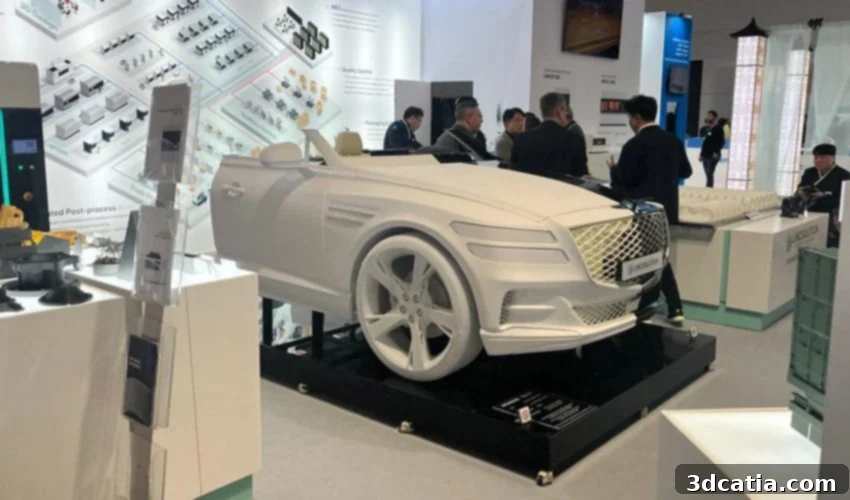
Formnext 2023: Driving Sustainable Mobility and Digital Transformation with Additive Manufacturing
Frankfurt’s Formnext expo, the premier global event for additive manufacturing, buzzed with distinct themes this year: automation, mobility, and sustainability. These interconnected concepts resonated across every industry represented, signaling a clear direction for the future of manufacturing. Our deep dive into the exhibition revealed why these topics are not just trending but are actively shaping innovative solutions across the board.
The prominence of the automotive industry at Formnext 2023 was unmistakable. In a sector where innovation, efficiency, and rapid iteration are paramount, additive manufacturing (AM) stands out as a transformative technology. While challenges like cost and scalability can limit AM’s direct application in high-volume series production, its benefits are profoundly impactful in areas such as prototyping, custom one-off parts, and small-batch manufacturing. The inherent ability of 3D printing to create complex geometries and enable unparalleled customization allows manufacturers to push design boundaries, optimize performance, and accelerate product development cycles. This makes AM an indispensable tool for automotive pioneers looking to gain a competitive edge and explore new engineering frontiers.
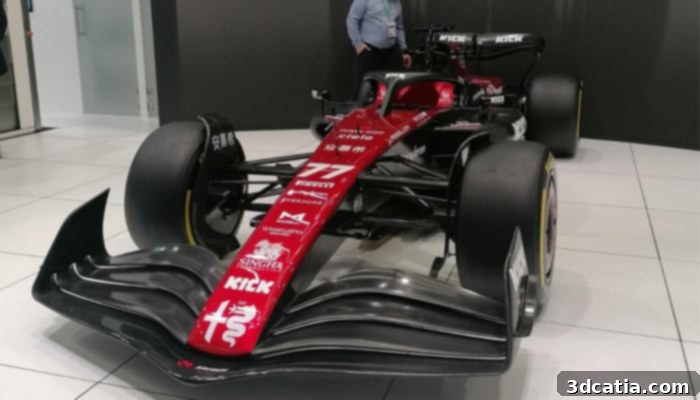
The Alfa Romeo racing car at Formnext 2023 showcasing advanced 3D printed components.
At Formnext, we witnessed firsthand the groundbreaking applications of AM in high-performance automotive. Racing cars from Alfa Romeo, as well as BWT Alpine in collaboration with 3DSystems, proudly displayed intricate 3D-printed components that contribute to their aerodynamic efficiency, lightweighting, and structural integrity. Furthermore, INTAMSYS partnered with the GreenTeam from the University of Stuttgart to present a remarkable 3D-printed, electric, self-driving racing car. These examples are not merely showcases of technological prowess; they underscore the incredible potential of AM for unique, high-value applications where customization and performance optimization are critical. While 3D printing often offers a ‘greener’ alternative for these specialized, individual items compared to traditional methods, the broader implications of sustainability for additive manufacturing within the wider automotive industry and large-scale series production require a more nuanced and critical examination. This crucial task of fostering transparent discourse and promoting sustainable practices has been taken on by organizations like Mobility Goes Additive.
Mobility, Sustainability & Additive Manufacturing: Fostering Transparency and Knowledge Exchange
The presence of Mobility Goes Additive (MGA) at Formnext 2023 highlighted the collaborative spirit driving AM innovation. MGA is a powerful network comprising approximately 120 key players spanning the entire additive manufacturing ecosystem—from end-users and research and development institutes to machine and material manufacturers. Their collective mission is to showcase and advance the immense potential of AM. MGA facilitates this by organizing eleven interdisciplinary working groups that tackle various critical topics related to AM, fostering an environment where expert knowledge can be openly exchanged. This collaborative approach is fundamental for transparently evaluating core themes like sustainability and mobility, ensuring a reflective and informed transfer of information. Particularly in the context of sustainability and mobility, MGA strategically focuses on the automotive industry to identify and demonstrate new, impactful applications. Regarding sustainability, MGA emphasizes the need for transparent data and accurate figures to correctly assess and communicate the environmental benefits and potential drawbacks of AM throughout the product lifecycle.
The imperative for transparent sustainability assessment extends far beyond the automotive sector, touching every industry that engages with additive manufacturing. To truly achieve a ‘green’ transformation of manufacturing through AM, a comprehensive approach is required, regardless of the specific sector. This involves a meticulous consideration of the carbon footprint associated with AM processes, the energy consumption of machines, strategies for waste reduction during production, and the potential for part reuse and material recycling. One industry that exemplifies the profound commitment to sustainable mobility and asset longevity is rail transportation. MGA has dedicated two distinct working groups specifically to the rail sector. Their objectives include defining the necessary regulatory frameworks and securing approvals for additive manufacturing technologies and materials destined for train parts. Beyond regulatory compliance, the focus is also on the sustainable, long-term creation of reliable train components, optimized for both performance and cost. This strategic integration of AM aims to significantly strengthen rail transport, solidifying its position as a more sustainable alternative to other modes of transportation.
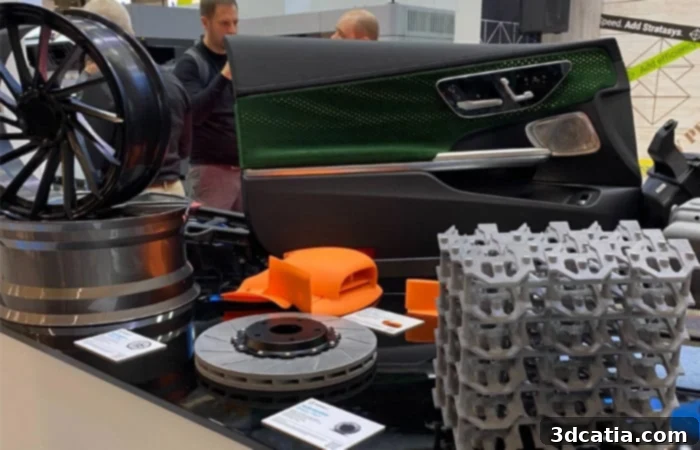
The importance of sustainable materials for the automotive and transportation industry was a key discussion point at Formnext.
European railways, in particular, are emerging as significant early adopters and drivers of additive manufacturing. There is a continuous exploration of new opportunities to integrate 3D printing more extensively into rail operations, a trend that was prominently showcased in Formnext’s comprehensive supporting program. Attendees at the Application Stage on November 9th gained invaluable insights into how leading European national train companies, including Austria’s ÖBB, France’s SNCF, and Germany’s DB, are leveraging additive manufacturing to address operational challenges, improve efficiency, and enhance sustainability. These presentations provided a clear perspective on both the immense potential and the inherent challenges in scaling AM solutions within the stringent requirements of the rail sector.
Additive Manufacturing on the Rails: Real-World Case Studies
Sebastian Otto from Austrian ÖBB Train Tech shared compelling insights into ÖBB’s innovative collaboration with Chromatic 3D Materials. This partnership focuses on utilizing AM for the crucial maintenance of its extensive train fleet. As previously reported, ÖBB has adopted the Chromatic RX-AM platform to produce vital parts and prototypes for its trains. A significant advantage of AM for ÖBB is its capability to fabricate spare parts that are no longer conventionally produced due to obsolete or discontinued models. This strategic use of 3D printing allows ÖBB to significantly extend the operational lifespan of its train fleet, preventing the costly and unsustainable necessity of manufacturing entirely new wagons simply because an essential spare part is unavailable. By embracing AM, ÖBB demonstrates a forward-thinking, sustainable approach to rail transport, embodying principles of a circular economy by maximizing asset longevity and minimizing waste.
German railway giant Deutsche Bahn (DB) shares a similar vision for extending the service life of its trains. Operating a vast rail network exceeding 33,000 kilometers, accommodating hundreds of regional trains and approximately 367 high-speed ICE trains, DB’s vehicles are constantly exposed to diverse environmental conditions and are subject to significant wear and tear. Consequently, the need for flexible and rapid maintenance is a critical driver for DB’s extensive adoption of additive manufacturing. AM distinctly outperforms traditional maintenance methods, particularly when urgent, spontaneous interventions and repairs are required, enabling quicker turnaround times and reduced operational disruptions.
DB effectively utilizes Formlabs SLA and SLS printers for a variety of applications, notably for printing specialized tools and custom fixings essential for maintenance tasks. Beyond immediate operational needs, DB is actively involved in testing new materials in collaboration with Formlabs, continually pushing the boundaries of AM capabilities. Helge Schneevogt and Antonia Knabe from DB Fahrzeuginstandhaltung GmbH (vehicle maintenance) underscored the profound importance of developing a robust digital warehouse within DB’s long-term strategy. Their ambitious goal is to establish a digital repository of print templates for approximately 10,000 parts by 2030, which would account for around 10% of the total spare parts required for vehicle maintenance. This digital inventory is projected to consist of roughly 70% polymer-based parts and 30% metal parts. However, the comprehensive implementation of this digital warehouse currently faces challenges related to part qualification, certification, material performance consistency, and integration into existing supply chain logistics, reflecting the complexities of scaling AM in a highly regulated industry.
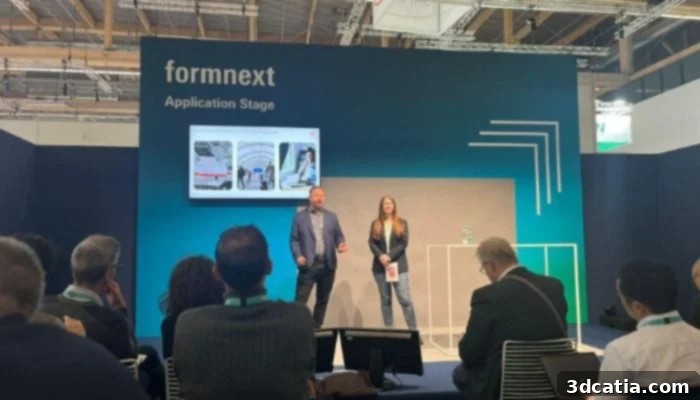
European rail company representatives shared their experiences with AM for rail transport at the Application Stage.
DB’s commitment to additive manufacturing extends beyond just the maintenance of train components. The company is also leveraging AM to significantly enhance passenger comfort and accessibility both inside the wagons and at train stations through custom-designed applications. The overarching aim is to forge a reliable and sustainable mode of transportation for the future. To realize this ambitious goal, DB has partnered with the Berlin-based software provider trinckle. A core strength of trinckle’s platform is its ability to generate automated design processes and provide advanced product configuration tools. This allows for unparalleled customization of 3D prints to meet specific requirements. For instance, DB is printing handrails integrated with Braille, enabling visually impaired individuals to navigate train stations more independently. This innovative application exemplifies how AM can be used to create inclusive solutions, customizing infrastructure components with individual content to serve diverse passenger needs.
Similarly, the French national railway company, SNCF, is actively exploring and experimenting with various additive technologies and materials to seamlessly integrate them into its extensive rail system, with a strong emphasis on sustainability. Pascal de Guio, speaking at Formnext, detailed SNCF’s experiences specifically with polymer printing, highlighting their work with Multi-Jet Fusion (MJF) technology. SNCF has conducted several promising application trials using PA12 material, demonstrating the potential for AM in various internal and non-critical components. However, de Guio also stressed a critical need for further development within the AM industry to significantly improve the repeatability, predictability, and manufacturability of materials like PA12. These quality characteristics are absolutely crucial for SNCF, given the stringent safety and performance standards of the rail sector. While quality remains paramount, the continuous focus in manufacturing is always on cost efficiency, which has also driven SNCF to experiment with other advanced technologies such as metal binder jetting and selective laser melting (SLM) for more structural or critical metal components.
The synergistic relationship between mobility and sustainability is undeniable, and additive manufacturing plays an increasingly pivotal role as a driving force in both areas. As eloquently demonstrated by the examples from European railroads and the collaborative efforts of Mobility Goes Additive, there is extensive ongoing research, development, and experimentation aimed at more deeply integrating additive manufacturing into rail transport and the broader automotive industry. These initiatives are not just about technological advancement; they are about shaping a future vision of manufacturing that prioritizes transparency, efficiency, and environmental responsibility. Formnext 2023 served as a vital platform, showcasing how these trending topics are converging to redefine industrial processes and unlock sustainable solutions for complex global challenges.
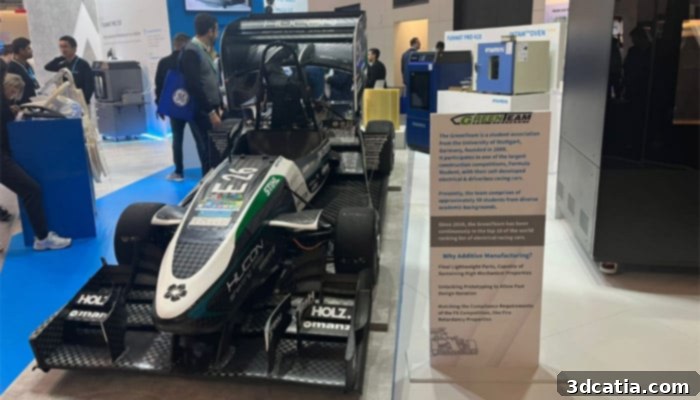
Sustainability and mobility were key considerations in the development of this racing car by Green Team and INTAMSYS.
What are your thoughts on the trending topics of mobility and sustainability in connection with additive manufacturing? Let us know in a comment below or on ourLinkedIn,Facebook, andTwitter pages! Don’t forget to sign up for our free weeklyNewsletter here, to receive the latest 3D printing news straight to your inbox! You can also find all our videos on ourYouTube channel.
*All image credits: 3Dnatives