
Revolutionizing Industries: Top 5 3D Printing Innovations Driving Progress in Healthcare, Automotive, and Beyond
In an era defined by rapid technological advancements, 3D printing, also known as additive manufacturing, continues to push the boundaries of what’s possible across a multitude of sectors. From healthcare and automotive to industrial design and consumer goods, this transformative technology is reshaping production workflows, enabling unprecedented customization, and offering agile solutions to complex challenges. Its ability to create intricate geometries layer by layer has not only accelerated product development but also opened doors for innovative applications that were once deemed impossible. This week, we delve into five compelling videos that powerfully illustrate how 3D printing is fundamentally changing our world, showcasing its profound impact on innovation and problem-solving. These examples highlight the versatility, speed, and precision that make additive manufacturing an indispensable tool for progress. If these insights pique your interest, we encourage you to explore even more groundbreaking 3D printing content on our Youtube channel. Get ready to be inspired by the future of manufacturing!
Top 1: 3D Printing Face Shields to Protect Against COVID-19
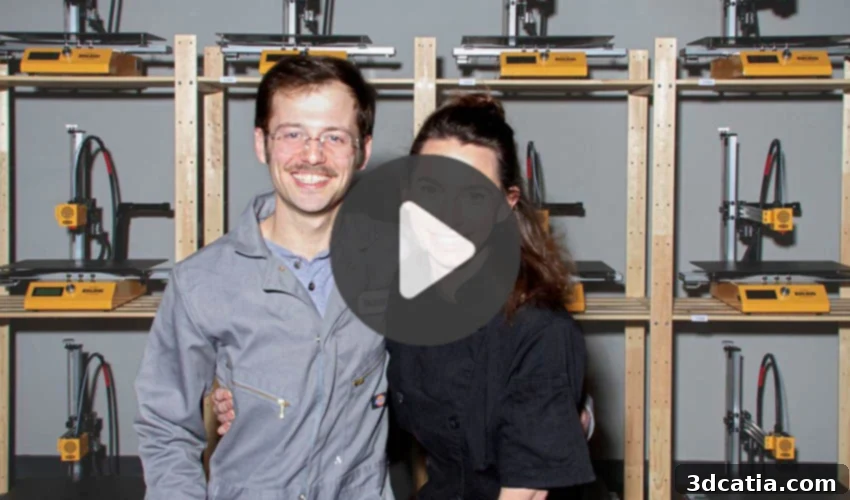
The global health crisis brought about by COVID-19 underscored the critical importance of adaptable and localized manufacturing. As supply chains faltered and the demand for personal protective equipment (PPE) surged, 3D printing emerged as a vital tool for communities and individuals to respond effectively. One inspiring example comes from Liverpool, United Kingdom, where a dedicated couple transformed their basement into a mini-production hub. Utilizing their personal 3D printers, they embarked on a mission to produce 300 face shields daily. This incredible initiative provided an additional layer of protection for frontline workers and community members against the highly transmissible virus. The couple’s existing business, which involved creating and selling custom 3D printers, provided them with the expertise and equipment needed to scale their efforts rapidly. Their motivation stemmed from hearing about plans to open a coronavirus testing site in their city, recognizing the immediate need for protective gear for the staff who would be conducting tests. This story perfectly encapsulates the power of decentralized manufacturing and community spirit that 3D printing facilitates, enabling quick responses to urgent needs when traditional supply lines are stretched thin. This grassroots effort mirrored larger-scale initiatives, such as that introduced by Prusa, which also harnessed its extensive 3D printer farm to produce vital shields for medical staff, demonstrating a collective commitment to leveraging additive manufacturing for public health.
Top 2: Assembling the 3D Printed Medical Face Shield from Prusa
Following in the footsteps of community-driven efforts, the renowned 3D printing company Prusa, a leader in open-source additive manufacturing, also played a pivotal role in addressing the PPE shortage. They released an accessible design for a 3D printed medical face shield, allowing individuals and organizations worldwide to contribute to the protective equipment supply. The accompanying video provides a comprehensive guide on how to assemble this shield to achieve optimal results, ensuring functionality and safety. However, Josef Prusa, the visionary founder of the company, shared crucial insights on his website regarding the complexities of producing medical-grade devices, emphasizing caution and responsibility. He explained, “I don’t intend to hamper the vibe we have now – not by a long shot, but printing respirators might not be the best idea at this time. Let me explain. None of the designs available right now have been tested to ensure they provide the protections needed, at least none of the ones I am aware of. To help with this, we have collected as many designs as we could find, and are working with experts to see if we can verify which ones really work. What are the key focus points? First, it’s the sealing, then the filter itself, the filter to the mask, and how the mask attaches to the face – it all must be perfect. Most of us print rigid materials that are hard to make compliant for seals. Even if we can get a good seal, will it remain functional e.g. even when the wearer talks?” This statement highlights the critical difference between simpler items like face shields and more complex medical devices such as respirators, which require rigorous testing, specific material properties for proper sealing, and adherence to stringent regulatory standards to ensure patient safety and efficacy. Prusa’s responsible approach underscored the importance of expert validation, even during emergencies, emphasizing that while 3D printing offers incredible agility, it must be balanced with scientific rigor when it comes to healthcare applications.
Top 3: 3D Printed Hands-Free Door Opener
In the ongoing battle against infectious diseases, minimizing contact with frequently touched surfaces is paramount. Materialise, a pioneering Belgian company with decades of experience in additive manufacturing, responded to this challenge by designing an ingenious 3D printed hands-free door opener. This simple yet highly effective device allows individuals to open doors using their arm or forearm, thereby eliminating direct hand contact with potentially contaminated handles. This innovation provides a practical and accessible solution for reducing the spread of viruses like the Coronavirus in public spaces, offices, and homes. The beauty of this design lies in its simplicity and the speed at which it can be produced and distributed using 3D printing technology. By leveraging readily available FDM (Fused Deposition Modeling) printers, individuals and facilities can print these openers locally, ensuring rapid deployment during critical times. This initiative by Materialise exemplifies how 3D printing can contribute to public health by creating practical tools that empower people to actively participate in preventing pathogen transmission. It’s a testament to the adaptability of additive manufacturing, moving beyond complex industrial applications to deliver immediate, impactful solutions for everyday safety. Numerous other innovative initiatives aimed at combating the spread of viruses, including 3D printed masks and ventilators, can be found, further showcasing the technology’s broad utility in health crises.
Top 4: 3D Printing to Accelerate Production of Car Parts
The automotive industry, characterized by its demand for high performance, lightweighting, and rapid innovation, has increasingly embraced 3D printing to gain a competitive edge. In the UK, Briggs Automotive Company (BAC), renowned for its single-seater supercars like the BAC Mono and BAC Mono R, has been a frontrunner in adopting additive manufacturing. The company recently announced its continued and expanded adoption of 3D printing across its production lifecycle. BAC has strategically partnered with 3DGBIRE, a leading professional 3D printing expert based in the UK, to seamlessly integrate Ultimaker 3D printers into its manufacturing workflow. This collaboration has allowed BAC to produce over 40 distinct 3D printed parts for its high-performance vehicles, covering everything from initial prototypes and specialized tooling to critical end-use components. The use of 3D printing in supercar manufacturing offers several key advantages: it enables rapid iteration of designs, significantly reduces the time and cost associated with traditional tooling, and allows for the creation of complex, topology-optimized geometries that enhance performance and reduce weight. For a company like BAC, where every gram and every aerodynamic curve counts, additive manufacturing provides the agility and precision necessary to push the boundaries of automotive engineering. This video provides a fascinating glimpse into how a high-end automotive manufacturer is leveraging cutting-edge 3D printing technology to accelerate production, enhance vehicle performance, and innovate at a pace previously unimaginable in traditional manufacturing processes. It exemplifies the transition of 3D printing from a prototyping tool to an integral part of high-value production.
Top 5: Visualizing Surgery Thanks to 3D Printing Technologies
Beyond the production of physical components and protective gear, additive manufacturing is profoundly transforming the medical sector through its ability to create highly accurate and patient-specific anatomical models. As many are aware, medical 3D printing plays a crucial role in designing custom implants and prosthetics tailored to individual patient anatomies. However, its applications extend significantly into pre-surgical planning and training, offering surgeons and medical professionals unprecedented insights and preparation opportunities. The video highlights a compelling application at the Marie Lannelongue Hospital, where young interns are benefiting immensely from realistic 3D printed anatomical models. These models allow them to apply their theoretical knowledge and practical skills in vascular surgery in a tangible, risk-free environment. Unlike traditional cadaver labs or virtual simulations, 3D printed models can precisely replicate the unique pathologies and anatomical variations of specific patients, providing an unparalleled level of realism. The hospital’s collaboration with industry leader GE Additive ensures the creation of incredibly accurate and realistic models, crucial for effective training. This approach reduces surgical risks, improves patient outcomes, and significantly shortens the learning curve for aspiring surgeons. By allowing interns to practice complex procedures on exact replicas of patient anatomy, 3D printing enhances their confidence, dexterity, and decision-making abilities before they enter the operating room. This transformative use of additive manufacturing solidifies its position as a cornerstone of modern medical education and personalized patient care, showcasing its power to innovate beyond manufacturing and directly impact human health and well-being.
The videos we’ve explored this week powerfully illustrate the transformative potential of 3D printing across diverse industries. From enabling rapid responses to global health crises with protective equipment and hygiene solutions, to accelerating innovation in high-performance automotive manufacturing, and revolutionizing medical training and pre-surgical planning, additive manufacturing stands as a testament to human ingenuity and technological advancement. This technology is not merely a tool for creation; it is a catalyst for innovation, adaptability, and progress, constantly finding new ways to solve real-world problems and improve lives. Whether it’s empowering local communities, enhancing industrial efficiency, or advancing patient care, 3D printing continues to redefine what’s possible. Are you inspired to make your own 3D printed face shield, or perhaps explore other applications of this incredible technology? We’d love to hear your thoughts and insights! Drop a comment below or connect with us on our Facebook and Twitter pages. And to ensure you stay at the forefront of this dynamic field, don’t forget to sign up for our free weekly Newsletter, delivering all the latest news and breakthroughs in the 3D printing industry straight to your inbox!