
Facebook’s Modular Device Patent: Pioneering Customizable Electronics with 3D Printing
As a global technology titan, now known as Meta, with billions of users across its platforms, the company has consistently positioned itself at the forefront of technological innovation. From its foundational role in social networking to its ambitious forays into the metaverse and virtual reality, Meta (formerly Facebook) maintains a relentless pursuit of future-defining advancements. This history of setting trends and pushing boundaries makes it entirely unsurprising that their latest venture, revealed through a recently filed patent, points towards an intriguing new direction for consumer electronics, potentially harnessing the transformative power of additive manufacturing.
The patent, filed by Meta’s highly secretive Building 8 division, offers a glimpse into the company’s aspirations for a new class of consumer hardware. Building 8 is renowned for its focus on audacious, innovative, and often futuristic ideas, pushing the limits of what’s possible in the consumer hardware space. The patent describes a “modular electronic device” designed around a principle strikingly similar to LEGO bricks, emphasizing user-driven assembly and customization. This concept allows users to configure their devices precisely to their individual needs and preferences, promising an unprecedented level of personalization in a market often dominated by fixed-form products.
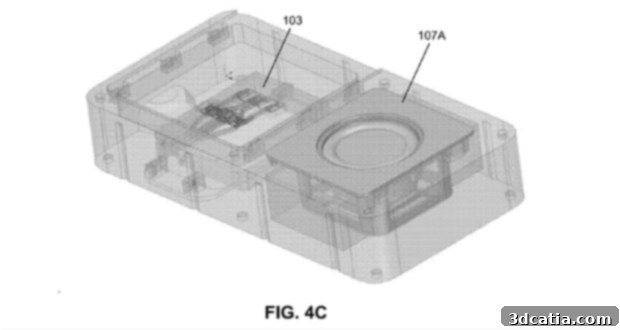
According to the official patent documentation and accompanying images, the proposed modular device is highly versatile. It could manifest as a smart speaker, akin to popular voice-controlled assistants, or even evolve into a fully functional smartphone. The patent details a range of integrated components, including a microphone for voice commands, a loudspeaker for audio output, a touch screen for interactive displays, and GPS functionality for location-based services. The inclusion of these elements strongly suggests its potential application as a communication device, effectively a modular telephone, capable of adapting its core functionality based on the modules attached.
The precise form and function of the device remain largely unknown. Could it be a customizable smart speaker, a modular smartphone, or something entirely new, perhaps in the vein of an Amazon Echo?
While many specifics of this innovative patent remain under wraps, one detail stands out as particularly significant for the future of manufacturing and consumer choice: the potential for its encasing to be produced using 3D printing. This means that users wouldn’t merely assemble pre-made modules; they could potentially personalize the physical shell of their device through additive manufacturing. This opens up a world of possibilities for aesthetic customization, functional enhancements, and even unique ergonomic designs tailored to individual users. The ability to 3D print components fundamentally shifts the paradigm from mass production to mass personalization, offering consumers an unprecedented degree of control over their hardware.
The integration of 3D printing into the manufacturing process of such a modular device offers numerous advantages beyond mere aesthetics. For instance, it allows for rapid prototyping and iteration during the development phase, enabling Building 8 to quickly test and refine new module designs. More importantly, it empowers end-users to become co-creators. Imagine a scenario where a user can download design files for specific enclosures or functional accessories and print them at home or through local service bureaus. This democratizes device ownership, extending product lifespans by enabling easy replacement of damaged parts or upgrades to new functionalities without needing to replace the entire device. This approach aligns with a growing demand for sustainable and repairable electronics, reducing electronic waste and fostering a more circular economy.
The concept of a modular smartphone, or any modular electronic device, is not entirely new. Companies like Google have previously ventured into this territory with ambitious projects such as Project Ara. Google’s Project Ara, initiated with great fanfare, aimed to create a smartphone where users could swap out individual components like cameras, batteries, and even processors, much like LEGO bricks. Despite several years of dedicated development, Project Ara was ultimately suspended, failing to produce a viable commercial product. The challenges were manifold, including manufacturing complexities, economic feasibility, design constraints, and the difficulty of integrating diverse modules into a cohesive user experience.
However, Meta’s approach with Building 8 and its modular device patent appears to be learning from past experiences. It is particularly noteworthy that some individuals who were instrumental in Project Ara’s development are now reportedly working within Meta’s Building 8 division. This transfer of talent and knowledge suggests that Meta might leverage the lessons learned from Ara’s shortcomings, potentially addressing issues of module standardization, interoperability, and market adoption more effectively. By integrating 3D printing from the outset, Meta might also bypass some of the manufacturing hurdles that plagued earlier modular device attempts, enabling more flexible and cost-effective production of custom enclosures and unique module interfaces.
Google’s ambitious Project Ara modular smartphone, designed for user-customizable components, was suspended in 2016 following several years of development.
Should Meta successfully bring this modular device to market, its implications for the consumer electronics industry could be profound. It could usher in an era where consumers are no longer bound by predefined product specifications but can actively participate in the design and evolution of their devices. This shift could foster a culture of longevity and adaptability in electronics, reducing the pressure to constantly upgrade to entirely new devices. Instead, users could incrementally enhance or repair their existing hardware, leading to greater user satisfaction and a more sustainable consumption model. This vision aligns perfectly with Meta’s broader strategy of building persistent, personalized digital and physical experiences, especially as it delves deeper into the metaverse, where customizable hardware could serve as key access points.
The integration of additive manufacturing further cements the potential revolutionary impact of this patent. 3D printing technologies are evolving rapidly, offering ever-increasing capabilities in terms of materials, precision, and production speed. By making device casings and potentially even certain internal structures 3D printable, Meta could significantly reduce tooling costs, accelerate design cycles, and offer an unparalleled degree of product differentiation. This approach supports a future where consumer devices are not just “smart” but also uniquely “personal,” reflecting the individual identities and evolving needs of their owners. It positions Meta not just as a software and virtual reality pioneer, but also as a hardware innovator poised to redefine physical interaction with technology.
While the full details of this new device and Meta’s development plans are still largely unknown, the very existence of such a patent from a division like Building 8 signals a bold step towards redefining the consumer electronics landscape. Whatever innovations are brewing behind Meta’s closed doors, they are almost certain to catalyze significant shifts in how we perceive, purchase, and interact with our personal technology. We eagerly anticipate how Meta will integrate additive manufacturing into this ambitious vision, potentially unlocking new frontiers of customization, sustainability, and user empowerment in the digital age.
What do you envision Facebook’s (Meta’s) patent meaning for the future of 3D printing and personalized electronics? Share your thoughts and predictions in a comment below or join the conversation on our Facebook and Twitter pages! Don’t forget to sign up for our free weekly Newsletter to receive all the latest news in 3D printing delivered straight to your inbox!