
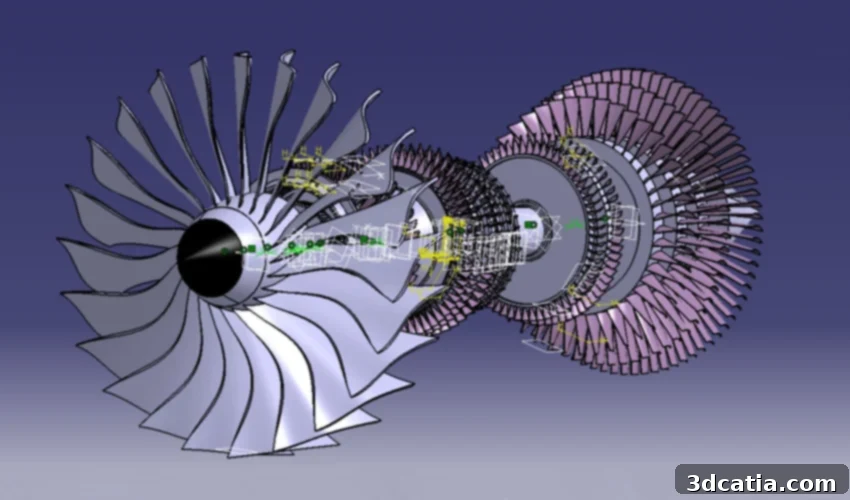
CATIA: The Ultimate Solution for Advanced 3D Design, Engineering, and Manufacturing
In today’s rapidly evolving technological landscape, the world of 3D modeling software offers a vast array of tools catering to diverse user needs, from hobbyists and students to seasoned professionals. Among these, CATIA, an acronym for Computer-Aided Three Dimensional Interactive Application, stands out as a preeminent, comprehensive, and multi-platform solution. Developed and marketed by the renowned French software company Dassault Systèmes, CATIA is much more than just a CAD (Computer-Aided Design) program. It encompasses a complete ecosystem for computer-aided design, manufacturing, engineering, simulation, 3D printing, and robust Product Lifecycle Management (PLM).
Distinguished by its unparalleled depth and breadth, CATIA is the software of choice for designing, manufacturing, and analyzing complex products across numerous high-stakes industries. While sharing common ground with other powerful tools like Solidworks (also from Dassault Systèmes) in offering powerful parametric modeling and photorealistic rendering capabilities, CATIA elevates the design experience. It provides significantly more advanced functionality, particularly for complex surface modeling and highly specialized modules tailored for specific industry workflows. This makes it an indispensable tool for innovators pushing the boundaries of product development and engineering excellence.
The Legacy and Evolution of CATIA
CATIA’s journey began in the 1970s, rooted in the internal needs of Dassault Systèmes’ engineering teams. Its initial development was famously centered around the sophisticated design requirements of the iconic Mirage fighter aircraft. This aerospace origin instilled in CATIA an inherent DNA of precision, complexity, and reliability, qualities that have remained central to its evolution. From its inception as an in-house tool, it quickly demonstrated its potential as a robust and indispensable solution for external clients in demanding sectors.
Over the decades, Dassault Systèmes has maintained a relentless commitment to innovation, continuously enhancing and expanding CATIA’s functionalities. This dedication has culminated in its most recent iterations, such as CATIA V5-6R and the revolutionary CATIA 3DExperience. Today, the software’s applications are vast and varied, primarily spanning engineering and systems engineering, sophisticated design, and construction. Its advanced capabilities make it an ideal tool for critical industries including, but not limited to, the aerospace sector, transportation, naval architecture, automotive design, and large-scale construction. Furthermore, CATIA is widely recognized as one of the most powerful and frequently utilized CAD programs for facilitating designs optimized for additive manufacturing, often referred to as 3D printing.
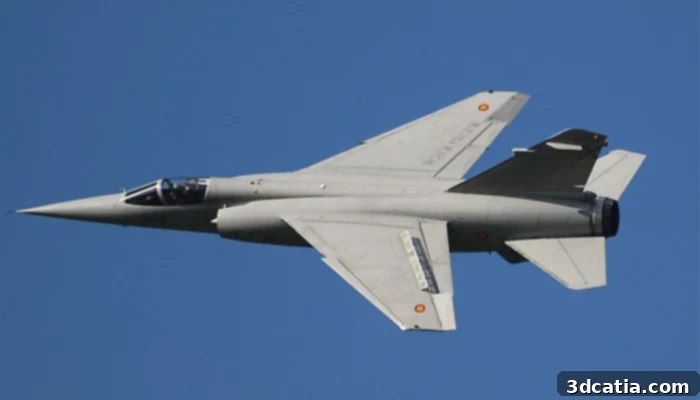
CATIA was initially used to design the Mirage fighter aircraft
Key Features and Core Capabilities of CATIA
CATIA’s robust capabilities empower users to create both parametric and non-parametric 3D models. Parametric modeling allows designers to capture design intent through constraints and relationships, enabling easy modification and iteration, which is crucial for engineering precision. Non-parametric modeling, on the other hand, provides the freedom for more organic, freeform shapes and artistic design, essential for styling and aesthetic considerations. This dual capability offers unparalleled flexibility in product development.
The software boasts broad operating system compatibility, supporting Windows, Solaris, IRIX, and HP-UX, ensuring its accessibility across various enterprise IT infrastructures. To cater to its global user base, CATIA is available in numerous languages, including English, French, German, Italian, Japanese, Chinese, Korean, and Russian, fostering international collaboration and localized user experiences. A fundamental feature, crucial for modern manufacturing, is its ability to export models in standard formats like STL. This enables seamless integration with 3D printing software and allows designs to be sent directly to 3D printers, bridging the gap between digital design and physical production.
Dassault Systèmes understands the importance of maintaining data integrity and project continuity across different software versions. For users with older versions of the program, the company provides essential tools to convert files, ensuring compatibility with the most recent releases. This commitment to backward compatibility protects investments in legacy data and facilitates smooth transitions to updated workflows. Currently, CATIA is primarily offered in two distinct versions, each tailored to specific functional requirements and user environments: CATIA V5-6R and CATIA 3DExperience.
CATIA V5-6R: Enhanced Productivity and Collaboration
CATIA V5-6R, with its latest iteration like V5-6R2016, represents a significant refinement in traditional CAD/CAM/CAE functionality. This version prioritizes enhanced user productivity and ease of use through streamlined interfaces and optimized workflows, allowing engineers and designers to accomplish tasks more efficiently. A core strength of V5-6R is its high compatibility, not only with previous V5 versions but also with other design software, facilitating robust data exchange in multi-CAD environments. This also ensures a smoother, more manageable transition path for organizations looking to migrate or integrate with the newer 3DExperience platform.
Collaboration is a cornerstone of modern product development, and CATIA V5-6R offers a superior collaborative experience. Teams can leverage “plug and play” virtual reality (VR) screens, enabling immersive interaction with product designs. This VR integration allows stakeholders to conduct design reviews, identify potential issues, and make informed decisions in a highly intuitive and engaging virtual environment, significantly reducing prototyping costs and accelerating development cycles. Users benefit from over 80 enhanced features, including advanced tools for complex room design, sophisticated Generative Shape Design applications for creating intricate and aesthetically pleasing surfaces, and numerous improvements in areas such as part design, assembly management, and manufacturing preparation modules.
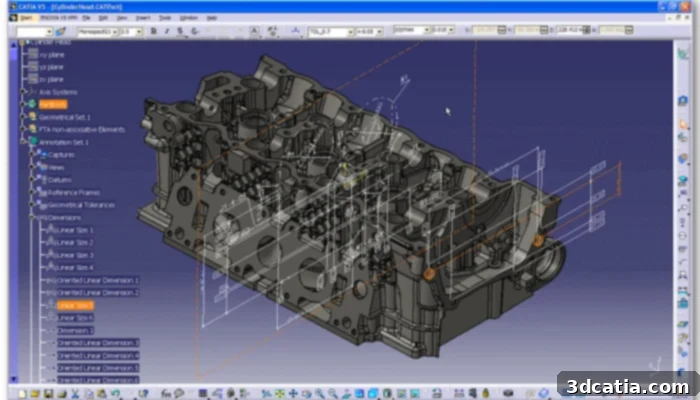
The version V5-6R of CATIA.
CATIA 3DExperience: A Holistic Platform for Innovation
Building upon the strengths of its predecessors, 3DExperience CATIA represents a paradigm shift in product development. While offering all the advanced design capabilities of V5-6R, it goes further by integrating other powerful Dassault Systèmes brands directly into a unified ecosystem. This includes Simulia for realistic simulation and analysis, Delmia for digital manufacturing and production planning, and Enovia for robust Product Lifecycle Management (PLM), project collaboration, and data management.
This seamless integration transforms the traditional approach to product development by combining design, manufacturing, simulation, and product optimization onto a single, interconnected platform. The 3DExperience ecosystem fosters true collaboration across departments and disciplines, ensuring data consistency and real-time communication throughout the entire product lifecycle. For additive manufacturing, this integrated approach is invaluable: designers can create complex geometries in CATIA, simulate their printability and performance in Simulia, plan the manufacturing process in Delmia, and manage all related data and workflows in Enovia – all within the same environment. This streamlined process significantly reduces errors, accelerates innovation, and optimizes designs specifically for 3D printing.
Moreover, 3DExperience CATIA offers modern, cloud-enabled functionalities that enhance user experience and accessibility. Users can view models without the need for additional software installations, making design reviews and stakeholder collaboration more accessible than ever. The ability to save designs directly to the cloud contributes to unparalleled ease of use, ensuring data security, version control, and accessibility from anywhere, at any time. Recent updates, such as CATIA R2023x, continue to introduce groundbreaking enhancements and new features. These advancements are designed to push the boundaries of virtual design further, fostering greater design creativity, improving collaborative workflows, and ultimately driving product innovation to new heights. Through its comprehensive suite of tools and integrated platform, CATIA 3DExperience empowers businesses to transform their product development processes and achieve unparalleled levels of efficiency and innovation.
Why Choose CATIA for Your Projects?
CATIA’s diverse applications collectively form the backbone of Dassault Systèmes’ solutions, meticulously engineered to address the complex and evolving needs of various industries. From the initial conceptual design phase through detailed engineering, manufacturing, and even in-service support, CATIA provides an end-to-end digital continuity that is unmatched. These robust programs are revolutionizing the way companies design, develop, and bring groundbreaking products to market, enabling them to tackle the most demanding engineering challenges with confidence and precision. Its ability to handle large assemblies, intricate surfacing, and multi-disciplinary engineering processes makes it an indispensable asset for global enterprises.
Beyond its powerful software capabilities, CATIA users also gain access to a vibrant and active global community. This community serves as an invaluable resource where professionals, students, and enthusiasts can discuss, exchange information, share ideas, and troubleshoot challenges related to CATIA and their ongoing projects. This collaborative environment fosters learning, skill development, and networking, further enhancing the value proposition of choosing CATIA. To explore the full potential of CATIA, learn more about its licensing options, and discover the different versions available, we encourage you to visit the official Dassault Systèmes website HERE.
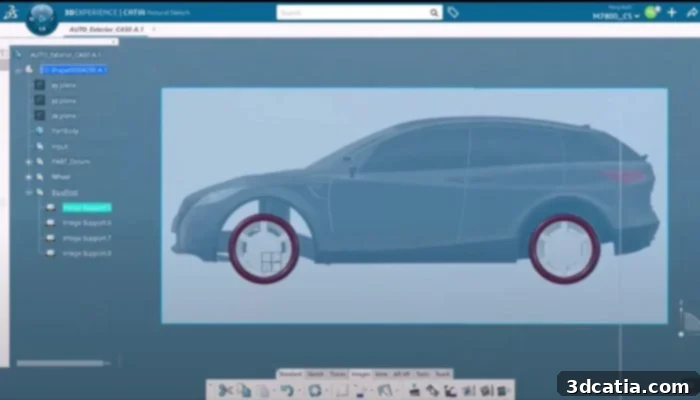
Photo Credits: Dassault Systèmes
What are your thoughts on CATIA software? Have you used it for your projects, and if so, what has been your experience? We invite you to share your insights in a comment below or join the conversation on our Facebook and Twitter pages! For the latest news and updates in the world of 3D printing and advanced manufacturing, don’t forget to sign up for our free weekly Newsletter, delivered straight to your inbox!