

Tesla Pioneers Sand 3D Printing for Next-Gen EV Manufacturing: Revolutionizing Production and Unlocking Significant Cost Savings
The global automotive industry is undergoing an unprecedented transformation, largely driven by the surging demand for electric vehicles (EVs). As environmental concerns intensify and technological advancements make EVs more accessible, the market continues to expand at a remarkable pace. In this dynamic landscape, Tesla, under the leadership of Elon Musk, has consistently maintained its position at the forefront of innovation, pushing the boundaries of what’s possible in EV design and production. While most traditional car manufacturers are now offering their own electric models, Tesla’s pioneering spirit often sets new benchmarks for efficiency and sustainability. Recent reports suggest that the company is looking to further solidify its competitive edge and dramatically cut production costs by exploring an innovative approach: integrating sand 3D printing into its manufacturing processes. This strategic move aims to complement Tesla’s already revolutionary techniques, signaling a potential paradigm shift in how electric vehicles are built.
Additive manufacturing, commonly known as 3D printing, has been an integral part of the automotive sector for many years, albeit often in more direct applications. We frequently hear about the use of Fused Deposition Modeling (FDM) for creating prototypes, custom tooling, or even end-use parts, as exemplified by cases like Ford’s initiatives. These applications involve directly printing the desired component. However, Tesla’s rumored strategy diverges significantly from these conventional uses. If adopted, this would mark one of the first instances where a major American car manufacturer extensively utilizes additive manufacturing for an *indirect* process on such a scale: employing sand 3D printing to create intricate and massive molds, which are then used in a subsequent casting method to produce the actual vehicle parts. This approach promises to leverage the unique advantages of 3D printing in ways that could redefine automotive manufacturing efficiency.

Sand 3D printing would complement Tesla’s existing car manufacturing methods, enabling the creation of larger, more complex parts (photo credits: Tesla)
Tesla’s Strategic Integration of Sand 3D Printing for Enhanced Efficiency
As indicated by the Reuters report, additive manufacturing is not expected to be used for the entire car manufacturing process in a direct sense. Instead, Tesla plans to integrate it synergistically with its already groundbreaking “gigacasting” process. This innovative method involves using colossal presses to mold the front and rear structures of a vehicle in single, massive pieces, dramatically reducing the number of individual components and simplifying the assembly line. The gigacasting approach has already proven instrumental in enabling Tesla to significantly reduce production costs and achieve a competitive lead in the industry. By introducing sand 3D printing into this equation, Tesla aims to further optimize its manufacturing workflow, widen the gap with competitors, and accelerate its mission to make electric vehicles more affordable and widely accessible.
Specifically, Tesla is exploring the adoption of sand binder jetting technology. This sophisticated additive manufacturing technique involves depositing a binder agent onto a bed of sand particles, layer by layer, to create highly precise and complex molds. The primary goal is to produce gigantic molds that will enable the company to die-cast nearly the entire underbody of an EV as a single, integrated piece, rather than the conventional approach of assembling hundreds of separate parts—a process that typically involves around 400 distinct components. Sand binder jetting is a well-established method for creating significantly cheaper, larger, and more intricate molds and cores, especially in foundries and for metal casting applications. Its versatility and ability to produce complex internal geometries without the need for traditional tooling make it an ideal candidate for Tesla’s ambitious goal. Moreover, the technology supports the creation of extremely large parts, which is a critical advantage when designing a one-piece vehicle underbody mold, ensuring structural integrity and design flexibility.
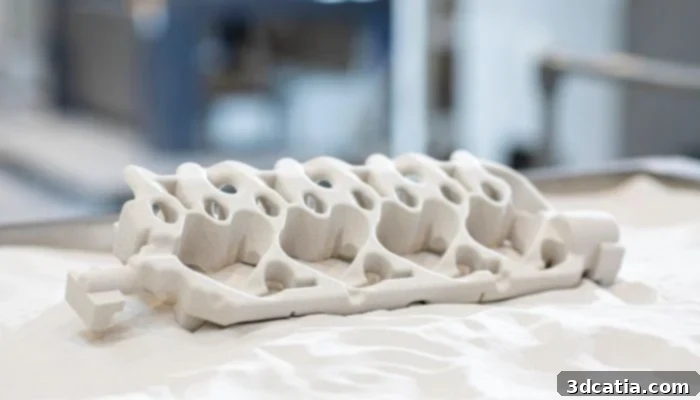
Tesla may utilize sand 3D printing for the creation of exceptionally large and complex molds, as shown in this ExOne example (photo credits: ExOne)
Unlocking Unprecedented Cost Savings and Accelerating Development
The underlying motivation for Tesla’s exploration of sand 3D printing is fundamentally economic. While there have been no official statements from Tesla regarding these plans, the Reuters report, citing two anonymous sources close to the matter, suggests that these new design and manufacturing techniques could drastically reduce the development cycle of a car from initial concept to market readiness, bringing it down to an astonishing 18-24 months. This represents a substantial decrease compared to the typical development timelines of other major car manufacturers, which often span several years. Such an acceleration would grant Tesla an unparalleled advantage in bringing new models to market faster, responding to consumer demands, and staying ahead of the rapidly evolving EV landscape.
Furthermore, the integration of sand 3D printing for mold creation directly addresses one of the most significant barriers in casting larger structures: prohibitive costs. Historically, casting extremely large, single-piece components has been financially unfeasible for mass production due to the enormous expense associated with designing and manufacturing traditional metal molds. The report highlights that the estimated cost for a conventional metal mold capable of casting such a massive part could be as high as $4 million. However, by adopting sand binder jetting for mold production, Tesla could potentially reduce this expenditure to a mere 3% of that cost, achieving dramatic savings in tooling. Beyond the initial cost reduction, sand casting also offers a much faster design validation cycle compared to its metal mold counterparts. This means that design iterations can be tested and refined much more quickly, shaving off crucial time from the pre-production phase. However, this innovative approach does present a material science challenge: Tesla would need to develop a tailor-made aluminum alloy. Current alloys used by the company reportedly react poorly with sand molds, failing to meet specific safety and performance criteria. Overcoming this material hurdle will be key to successfully implementing the strategy, potentially necessitating significant investment in metallurgical research and development.
It is crucial to emphasize that these discussions and reported plans are not yet officially confirmed. Even the sources cited by Reuters noted that sand 3D printing is merely one of several potential manufacturing methods currently under consideration by Tesla. Nevertheless, the prospect of Tesla adopting sand binder jetting on this scale represents an incredibly exciting and potentially transformative advancement in the automotive manufacturing sector, particularly for electric vehicles. The benefits for consumers could be profound in the near future, primarily through the potential for more affordable EVs. Indeed, these strategic discussions are reportedly part of a broader, long-term goal for Tesla to unveil a new model priced around $25,000 within the coming years, making sustainable transportation accessible to a much wider audience. This vision, powered by innovative manufacturing techniques, could truly democratize electric vehicle ownership.
What are your thoughts on Tesla’s potential use of sand 3D printing in the creation of its electric vehicles? Do you believe the company will ultimately adopt this groundbreaking new method, and how do you think it might impact the wider automotive industry? We invite you to share your insights in a comment below or join the discussion on our LinkedIn, Facebook, and Twitter pages! Don’t forget to sign up for our free weekly Newsletter here to receive the latest 3D printing news directly to your inbox. You can also explore all our videos and interviews on our YouTube channel for more in-depth content.
*Cover Photo Credits: Tesla