
Achieving Unprecedented Precision: Electrochemical Post-Processing for Metal 3D Printed Parts
As metal additive manufacturing continues its rapid expansion, the pursuit of exceptionally high-quality and high-precision components for specialized and demanding applications remains a significant challenge. Industries such as aerospace, automotive, and medical implants require parts with stringent dimensional tolerances and impeccable surface finishes. To address this critical need, a pioneering team of researchers at Saarland University in Germany has developed an innovative non-contact process rooted in electrochemistry. This breakthrough technology is designed to transform conventionally metal 3D printed parts into intricate, end-use components, achieving dimensional tolerances down to a few thousandths of a millimeter. This method promises to unlock the full potential of metal additive manufacturing, enabling its broader adoption for critical applications where precision and performance are paramount.
The industrial demand for metal parts is consistently robust, necessitating adherence to rigorous specifications, particularly concerning dimensional accuracy and surface integrity. Components used in aircraft engines, automotive powertrains, and rocket propulsion systems are typically assemblies of multiple parts, each engineered to endure immense mechanical stresses and extreme operating conditions. In this context, the precise fit and flawless operation of every single component are non-negotiable for overall system reliability and safety. Metal additive manufacturing has revolutionized design capabilities, allowing for the consolidation of multiple components into single, highly complex geometries and the creation of optimized structures that were previously impossible to achieve. However, despite these remarkable advantages, mastering the technology to consistently produce parts with mechanical characteristics comparable to traditionally machined components, especially regarding dimensional accuracy and surface finish, remains a complex endeavor. The inherent “layer-by-layer” nature of 3D printing often leaves visible layer lines and micro-scale inaccuracies, which are unacceptable for many high-performance applications.
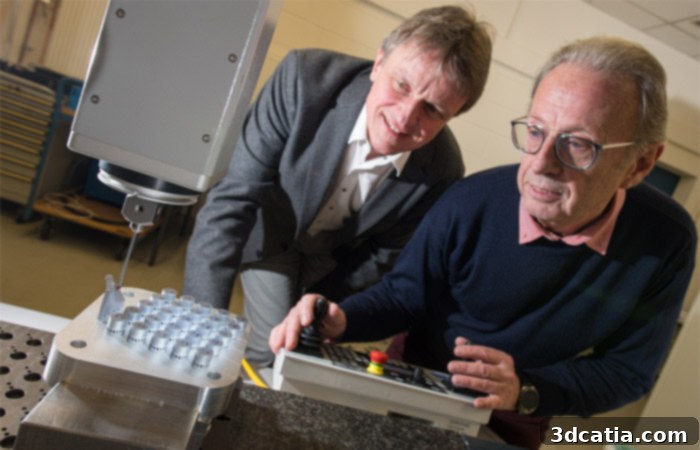
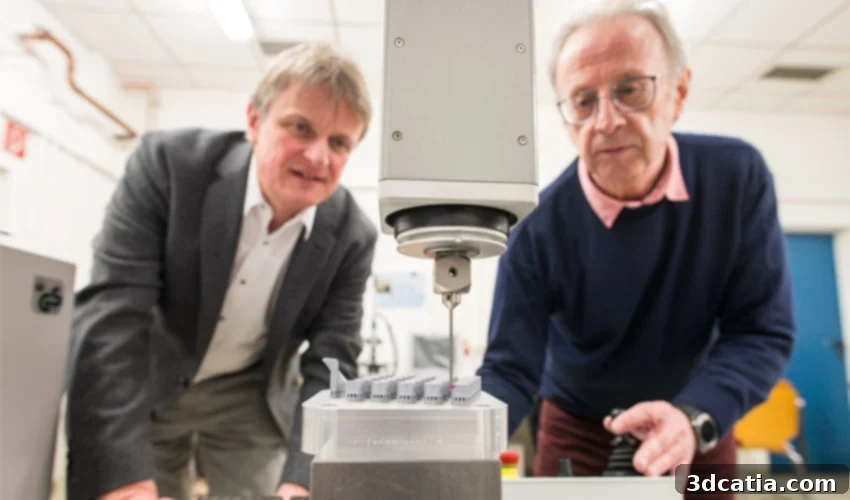
Precision machining is the speciality of researchers Dirk Bähre (left) and Stefan Wilhelm, his technical assistant | Credits: Oliver Dietze
The Electrochemical Machining Breakthrough for Additive Manufacturing
Recognizing the persistent challenges in achieving the required precision for metal 3D printed parts, Professor Dirk Bähre and his dedicated research team have pioneered a non-contact method specifically tailored for the post-processing of these components. Their innovation centers around electrochemical machining (ECM), a highly effective technique for material removal through a controlled electrochemical process. Professor Bähre elaborates on the profound capabilities of this method: “Electrochemical material removal enables the creation of even the most intricate geometries within the hardest metals. Our non-destructive, non-contact manufacturing technology provides an efficient means to machine parts with complex shapes, even when fabricated from high-strength and notoriously difficult-to-machine materials.” This approach elegantly sidesteps the mechanical stresses and thermal distortions often associated with conventional machining processes, which can compromise the integrity of intricate 3D printed structures.
Traditional machining methods, while precise, can introduce tool wear, heat-affected zones, and residual stresses, especially when dealing with complex geometries or advanced alloys common in additive manufacturing. The non-contact nature of ECM eliminates these issues, offering a superior alternative for finishing delicate or geometrically complex parts. Furthermore, the ability of ECM to process high-strength materials without significantly impacting their microstructure or mechanical properties is a game-changer for critical applications. By leveraging electrochemical principles, the Saarland University team is bridging the gap between the design freedom offered by metal 3D printing and the stringent requirements for finished component quality, paving the way for wider industrial adoption of additive manufacturing in performance-critical sectors.
Delving into the Mechanics: How Electrochemical Machining Transforms Metal Parts
The electrochemical-based process developed at Saarland University operates on a fundamental principle of controlled anodic dissolution. The initial and crucial step involves immersing the 3D printed metal parts in a carefully formulated fluid electrolyte solution. Once submerged, these parts can then undergo electrochemical machining to achieve the exact geometry and tolerance levels required. The setup is elegantly simple yet remarkably effective: it primarily requires a source of electrical power. An electric current is then precisely applied, flowing between a specialized tool, which acts as the cathode, and the 3D printed part itself, serving as the anode. The entire assembly is enveloped within a conductive fluid, typically an aqueous salt solution, which facilitates the electrochemical reactions.
During the process, metal atoms present on the surface of the workpiece are ionized. These positively charged metal ions then dissolve and enter the electrolyte solution. This selective removal of material from the workpiece surface allows for the gradual and precise shaping of the part. The key advantages of this method lie in its non-contact nature, meaning there is no mechanical force exerted on the part, and its non-thermal characteristic, which prevents any heat-induced stress or distortion. Professor Bähre further emphasizes the meticulous control achievable with their method: “By carefully adjusting parameters such as the duration of the current pulses and introducing controlled vibration of the tool, we can ensure that material is removed from the surface with exceptional uniformity. This level of control is instrumental in producing remarkably smooth surfaces and achieving extraordinarily high dimensional accuracy, which is critical for demanding applications.” This precision allows the process to remove microscopic irregularities and layer lines inherent in additive manufacturing, resulting in a finished product with superior surface quality and dimensional integrity, rivaling or even exceeding that of traditionally machined components.
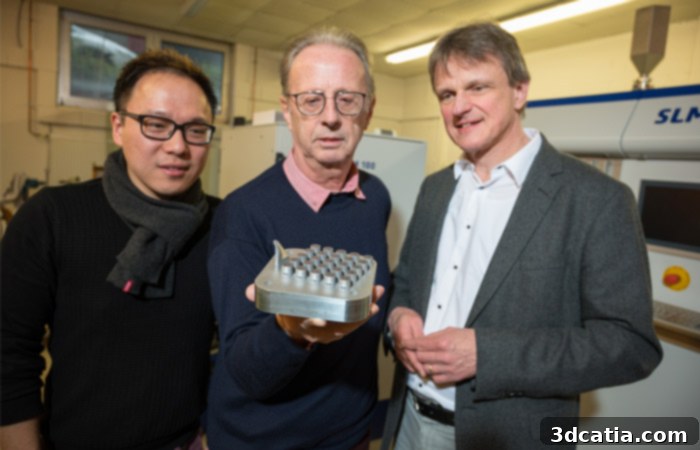
The post-processing method significantly improves the dimensional accuracy of the parts, enhancing their suitability for critical applications | Credits: Oliver Dietze
Broadening Applications and Future Prospects for High-Precision AM Parts
The Saarland University team’s rigorous research extends beyond theoretical development, encompassing comprehensive practical evaluations. They have successfully tested their electrochemical post-processing method on a diverse range of metal alloys, including commonly used materials like steel, aluminum, and titanium. This extensive testing involves meticulously evaluating every stage of the process, from initial immersion to final dimensional verification, ensuring robustness and repeatability across different material properties. The overarching objective of this ongoing research is to continuously refine and optimize the electrochemical methods employed, with the ultimate goal of achieving even smoother surfaces and pushing the boundaries of precision to unprecedented levels. This dedication to iterative improvement ensures the technology remains at the forefront of metal additive manufacturing post-processing solutions.
The implications of this research are profound and far-reaching, poised to significantly impact various industrial sectors. By enabling the production of highly accurate and high-performance 3D printed parts, this technology will undoubtedly accelerate the adoption of additive manufacturing for end-use components in critical applications. For instance, in the aerospace industry, lighter, more complex engine parts with superior surface finishes can lead to enhanced fuel efficiency and prolonged operational life. In the automotive sector, precision-finished components can improve engine performance, reduce wear, and contribute to overall vehicle reliability. Furthermore, sectors like medical device manufacturing, where biocompatibility and precise fit are paramount, stand to benefit immensely from parts with improved surface quality and dimensional integrity. This electrochemical post-processing method effectively elevates the capabilities of metal 3D printing, transforming it from a prototyping tool into a reliable and indispensable manufacturing technology for demanding, high-value applications. The full details of this groundbreaking research can be explored HERE.
What are your thoughts on this innovative approach to refining metal 3D printed parts? We encourage you to share your insights and opinions in a comment below or engage with us on our Facebook and Twitter pages. Don’t miss out on the latest advancements and news in the world of additive manufacturing; make sure to sign up for our free weekly newsletter, delivered directly to your inbox!