

How 3D Printing is Revolutionizing Design and Manufacturing for US Automakers
The automotive industry is in constant pursuit of innovation, efficiency, and performance, and 3D printing technologies, also known as additive manufacturing, have emerged as a pivotal force in achieving these goals. From initial concept design to final production, this transformative technology is reshaping how vehicles are conceived, prototyped, and ultimately brought to market. By enabling the creation of lightweight components with complex, custom geometries, additive manufacturing empowers carmakers to accelerate their innovation cycles, significantly reduce material waste, and enhance vehicle performance across the board. This widespread adoption is evident across the sector, with nearly every major automaker now leveraging 3D printing in various capacities – whether for rapid prototyping, developing specialized tooling, or even producing high-performance end-use parts. To underscore this critical shift and the growing embrace of these technologies, we have compiled a comprehensive map showcasing the numerous United States automotive manufacturers that are actively integrating 3D printing into their operations nationwide.
The Undeniable Benefits of Additive Manufacturing in the Automotive Sector
The transition to 3D printing in automotive manufacturing is driven by a compelling suite of benefits that address some of the industry’s most persistent challenges. Additive manufacturing offers unprecedented design freedom, allowing engineers to create intricate structures that were previously impossible or cost-prohibitive with traditional manufacturing methods. This capability is crucial for optimizing parts for weight reduction without compromising structural integrity, leading to improved fuel efficiency or extended range for electric vehicles. Furthermore, the speed and flexibility of 3D printing significantly compress product development timelines, allowing automakers to iterate designs faster and bring new models or features to market with greater agility. The ability to produce parts on demand also contributes to more sustainable practices by reducing material waste, optimizing inventory, and enabling localized production. These advantages collectively position 3D printing as an indispensable tool for future automotive innovation.
Key Applications of Additive Manufacturing in Car Manufacturing
Rapid Prototyping and Design Iteration
One of the earliest and most widespread applications of 3D printing in the automotive industry is rapid prototyping. Before additive manufacturing, creating physical prototypes could be a time-consuming and expensive process, often requiring specialized tooling and several weeks to produce. With 3D printing, designers and engineers can quickly produce multiple iterations of a part, component, or even an entire vehicle model within hours or days. This accelerates the design cycle, allows for faster testing and validation of concepts, and significantly reduces the cost associated with early-stage development. Automakers can experiment with various designs, test aerodynamics, ergonomics, and fitment with unprecedented speed, ultimately leading to more refined and high-quality final products.
Tooling, Jigs, and Fixtures
Beyond prototyping, 3D printing has become invaluable for creating custom tooling, jigs, and fixtures used on the assembly line and in manufacturing processes. These specialized tools are essential for maintaining precision, ensuring repeatable quality, and improving worker ergonomics. Traditional manufacturing of such tools can be slow and expensive, especially for low-volume or highly customized applications. Additive manufacturing allows for the quick and cost-effective production of these critical items, often designed specifically for a particular task or component. This capability reduces downtime, optimizes production workflows, and allows for greater flexibility in manufacturing processes. From custom wrenches and guides to complex assembly jigs, 3D printed tools are making manufacturing lines more efficient and adaptable.
End-Use Parts and Components
While prototyping and tooling are established uses, the most exciting frontier for additive manufacturing is the direct production of end-use parts. Advancements in materials science and printer technology mean that 3D printed components can now meet the rigorous demands of automotive performance, durability, and safety standards. This includes everything from interior trim pieces and air ducts to structural components, complex engine parts, and specialized spare parts. The ability to produce lightweight, topologically optimized parts directly translates into better fuel economy, reduced emissions, and improved vehicle dynamics. For electric vehicles, 3D printing is crucial for creating optimized battery enclosures, thermal management systems, and lightweight structural elements that extend range and enhance performance.
- Lightweighting: Producing complex geometries and lattice structures that reduce weight without sacrificing strength, vital for performance and fuel efficiency.
- Part Consolidation: Combining multiple components into a single 3D printed part, reducing assembly time, complexity, and potential failure points.
- Customization: Enabling personalized parts for high-end vehicles or limited-edition models, offering unique aesthetic and functional elements.
- Spare Parts: Facilitating on-demand production of hard-to-find or discontinued spare parts, reducing inventory costs and supporting older vehicle models.
- Functional Components: Creating intricate fluid channels, heat exchangers, and other functional parts that improve system performance.
Customization and Personalization
The demand for vehicle personalization is growing, and 3D printing is uniquely positioned to meet this need. Automakers can offer customers bespoke interior elements, custom trim, unique badging, or even personalized ergonomic features tailored to individual drivers. This level of customization was previously reserved for ultra-luxury vehicles or aftermarket modifications, but 3D printing makes it more accessible. Beyond consumer personalization, this technology also supports the rapid development and production of specialized vehicles, such as those for motorsports, defense, or specific commercial applications, where low-volume production of highly specialized parts is essential. Furthermore, the ability to rapidly produce specialized molds and patterns opens up new avenues for custom car body panels and aerodynamic enhancements that might otherwise be prohibitively expensive to manufacture.
Sustainability and Waste Reduction
Environmental responsibility is a key driver for the automotive industry. 3D printing contributes significantly to sustainability efforts by minimizing material waste. Unlike subtractive manufacturing processes that cut away material from a larger block, additive manufacturing builds parts layer by layer, only using the material that is needed. This drastically reduces scrap material. Additionally, the ability to produce lightweight parts leads to more fuel-efficient vehicles with lower emissions. Localized, on-demand production enabled by 3D printing also reduces the carbon footprint associated with long-distance shipping and extensive warehousing. These factors align perfectly with global initiatives for greener manufacturing and more sustainable transportation.
Leading US Automotive Manufacturers Leveraging 3D Printing
The integration of 3D printing across the US automotive landscape showcases a diverse and dynamic approach to innovation. Our comprehensive map highlights how both established industry titans and agile newcomers are harnessing this technology to push the boundaries of vehicle design and production. From the historic manufacturing hubs of Detroit to the tech-centric innovation centers of Silicon Valley, these companies are at the forefront of automotive evolution driven by additive manufacturing.
Established Automotive Giants
Household names like Ford and General Motors, alongside their extensive networks of subsidiary brands such as Chevrolet, GMC, Cadillac, and Buick, are deeply invested in 3D printing. Stellantis, encompassing iconic marques like Chrysler, Dodge, Jeep, and Ram, also heavily utilizes these technologies. For these automotive giants, 3D printing is instrumental in streamlining their massive operations. They leverage it extensively for rapid prototyping of new models and components, ensuring design integrity and functional testing before costly mass production tooling is committed. Furthermore, they employ additive manufacturing to create custom jigs and fixtures for their complex assembly lines, enhancing efficiency and worker safety. While end-use parts might be more selectively adopted for high-performance or specialized components, their embrace of 3D printing for design, validation, and manufacturing support is a testament to its proven value at scale.
Next-Generation Innovators
The landscape of US automotive manufacturing is also being redefined by a new wave of visionary innovators who are practically built around additive manufacturing principles. Companies like Tesla, Rivian, and Lucid Motors are utilizing 3D printing to accelerate the development of their cutting-edge electric vehicles, optimizing battery enclosures, thermal management systems, and aerodynamic parts for maximum efficiency and range. Then there are pioneers such as Czinger and Divergent Technologies, who are taking 3D printing to its absolute extreme, creating hyper-performance vehicles with fully 3D printed chassis and structural components. These companies are not just using additive manufacturing for parts; they are rethinking the entire vehicle architecture. Aptera Motors, focused on ultra-efficient solar electric vehicles, also benefits from the rapid iteration and lightweighting capabilities of 3D printing. These innovators demonstrate the profound potential of 3D printing to enable radical designs, rapid product development, and highly efficient manufacturing processes, fundamentally challenging traditional automotive paradigms.
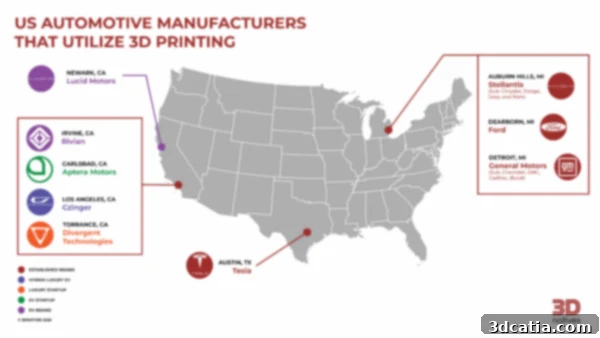
Image Credit: 3Dnatives
To gain a deeper insight into this landscape and view the comprehensive list of US automotive manufacturers utilizing 3D printing, you can download our exclusive map as a PDF by clicking HERE!
The Future of 3D Printing in the Automotive Sector
The journey of 3D printing in the automotive industry is far from over; it’s just gaining momentum. As materials become more advanced, printing speeds increase, and machine capabilities expand, we can expect to see even more radical transformations. The focus will likely shift towards greater integration into mainstream production, not just for niche or performance parts but for a broader range of components. This includes mass customization options directly from the factory, more robust and sustainable supply chains, and the continued drive towards lighter, more efficient, and more complex vehicle designs. The synergy between generative design software and advanced additive manufacturing promises to unlock new levels of performance and aesthetics previously unimaginable, making the future of automotive manufacturing inherently linked with the continuous evolution of 3D printing.
What are your thoughts on the ever-increasing prevalence of 3D printing and additive manufacturing within the automotive industry? Are there any significant players or applications that we might have overlooked in our assessment? We invite you to share your insights in the comments section below or engage with us on our LinkedIn or Facebook pages! Moreover, don’t miss out on the latest advancements and news in the world of 3D printing by signing up for our free weekly Newsletter, delivered straight to your inbox. You can also explore all our informative videos and industry updates on our dedicated YouTube channel.