
European Additive Manufacturing Trends: Navigating Growth and Future Opportunities
The Additive Manufacturing (AM) sector has undeniably cemented its position as a transformative force in modern industrial production. Its dynamic nature means constant evolution, with new technologies, applications, and market dynamics emerging regularly. Understanding these shifts is paramount for businesses, policymakers, and innovators alike. Recognizing this critical need, CECIMO, the European Association of Machine Tool Industries and Related Manufacturing Technologies, has, for many years, spearheaded the European Additive Manufacturing Survey. This vital initiative, conducted over six-month periods, aims to meticulously identify and analyze prevailing trends within the European AM landscape, providing invaluable intelligence to help industries pinpoint potential major business areas and strategic opportunities. To ensure the most comprehensive data collection and robust insights, CECIMO has forged a strong partnership with the VDMA, the German Engineering Federation, an organization that similarly represents numerous AM companies across Germany, further enhancing the survey’s scope and credibility.
The collaborative report, a cornerstone for understanding European AM dynamics, is thoughtfully structured into two distinct but complementary sections. The first segment synthesizes data collected from both the CECIMO and VDMA surveys, offering a holistic perspective. Notably, the CECIMO survey primarily focuses on future expectations within the industry, capturing the sentiment and foresight of market players. In contrast, the VDMA survey delves into the actual, observed development of the sector, providing a reality check against expectations. This dual approach offers a nuanced understanding of market trajectories. The second part of the report then isolates data from countries that independently utilize the CECIMO survey, allowing for country-specific insights. Collectively, both sections meticulously address overarching trends, but also provide granular data on critical areas such as investment patterns, detailed statistics on materials and machinery adoption, export performance, and demand from various customer industries, including high-growth sectors like automotive and aerospace. This granular analysis equips stakeholders with the detailed information necessary to make informed strategic decisions.
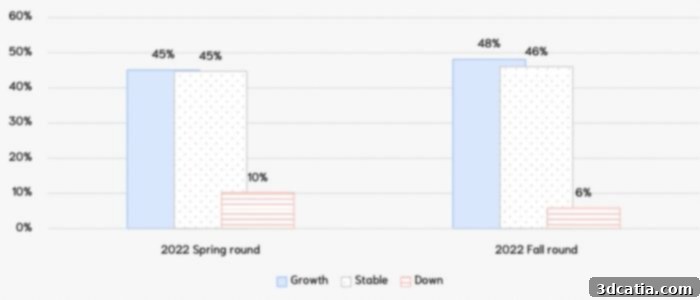
Expectations of growth within the domestic market have increased when compared to the previous survey of spring 2022 (Image: CECIMO)
Emerging Optimism and Robust Growth in Europe’s AM Sector
CECIMO’s latest findings reveal a distinct bifurcation in trend analysis: domestic versus foreign markets. Focusing on the domestic market, the survey highlights a significant surge in optimism. Approximately 50% of respondents now anticipate a slight increase in domestic market growth, a considerable uplift in confidence. Crucially, only a mere 6% of respondents foresee a decline, a figure that has notably decreased since the previous survey conducted in Spring 2022. This shift unequivocally indicates a more positive and robust outlook for the internal European AM market, suggesting growing adoption and confidence among local businesses. Parallel to this, the foreign market exhibits equally encouraging signs. In stark contrast to earlier surveys, respondents now hold a significantly more positive perspective on the growth prospects of the international AM market. A substantial 47% project an increase in exports and incoming orders from abroad within the next six months. Another 47% believe that foreign order volumes will remain stable, while only a small minority of 6% anticipate a decrease. This balanced yet optimistic view underscores an ever-increasing confidence within European additive manufacturing companies, serving as a strong indicator of sustained and strengthening foreign demand for their products and services across global markets.
Delving deeper into the assessment of the order situation across specific AM categories for the upcoming six months, particularly when benchmarked against the preceding half-year, the pervasive sense of optimism becomes even more pronounced. This confidence is evident in the consistently higher percentage expectations across all key AM categories: products/manufacturing parts, machines, materials, and services. According to the comprehensive CECIMO survey, the category poised for the most substantial growth is AM products and manufacturing parts. A striking 52% of respondents anticipate growth in this segment, while a remarkably low 1% expect a decline. This single-digit decline figure is profoundly encouraging, especially when juxtaposed with the 16% decline expectation recorded in the Spring 2022 survey, illustrating a dramatic positive shift in market sentiment. The remaining 36% predict stability, reinforcing the segment’s strong health. Perhaps less surprisingly to seasoned industry observers, the second-best performing category is AM machinery. Following a minor dip in the spring of 2022, this segment has now rebounded significantly, signifying renewed investment in AM capabilities. Positively, here too, only 1% of respondents foresee a decrease in incoming orders, translating into a direct benefit for manufacturers of AM machines who can anticipate robust demand for their innovative equipment. This widespread positive sentiment across core categories suggests a maturing and expanding market where additive manufacturing is increasingly integrated into mainstream production workflows.
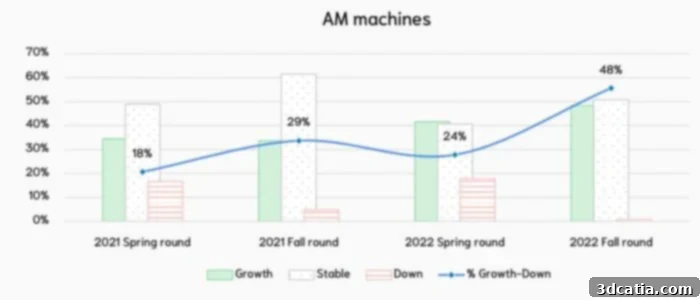
For the respondents of the survey, the AM machine category is extremely promising (Photo credit: CECIMO)
AM Industry Anticipates Investment Surge and Strong Export Performance
Examining the investment landscape within the European additive manufacturing sector reveals a nuanced yet predominantly positive outlook. When comparing this year’s survey results with previous iterations, a higher percentage of companies (36%) now express expectations for an increase in future investments. This forward-looking confidence underscores a belief in the sustained growth and profitability of the AM market. However, it is also important to note a slight increase in companies anticipating a decrease in investments (9%), perhaps reflecting broader economic uncertainties or specific sector-related challenges. Despite this minor caveat, CECIMO remains overtly optimistic, emphasizing that given the inherent strength of the additive market and its consistent growth trajectory, this positive investment development is highly likely to persist. The continuous innovation and expanding application areas within AM are powerful drivers for continued capital expenditure. Furthermore, the survey provided critical insights into future export trends. The overarching consensus points towards an expectation of more foreign and export orders, mirroring the positive tendencies observed in the forecasts for the domestic market. The percentage of respondents expressing negative sentiment regarding exports is notably lower, while a greater proportion of respondents confidently project an increase. This robust export confidence highlights the global appeal and competitiveness of European AM solutions. Among all categories, AM service providers are anticipated to demonstrate the most impressive growth in orders, boasting a substantial positive balance of 59%. This strong performance by service providers underscores the increasing demand for outsourced additive manufacturing capabilities, specialized expertise, and the flexibility they offer to businesses looking to adopt AM without significant upfront capital investment.
The evolution of material trends within European additive manufacturing offers another compelling narrative of sector development. When respondents were asked to provide their opinions on overall material order numbers, a direct comparison with the Spring 2022 survey reveals continued strong growth, albeit with notable shifts in preferences and demand. Interestingly, the trade in composite materials experienced a slight decline in terms of order predictions. This might suggest a temporary plateau or a reallocation of focus towards other material classes for specific applications, though composites remain a vital part of the AM ecosystem for their unique strength-to-weight ratios. Metals, however, continue to be a powerhouse in the AM industry, securing a strong second place with 60% of respondents anticipating growth. Crucially, only a mere 1% of respondents expect a negative decline in metal orders for the next six months, underscoring the enduring and robust demand for metal AM parts in high-performance and industrial applications across sectors like aerospace, medical, and automotive. Perhaps the most striking shift is observed in ceramics. As a material for AM, the consensus regarding trends in Europe indicates a significant and sustained increase in interest and adoption. Specifically, 39% of respondents now forecast growth in ceramic AM, a remarkable leap from only 12% in the previous survey. This surge points to the growing recognition of ceramics’ unique properties, such as high-temperature resistance, chemical inertness, and biocompatibility, opening doors for advanced applications in areas like medical implants, electronics, and specialized industrial components.
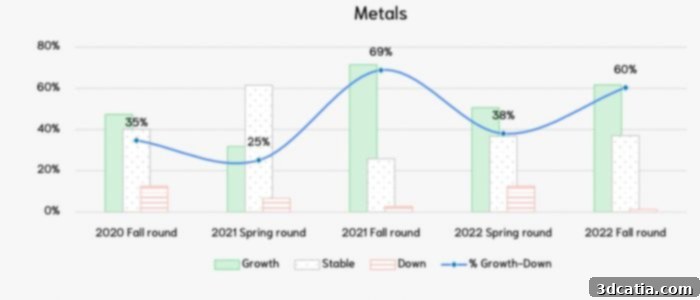
In the metals as materials sector, just 1% expect a decline (Image: CECIMO)
Customer Segment Insights: Aerospace Soars, Automotive Navigates Challenges
CECIMO’s comprehensive report on AM trends in Europe also meticulously examines order intake by customer segment, revealing varied dynamics across different industries. Overall, there’s a strong improvement in the percentage balance for sectors such as aerospace, mechanical engineering, and chemicals & pharmaceuticals, indicating enhanced business expectations in these areas. The aerospace sector deserves particular emphasis for its phenomenal growth: its positive percentage surged from a modest 7% to an impressive 37%. This represents the highest measured value since the inception of the survey, highlighting a robust and rapidly expanding adoption of AM within this critical industry. The demand is driven by the need for lightweight, complex, and high-performance components, along with rapid prototyping and maintenance, repair, and overhaul (MRO) applications, where AM offers unparalleled advantages in design freedom and material efficiency. In contrast, respondents express less confidence in the automotive sector. Although order expectations in this industry remain high, the positive growth balance has diminished significantly from 41% to 28%. This reduction in optimism, as identified by CECIMO, is primarily attributed to increasing challenges and persistent problems on the supply side, including semiconductor shortages and geopolitical instabilities, which have impacted production schedules and investment decisions. While AM’s role in prototyping and specialized tooling for automotive remains strong, its integration into high-volume end-use parts faces hurdles that may slow its overall growth trajectory in this segment compared to others. The chemical and pharmaceutical sector, after previous fluctuations, could finally demonstrate a positive expectation value for AM orders again. However, this encouraging rebound is somewhat tempered by the fact that these expectations for additive manufacturing orders are still below the peak levels observed in 2020 and 2021. This suggests potential for further growth but also indicates that the sector is proceeding with cautious optimism, possibly due to strict regulatory requirements and the need for rigorous validation processes for AM-produced components.
In summary, the latest report from CECIMO, alongside the collective attitudes expressed by respondents regarding AM trends in Europe, paints an overwhelmingly positive picture. When directly compared with findings from previously conducted surveys, the sustained optimism, coupled with significant growth in key areas like domestic and foreign markets, AM products, machinery, and materials like ceramics, underscores the robustness and accelerating maturity of the European additive manufacturing sector. While challenges persist, particularly within the automotive sector’s supply chain, and the chemical & pharmaceutical sector works towards its full potential, the overall trajectory is one of strong expansion and increasing integration into industrial processes. This ongoing positive development signals a dynamic and innovative future for AM in Europe, driven by continuous technological advancements and expanding application opportunities. For those eager to delve deeper into these transformative AM trends and gain even more granular insights, the full report offers comprehensive data and analysis, serving as an indispensable resource for strategic planning and decision-making within the industry. Understanding these evolving dynamics is crucial for businesses seeking to leverage the full potential of additive manufacturing and secure their competitive edge in a rapidly changing global landscape.
What are your thoughts on these exciting trends shaping the future of Additive Manufacturing in Europe? Which particular trend do you believe holds the most significance for the industry’s continued evolution? We invite you to share your insights and engage in the conversation by leaving a comment below, or by connecting with us on our LinkedIn, Facebook, and Twitter pages! Don’t miss out on the latest advancements and news from the 3D printing world – sign up for our free weekly Newsletter here to have key updates delivered straight to your inbox! Additionally, explore our extensive library of videos and discussions on our YouTube channel for more in-depth content.
*Cover photo credits: CECIMO