
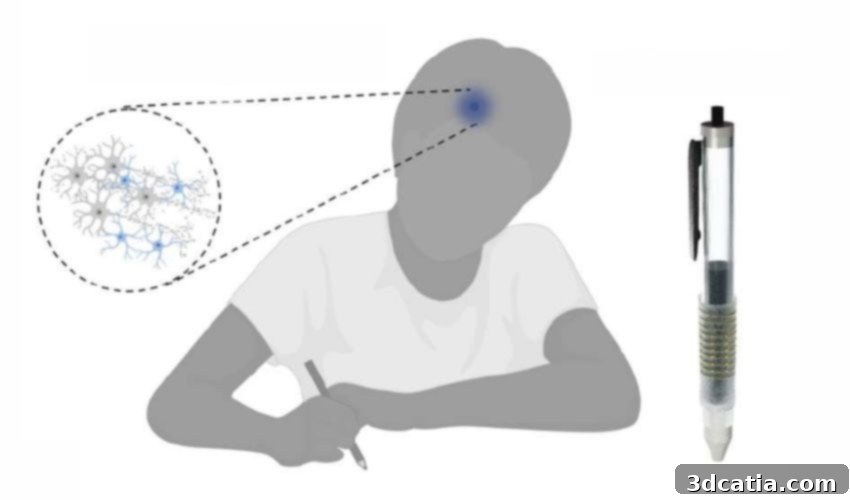
Revolutionizing Parkinson’s Diagnosis: The Power of a 3D Printed Smart Pen
Parkinson’s disease (PD) stands as the second most prevalent neurodegenerative disorder globally, affecting an estimated 10 million individuals worldwide, trailing only Alzheimer’s disease. Despite its widespread impact, diagnosing PD remains a significant challenge. Unlike many other conditions, there are currently no definitive laboratory tests or imaging scans that can confirm a Parkinson’s diagnosis. While certain tests, such as MRIs or blood work, can help rule out other conditions that mimic PD symptoms or offer supportive evidence, they cannot provide a conclusive diagnosis on their own. Instead, a diagnosis relies heavily on a “clinical” assessment, where healthcare professionals meticulously evaluate a patient’s medical history, observed symptoms, and the findings from a physical neurological examination. This traditional diagnostic approach, however, often suffers from inherent inefficiencies, subjectivity, and a notable lack of objective, quantifiable standards, leading to potential delays in diagnosis and treatment initiation.
Recognizing these critical limitations, a dedicated team of researchers at the University of California, Los Angeles (UCLA) has embarked on an innovative quest to develop a groundbreaking alternative: a 3D printed diagnostic pen. Parkinson’s disease manifests differently in each individual, presenting a diverse spectrum of symptoms that commonly include, but are not limited to, involuntary tremors, debilitating slowness of movement (bradykinesia), and muscle rigidity. Handwriting, a complex activity that seamlessly integrates cognitive, perceptual, and fine motor skills, is profoundly affected by the progression of PD. By meticulously analyzing subtle changes and irregularities in handwriting patterns, this novel diagnostic pen aims to provide users and clinicians with invaluable, objective insights and quantitative biometric markers crucial for an earlier and more accurate diagnosis of Parkinson’s disease. This approach taps into a readily observable behavior that directly reflects the neurological impairments characteristic of the condition.
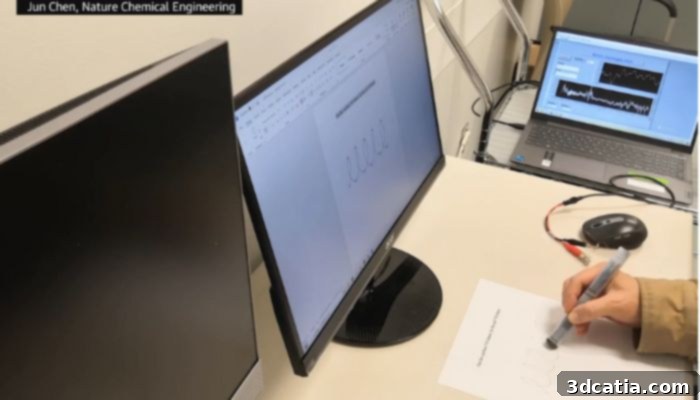
Parkinson’s Disease patient writing with 3D printed pen (Photo Credit: Jun Chen via The Guardian)
A 3D Printed Upgrade: Enhancing Diagnostic Accessibility and Precision
The concept of a diagnostic pen for Parkinson’s disease is not entirely new. Indeed, conventional handwriting analysis tools, such as specialized digital tablets, have been in use for some time. These existing tools are highly proficient at tracking the trajectory of handwriting and meticulously analyzing the resulting traces left on a surface. However, a significant drawback of these conventional methods is their tendency to overlook or inadequately capture the subtle, yet critical, motor symptoms that occur *during* the act of writing, particularly the minute tremors and inconsistencies in pressure or speed that are hallmark signs of early Parkinson’s. Furthermore, these traditional digital tablets are often characterized by their high cost and complex setup requirements, presenting considerable barriers to broad implementation and routine use outside of specialized clinical environments. The UCLA researchers were particularly mindful of the global health landscape, recognizing that low-income countries, in particular, face severe limitations in accessing subspecialty resources for PD diagnosis, compounded by an insufficient number of neurologists. This underscored the urgent need for a diagnostic solution that is not only accurate but also affordable, portable, and user-friendly for widespread adoption.
Driven by these considerations, the UCLA team embarked on a mission to engineer a diagnostic tool that would not only be more accessible but also capable of delivering superior quantitative results. The culmination of their efforts is a pioneering diagnostic pen featuring an advanced magnetoelastic tip combined with ferrofluid ink. This innovative design is meticulously crafted to sensitively convert even the most subtle on-surface and in-air writing motions into high-fidelity sensing signals, enabling self-powered, real-time handwriting analysis. The core innovation lies in its ability to detect minute changes in pressure and movement that traditional methods often miss. Crucially, the researchers prioritized scalability and ease of manufacturing. To achieve this, they designed a straightforward, yet robust, barrel structure for the pen, which can be efficiently and cost-effectively produced through 3D printing technology. The team utilized a Stratasys F123 Composite-Ready FDM 3D printer for fabricating the pen’s barrel, demonstrating how additive manufacturing can facilitate the rapid prototyping and mass production of sophisticated medical devices, making advanced diagnostics more attainable.
Unveiling the Mechanism: How the Smart Pen Works
The ingenious design of the UCLA diagnostic pen leverages fundamental principles of physics to translate the complexities of handwriting into quantifiable electrical signals. When a user engages with the pen, applying pressure during writing, the pen’s specialized tip undergoes a subtle deformation. This physical deformation initiates a critical phenomenon known as the magnetoelastic effect, which refers to the intrinsic property of a material to alter its magnetic characteristics under mechanical strain. Consequently, the pressure exerted on the pen’s tip causes a detectable shift in the magnetic flux within its components. Simultaneously, the ferrofluid ink, a specialized liquid containing suspended ferromagnetic nanoparticles, moves within the pen’s reservoir during the writing process. The combination of this magnetic flux variation and the dynamic movement of the ferrofluid ink synergistically generates distinct voltage signals in a surrounding coil. The fundamental premise is that individuals living with Parkinson’s disease exhibit specific handwriting irregularities, such as tremors, micrographia (abnormally small handwriting), or dysgraphia (impaired handwriting ability), which will manifest as discernible abnormalities in these generated voltage signals. For instance, the characteristic hand tremors associated with PD are expected to register as additional, minor, yet distinct, peaks within the otherwise smoother voltage signal pattern of normal handwriting. In essence, the pen acts as a sophisticated transducer, converting nuanced biomechanical handwriting movements into precise electrical data, thereby providing an objective method to quantify irregularities that are often difficult to perceive with the naked eye.
To validate their innovative device, the UCLA team conducted an initial pilot study. This preliminary investigation involved 16 participants, among whom three had a confirmed diagnosis of Parkinson’s disease. During the study, participants were instructed to perform a series of writing and drawing tasks, both on a physical surface and in the air. These tasks included writing specific words and drawing intricate wavy lines and spirals – exercises specifically chosen for their ability to capture a broad range of motor movements and fine motor control essential for handwriting, and thus, susceptible to PD-related impairments. Following the data collection, the researchers employed advanced machine learning models to meticulously analyze and classify the participants’ handwriting signals. After an intensive training phase, one of these sophisticated machine learning models demonstrated remarkable efficacy, achieving an average accuracy of 96.22% in distinguishing patients with Parkinson’s disease from healthy controls. This high level of accuracy in a preliminary study offers compelling proof of concept for the diagnostic pen’s potential as a highly sensitive and objective tool for early PD detection.
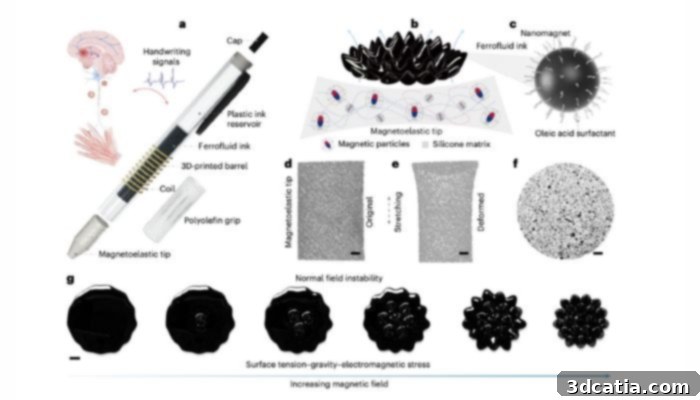
Diagram of the 3D printed pen. (Image Credit: UCLA)
Going Forward: Towards Clinical Implementation and Broader Impact
While the initial results from the UCLA pilot study are incredibly promising, extensive further testing is unequivocally required before the 3D printed diagnostic pen can be confidently integrated into real-world clinical settings. The initial study, involving only 16 participants, provides a strong foundation but necessitates validation through larger, more comprehensive clinical trials. These subsequent studies must include a significantly more diverse and extensive pool of individuals, encompassing various demographic backgrounds, stages of Parkinson’s progression, and co-morbidities, to thoroughly verify the efficacy and generalizability of the pen as a reliable diagnostic tool. Additionally, longitudinal studies will be essential to assess the pen’s ability to track disease progression over time and monitor the effectiveness of various treatments.
Experts in the field also underscore the importance of a multi-biomarker approach to PD diagnosis. As reported by The Guardian, referencing insights from Chrystalina Antoniades, an associate professor of clinical neuroscience at the University of Oxford who was not directly involved in this research, while this pen could indeed serve as an excellent indicator of PD, clinicians should ideally utilize a combination of biomarkers to make a definitive diagnosis. Antoniades aptly explained, “This [pen] is diagnosing the problem with handwriting, which is just one of the many symptoms that we see in our patients. But it can be complementing what we already found, picking up something that might be difficult to see.” Her commentary highlights the pen’s significant value as a complementary diagnostic tool, capable of identifying subtle motor impairments that might otherwise be overlooked during routine examinations. It offers an objective lens to quantify a subjective observation, thereby supporting earlier detection and more informed clinical decisions. The development of this accessible and objective tool holds immense promise for transforming the diagnostic landscape for Parkinson’s disease, particularly in regions with limited neurological resources. By facilitating earlier and more accurate diagnoses, it could significantly improve patient outcomes by enabling timely intervention and management strategies.
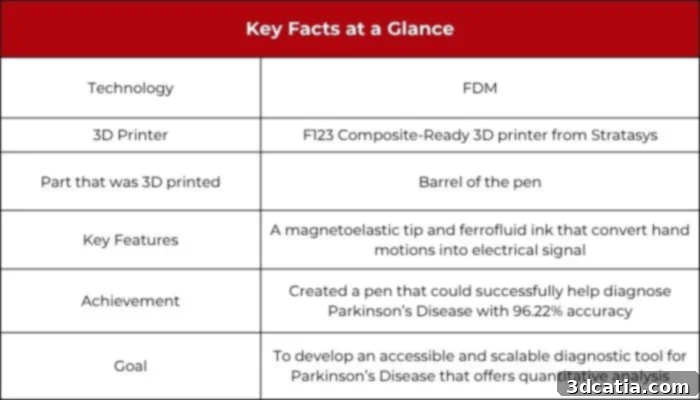
Image Credits: 3Dnatives
In conclusion, while it is clear that more rigorous research and larger-scale validation studies are necessary, the 3D printed diagnostic pen developed by the UCLA team represents a profoundly promising advancement in medical technology. Its potential to provide earlier, more accurate, and more accessible diagnoses of Parkinson’s disease could significantly impact the lives of millions worldwide. This innovation not only showcases the power of interdisciplinary research, combining engineering, neurology, and material science, but also highlights the transformative capabilities of 3D printing in developing scalable, low-cost medical devices. This technology could pave the way for a future where early detection of neurodegenerative diseases is not a luxury, but a widely available standard of care. To delve deeper into the specifics of this groundbreaking research, the full study from UCLA is available for review by clicking here.
What are your thoughts on this innovative 3D printed pen for diagnosing Parkinson’s disease? We invite you to share your insights in the comments section below or engage with us on our LinkedIn and Facebook pages. Additionally, don’t miss out on the latest advancements in 3D printing; sign up for our free weekly Newsletter to receive top industry news directly in your inbox. For a visual experience, you can explore all our videos on our YouTube channel. If you’re keen on discovering more about medical and dental 3D printing news, please visit our dedicated page HERE.
*Cover Photo Credit: UCLA