
Revolutionizing Sound Insulation: 3D Printing and Metamaterials for Advanced Acoustic Panels
Sound insulation is a crucial, yet often overlooked, element that significantly impacts our quality of life and the functionality of various environments. From the tranquil comfort of our homes to the critical quietness required in hospitals, and the operational efficiency of industrial facilities or the refined experience within modern automobiles, effective noise control is paramount. Historically, achieving robust sound insulation often meant bulky, heavy, and space-consuming solutions. However, a recent breakthrough study highlights the transformative potential of additive manufacturing, specifically 3D printing, in this domain. This innovative research demonstrates that by combining 3D printing with advanced acoustic metamaterials, it’s possible to produce noise-insulating panels that are not only significantly lighter and narrower but also maintain or even surpass the efficiency of conventional systems. The study introduces a novel approach to sound dissipation within these panels, proposing a unique design that promises superior acoustic performance. Let’s delve deeper into the fascinating world of these next-generation insulating panels and uncover their groundbreaking features!
The cornerstone of this remarkable study lies in its pioneering focus on the design of large, labyrinth-shaped panels integrated with acoustic metamaterials. Unlike traditional materials that primarily rely on density and porosity to block or absorb sound, metamaterials are ingeniously engineered structures that derive their extraordinary properties not from their chemical composition, but from their intricate geometric configurations. In this specific application, researchers have meticulously designed a sophisticated labyrinth-like internal architecture. This intricate network forces sound waves to traverse a convoluted, extended path as they attempt to pass through the material. As sound energy navigates this tortuous journey, it undergoes multiple reflections, scattering events, and interference phenomena within the confined channels of the labyrinth. This process effectively dissipates the sound energy by converting it into heat and reflecting it, preventing its transmission. The sheer ingenuity of this structure allows for exceptionally high sound absorption across an unusually broad spectrum of frequencies, a performance metric that significantly outstrips the capabilities of many current acoustic panel designs. The ability to manipulate sound waves at such a fundamental level offers unprecedented control over noise, paving the way for more effective and versatile insulation solutions.
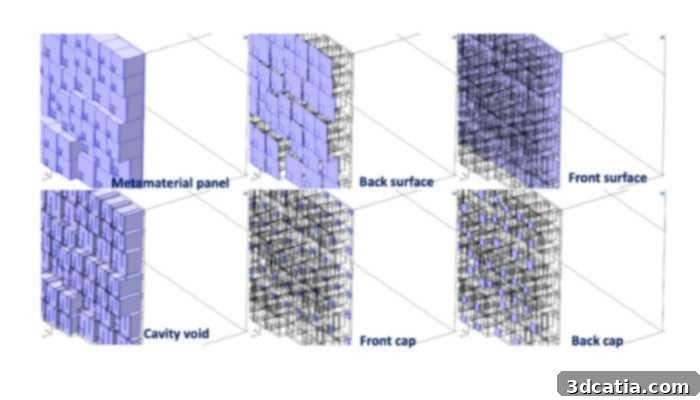
Images of the panels (photo credits: Federico Bosia)
Following extensive theoretical modeling and rigorous experimental validation, the innovative design for these acoustic panels was definitively approved for fabrication using 3D printing technology. Additive manufacturing, often referred to as 3D printing, emerges as an indispensable tool in this endeavor due to its unparalleled ability to create complex geometries with astonishing precision. The intricate internal labyrinthine structures, so critical for the panels’ sound-dissipating capabilities, simply cannot be achieved with conventional manufacturing methods. 3D printing allows for millimeter-level accuracy in constructing these highly detailed internal architectures, ensuring that each channel and chamber of the metamaterial performs exactly as designed to manipulate sound waves. Furthermore, the research specifically points towards the utilization of polymeric materials that are intrinsically optimized for enhanced sound absorption characteristics. These advanced polymers can be strategically combined with porous materials, forming a composite structure that further amplifies their acoustic efficiency. This synergistic approach leverages the strengths of both material types, resulting in panels with superior broadband absorption properties. Crucially, additive manufacturing’s inherent flexibility facilitates unprecedented design customization, allowing engineers to tailor the panels’ acoustic properties precisely to the specific frequency ranges and environmental requirements of any given application. This level of bespoke design was previously unattainable, opening up a new frontier in acoustic engineering.
The comprehensive study unequivocally confirms that 3D printed acoustic panels, ingeniously incorporating metamaterials, represent an exceptionally efficient and versatile solution for noise mitigation across a vast frequency spectrum. The benefits of this innovative approach are multifaceted and compelling. Their modular nature allows for scalable implementation, easily adapting to different spaces and configurations, from small enclosures to large architectural installations. The lightweight design, a direct consequence of both the material choice and the optimized internal structure, significantly reduces structural loads and facilitates easier installation, particularly in scenarios where weight is a critical factor, such as in aerospace or automotive applications. Beyond these practical advantages, the panels exhibit a remarkably high sound absorption capacity, effectively taming unwanted noise and enhancing acoustic comfort. This superior performance, combined with their reduced bulk and enhanced flexibility in design, positions them as a highly attractive and formidable alternative to conventional, often cumbersome, sound insulation systems. Whether for creating quieter urban living spaces, optimizing office acoustics for improved productivity, or reducing noise pollution in industrial settings, these advanced panels offer a transformative solution.
Despite the groundbreaking success demonstrated by this research, the field of 3D printed acoustic metamaterials is still ripe with opportunities for further innovation and refinement. Future research endeavors will undoubtedly focus on several critical areas to advance this technology towards widespread adoption. One key area involves the continuous optimization of the materials used, exploring novel polymers, composites, or even hybrid materials that could offer even greater absorption capabilities, enhanced durability, or more sustainable production. Furthermore, the scalability of production and the economic feasibility of manufacturing these complex panels at an industrial scale will be crucial for their commercial implementation. Rigorous testing in diverse real-world environments is also essential to validate their long-term performance, resistance to environmental factors, and overall effectiveness under various operating conditions. Beyond material and manufacturing improvements, the exploration of entirely new metamaterial designs holds immense promise. Researchers could investigate topological acoustics, programmable acoustic metamaterials, or even active metamaterial systems that can dynamically adjust their acoustic properties in real-time. Such advancements could further expand the applications of this technology into areas currently thought impossible, solidifying its position as a truly key solution for the next generation of acoustic insulation challenges and fundamentally reshaping how we manage and control sound in our increasingly noisy world.
What are your thoughts on these innovative 3D printed acoustic panels and their potential to redefine noise control? We’d love to hear your insights and predictions for this exciting technology! Feel free to share your comments below or engage with us on our LinkedIn, Facebook, and Twitter pages. To stay informed about the very latest developments and breakthroughs in the world of additive manufacturing, don’t forget to sign up for our free weekly Newsletter here – delivering the most recent 3D printing news straight to your inbox! You can also find an extensive library of all our videos and expert interviews on our YouTube channel, offering deeper dives into cutting-edge 3D printing applications.
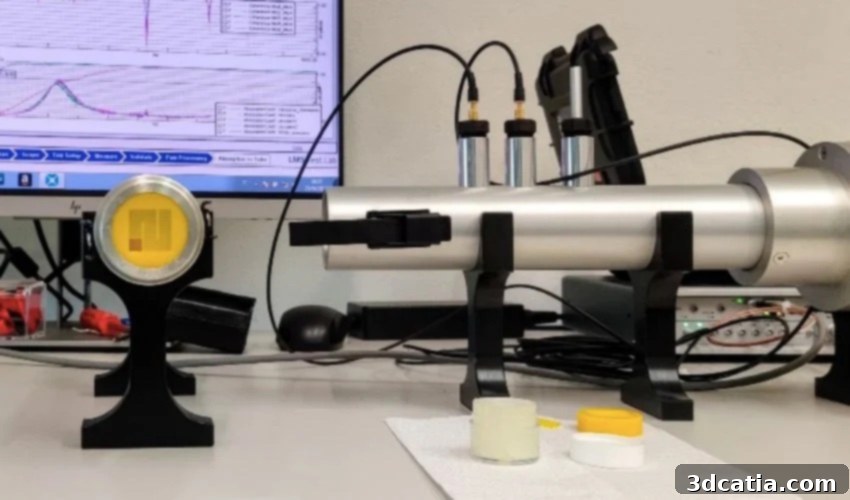
*Cover Photo: Impedance tube opened with the sample mounted on its support, illustrating the experimental setup for acoustic testing (photo credits: Federico Bosia)