
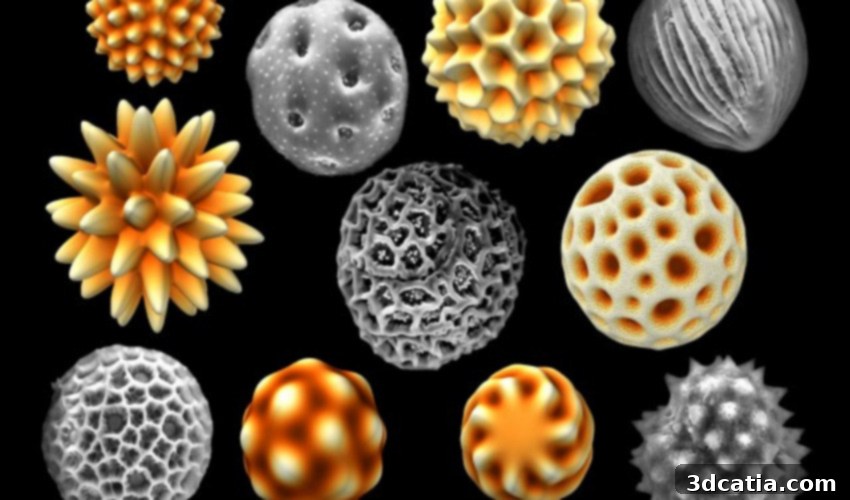
Unlocking Microscopic Worlds: How 3D Printing Transforms Pollen Research and Scientific Education
Across diverse and dynamic fields such as medical science, advanced manufacturing, and aerospace engineering, 3D printing, also known as additive manufacturing, has emerged as a revolutionary technology. Its applications are far-reaching, enabling both students and seasoned professionals to grasp and apply incredibly complex concepts with greater ease and precision. Consider the medical sector, for instance: highly accurate anatomical models of patients’ organs are meticulously 3D printed. These tangible replicas serve as invaluable tools for surgeons, allowing them to thoroughly plan and rehearse intricate surgical procedures, ultimately leading to improved treatment pathways and better patient outcomes. Beyond the macro scale, 3D printing also offers an innovative lens into the microscopic realm, allowing researchers to explore objects typically too minute for the naked eye. This capability not only facilitates the presentation of intricate designs but also provides a powerful means to closely examine these tiny structures. This very principle underpins the exciting 3D Pollen Project, an initiative leveraging the power of 3D printing to provide students and researchers with an unprecedented view of pollen grains. While many of us perceive pollen merely as an unseen allergen, these microscopic grains actually hold a wealth of information, representing a veritable “holy grail” for scientists and learners alike.
The innovative 3D Pollen Project is the brainchild of Oliver Wilson, a dedicated PhD student at the esteemed University of Reading. Launched with a clear vision, the project aims to systematically process and scan pollen grains, generating highly accurate, printable 3D models that can then be uploaded to a comprehensive, publicly accessible online database. To achieve this ambitious goal, Wilson’s team employs cutting-edge laser scanning confocal microscopy. This sophisticated process is renowned for its ability to capture incredibly high-resolution optical images, providing the intricate detail necessary for precise 3D reconstruction. Crucially, the data obtained through this method is perfectly compatible with 3D printing technologies, allowing for the faithful reproduction of these microscopic structures. Thanks to vital funding and support from “I’m A Scientist” and the University of Reading, these meticulously created 3D scans are made available online, completely free of charge. The overarching aim is for these digital models to “be of use and interest to scientists, communicators, teachers, and the wider public, for outreach, education, and research.” This commitment to open access ensures that this valuable resource can benefit a broad audience, fostering scientific literacy and discovery. Furthermore, while the project team currently lacks the in-house capabilities to physically print the pollen grains themselves, they offer an invaluable service: if provided with a pollen sample, they can meticulously scan it and then directly send the digital 3D model to interested parties for their own printing endeavors. To date, an impressive collection of 30 distinct pollen grain models have already been scanned and are readily available for download online, and Oliver Wilson has ambitious plans to significantly expand this digital library with even more fascinating specimens.
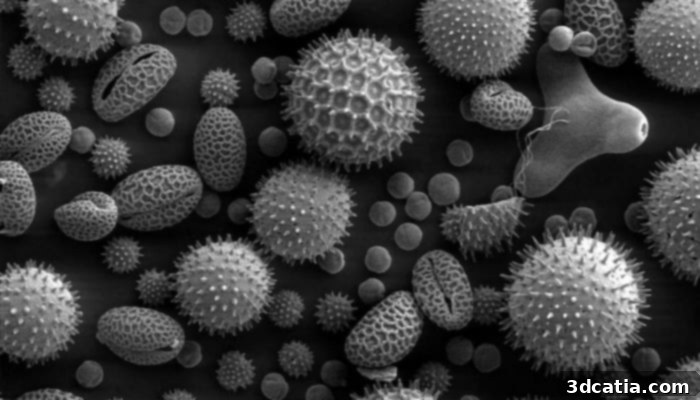
Different pollen grains in their microscopic form (photo credits: Dartmouth College Electron Microscope Facility)
The significance of pollen study, as highlighted on the 3D Pollen Project website, extends across a multitude of scientific disciplines. Pollen grains are remarkably durable and possess distinctive morphological characteristics, making them invaluable for a wide array of research applications. Their unique features allow scientists to explore the intricate effects of climate change on ecosystems over time, assess the quality and geographical origin of honey, conduct precise forensic analyses in criminal investigations, and even contribute to advancements in medicine and the development of new vaccines. However, despite their scientific utility, pollen grains present a substantial challenge due to their minuscule size. Not only are they inherently difficult to study with conventional methods, but they are also incredibly challenging to showcase effectively to a broader audience. Traditional microscopy, while fundamental, can be limiting. It often forces the interpretation of a complex, three-dimensional pollen structure into a flattened, two-dimensional image, thereby losing crucial information regarding depth, texture, and a full, holistic view of the grain. This limitation often hinders comprehensive understanding and effective communication of scientific findings. The advent of these downloadable 3D scans fundamentally transforms this paradigm. When printed, these digital models can be magnified to an easily observable size, allowing researchers and students to manipulate and examine the pollen grains from every conceivable angle. This tactile and multi-perspectival approach offers a far richer and more complete understanding than any 2D image could provide. By enabling greater ease in both teaching and presenting research, 3D printing of pollen grains promises to revolutionize how we interact with and comprehend these vital microscopic structures, fostering deeper insights and enhancing educational experiences.
Improving Education and Research with Tangible 3D Printing Models
The application of 3D printing in the realms of scientific research and education is not a novel concept, yet its impact continues to grow exponentially. This transformative technology is increasingly being integrated into educational institutions at all levels, serving a dual purpose. Firstly, it provides students of all ages with invaluable hands-on experience in important technical and problem-solving skills, preparing them for future careers in STEM fields. Secondly, and perhaps more profoundly, it offers an unparalleled method for visualizing and interacting with complex concepts that might otherwise remain abstract and challenging to grasp. In medical education, for example, researchers have recently utilized 3D printing to produce highly realistic human heart models. These intricate replicas provide surgeons with an invaluable tool for pre-operative planning, allowing them to physically explore and understand a patient’s unique anatomy before entering the operating theatre, thereby minimizing risks and improving surgical precision. Similarly, in fields like biology, chemistry, and physics, 3D printed models of molecules, cellular structures, or geological formations can transform theoretical lessons into tangible learning experiences. Students can physically manipulate these models, gaining a deeper, intuitive understanding of their spatial relationships and functional characteristics. The 3D Pollen Project perfectly exemplifies this broader trend, showcasing how additive manufacturing can make the invisible visible and the abstract concrete, thereby democratizing access to complex scientific data and fostering a new generation of curious and capable scientists. For those eager to delve deeper into the fascinating world of microscopic pollen and 3D printing, more comprehensive information on the 3D Pollen Project can be found directly on their official website.
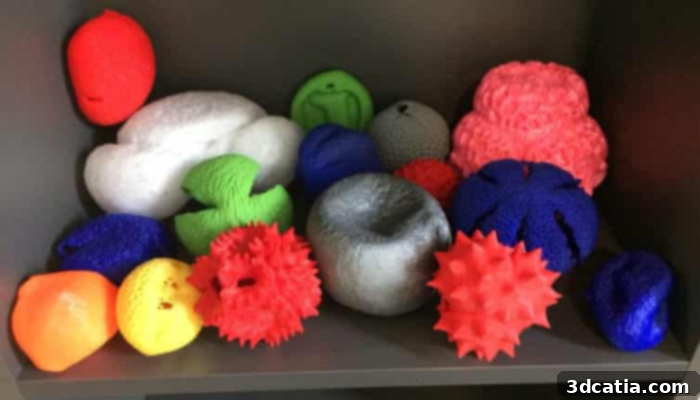
A selection of 3D pollen models (photo credits: 3D Pollen Project)
What are your thoughts on the groundbreaking 3D Pollen Project and its potential to revolutionize both education and scientific research? Are you inspired by the prospect of being able to physically hold and examine a magnified 3D printed grain of pollen? We invite you to share your insights and opinions in a comment below, or join the conversation on our social media channels, including our Facebook and Twitter pages! Don’t miss out on the latest advancements and innovations in the world of additive manufacturing. Be sure to sign up for our free weekly Newsletter, delivering all the essential 3D printing news straight to your inbox, keeping you at the forefront of this rapidly evolving technology!
*Thumbnail: A scanning electron microscope image of pollen provided by Asja Radja; Simulations: Asja Radja and Maxim Lavrentovich.