
Revolutionizing Medical Treatment: How 3D Bioprinting Delivers a World-First Drug-Releasing Ear Implant
The landscape of modern medicine is being profoundly reshaped by the remarkable advancements in medical 3D printing. What once seemed like theoretical concepts are now firmly transitioning into practical, life-changing applications, particularly with the emergence of 3D bioprinting. This innovative technology has pushed the boundaries of what’s possible, leading to groundbreaking research and clinical trials across the globe. Recent developments showcase the ability to 3D print intricate biological structures, including delicate brain tissue, functional skin grafts, and even preliminary organ tissues. These achievements herald a future where 3D printed transplants become a viable reality, offering new hope for patients on transplant waiting lists and opening novel avenues for cancer treatment by allowing for more accurate disease modeling and drug testing. Beyond bioprinting, the broader field of medical 3D printing has already made significant strides with the widespread adoption of 3D printed implants and prosthetics, providing invaluable assistance to patients recovering from debilitating diseases and traumatic physical accidents. These personalized medical devices have dramatically improved quality of life, offering custom-fit solutions that enhance comfort and functionality. A truly pioneering example, combining the intricate capabilities of bioprinting with the practical application of implants, recently took place in Germany. This milestone involved the successful implantation of a functional, bioprinted device, made possible through the advanced bioprinting technology provided by Desktop Health, the specialized medical 3D printing division of Desktop Metal.
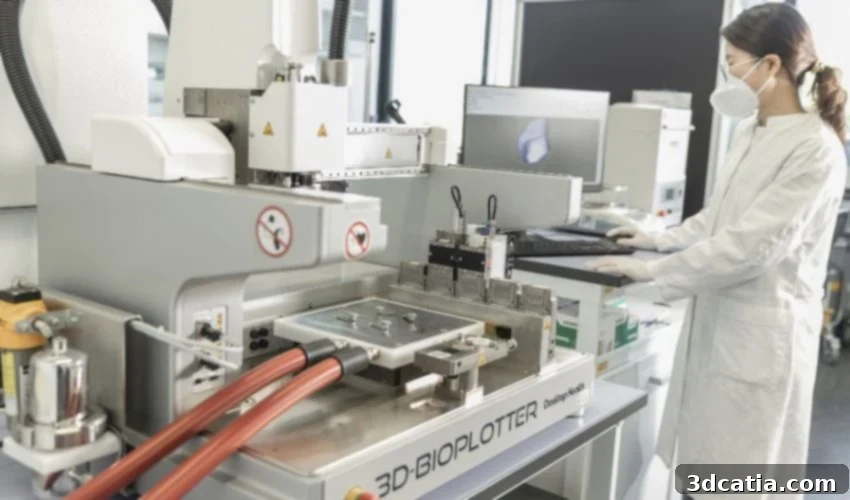
This extraordinary medical achievement was orchestrated with the crucial support of the Desktop Health 3D-Bioplotter® Manufacturing Series 3D printer. Renowned for its precision and versatility in bioprinting, this state-of-the-art device has been instrumental in numerous research and clinical projects, seeing active deployment in leading medical institutions across both the United States and Germany. Its recent triumph comes from the ENT Clinic at Hannover Medical School (MHH), which has etched its name in medical history as the first clinic worldwide to successfully print and implant a customized, drug-releasing ear implant into an adult patient. This accomplishment signifies a pivotal moment, showcasing the tangible benefits of advanced additive manufacturing in addressing complex medical conditions and demonstrating a new paradigm in personalized patient care. The ability to create implants that are not only anatomically precise but also capable of active therapeutic delivery opens up a vast array of possibilities for future medical interventions.
The 3D bioprinted ear implant, a testament to personalized medicine.
Hannover Medical School acquired its sophisticated 3D-Bioplotter from Desktop Metal in 2020, with a clear strategic vision: to leverage its capabilities for the development of innovative medical implant applications like this one. The patient at the MHH clinic who received this groundbreaking ear implant had been suffering from a persistent and debilitating narrowing of the ear canal. This condition, known medically as stenosis, had proven stubbornly recurrent, despite the patient undergoing multiple traditional surgical interventions. The conventional approaches, unfortunately, offered only temporary relief, highlighting the urgent need for a more permanent and effective solution. The newly implanted bioprinted device represents a significant departure from these prior methods, functioning with a dual mechanism designed for long-term efficacy. Firstly, it acts as an intricate, personalized stent, meticulously engineered to mechanically prevent the passage from narrowing again. Its custom design ensures a perfect anatomical fit, providing stable support where previous interventions failed. Secondly, and perhaps even more remarkably, the implant is engineered to actively supply the patient with a carefully calibrated dose of active pharmaceutical ingredients directly to the affected area. This localized drug delivery is crucial for promoting targeted healing, reducing inflammation, and ultimately preventing the underlying conditions that caused the recurrence. Dr. Verena Scheper, whose dedicated team from the Department of Inner Ear Pharmacology at the ENT Clinic at Hannover Medical School meticulously developed the implant and subsequently printed it using the Desktop Health 3D printer, expressed immense optimism, stating, “The first follow-up has already been very promising.” This initial success offers significant hope, not just for this individual patient, but for the broader potential of bioprinted, drug-releasing medical devices in addressing complex, recurrent conditions.
The positive sentiment surrounding this medical breakthrough is echoed by the ENT Clinic Director, Dr. Thomas Lenarz. Reflecting on the profound implications of this successful implantation, Dr. Lenarz stated with conviction, “We have thus opened the door to a new type of pioneering patient care.” His words underscore the clinic’s unwavering commitment to pushing the boundaries of medical innovation and delivering cutting-edge solutions to its patients. Hannover Medical School’s ENT Clinic is internationally recognized for its exceptional contributions to audiology and otology, particularly for establishing and maintaining the world’s largest cochlear implant program. This monumental program was initially introduced to provide comprehensive care for patients suffering from severe hearing impairment, offering them the ability to regain a sense of sound and significantly improve their quality of life. To date, an impressive number of over 11,000 patients have received life-changing aural assistance through a cochlear implant at MHH. Beyond its flagship cochlear implant program, the clinic demonstrates a holistic approach to hearing health. It is actively involved in critical initiatives such as the early detection of hearing loss in childhood, which is vital for timely intervention and developmental support. Furthermore, the clinic plays a pivotal role in the provision of advanced hearing aids and their continuous development, ensuring that patients have access to the most sophisticated and effective assistive listening devices available. Its expertise also extends to the meticulous diagnosis and innovative treatment of complex conditions such as tinnitus and various other types of sensorineural hearing loss. To ensure that its patients receive the most comprehensive and state-of-the-art treatment, the ENT Clinic fosters robust collaborations with a wide network of national acousticians, leading product manufacturers, and pioneering researchers. This extensive partnership network allows MHH to integrate the latest technological advancements and clinical insights into its patient care protocols. In parallel, the clinic also boasts a strong in-house research and development capability, diligently working to conceptualize and develop new medical products and treatment methodologies, further solidifying its position at the forefront of audiological innovation.
3D Bioprinting with Desktop Metal: Pioneering the Future of Personalized Medicine
From the perspective of the 3D printer producer, this achievement represents a monumental validation of their technology and vision. For Desktop Health, and by extension, its parent company Desktop Metal, the successful outcome of the drug-releasing ear implant project is an incredibly encouraging example of 3D printing technology not just advancing, but fundamentally breaking ground into entirely new realms of medical possibility. This groundbreaking application serves as a powerful testament to the precision, reliability, and transformative potential of the Desktop Health 3D-Bioplotter 3D printer. This particular project now adds valuable clinical data to an already extensive list of achievements for what is widely recognized as the world’s most cited and researched bioprinter. Its consistent appearance in numerous peer-reviewed scientific and medical journals underscores its critical role in advancing biomedical research and development globally. The robustness of its design and the consistency of its performance have made it an indispensable tool for researchers pushing the boundaries of tissue engineering and regenerative medicine, now extending directly into patient care.
Ric Fulop, the visionary Founder and CEO of Desktop Metal, views the successful production and implantation of this sophisticated ear implant as a definitive transition into a groundbreaking new phase of bioprinting. This shift moves bioprinting from the realm of academic research and laboratory experimentation directly into impactful clinical applications for real patients. Fulop articulates this profound transition by explaining, “The benefits of 3D bioprinting are just beginning to move into actual patients, and we celebrate this important shift in medicine that MHH and other medical innovators are driving forward.” He highlights the collaborative spirit and pioneering efforts of institutions like MHH that are propelling this medical revolution. Fulop further emphasizes the rapid evolution of the field, noting, “In recent months, we’ve seen the first products developed over many years on the 3D-Bioplotter moving into commercial and patient applications. We celebrate these important milestones, and what they mean for personalized patient care.” This underscores a critical paradigm shift: from theoretical possibility to tangible, commercialized medical solutions. The ultimate goal, as Fulop passionately states, is personalized patient care, where treatments are precisely tailored to the unique physiological and medical needs of each individual. He concludes by acknowledging the immense effort behind this success: “Our entire team celebrates this important accomplishment by the Hannover Medical School ENT clinic, which has been years in the making.” This sentiment reflects not just pride in the technology, but deep appreciation for the years of dedicated research, collaboration, and clinical expertise that culminated in this groundbreaking patient outcome. For those interested in delving deeper into the specifics of this remarkable 3D printed ear implant and its development, comprehensive information is available by clicking HERE.
This incredible advancement by Desktop Health and Hannover Medical School truly marks a new era in medical treatment. What are your thoughts on Desktop Health’s pioneering 3D printed drug-releasing ear implant and the future of personalized medicine? We invite you to share your insights in a comment below or join the conversation on our LinkedIn, Facebook, and Twitter pages! Don’t miss out on the latest innovations and breakthroughs in additive manufacturing; sign up for our free weekly Newsletter here to receive the most current 3D printing news directly in your inbox! You can also find all our fascinating videos and interviews on our dedicated YouTube channel, offering a visual journey through the world of 3D printing.
*All photo credits: Business Wire / Desktop Health