
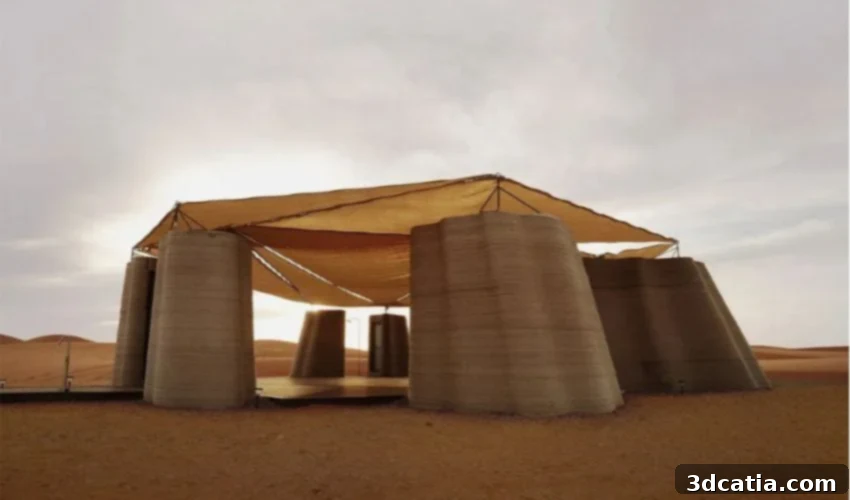
Revolutionizing Desert Reforestation: designRESERVE’s 3D-Printed ‘Desert Ark’ Shelters in Inner Mongolia
In a groundbreaking fusion of humanitarian effort and advanced construction technology, the Chinese architecture studio designRESERVE has unveiled ‘Desert Ark,’ a series of innovative 3D-printed modules strategically installed in the challenging Tengger Desert within China’s Inner Mongolia Autonomous Region. These remarkable small shelters are purpose-built to provide essential support and accommodation for dedicated volunteers engaged in the vital work of planting trees and spearheading reforestation initiatives in this vast and arid landscape. Spanning a total area of approximately 150 square meters, the Desert Ark complex thoughtfully integrates nine independent units. These units serve distinct functions, including comfortable bedrooms for rest, fully equipped kitchens for meal preparation, inviting living rooms for communal gathering, and crucial shower and toilet facilities, all artfully arranged around a central, shared terrace that fosters a sense of community among the volunteers. This pioneering project, brought to life through 3D concrete printing – specifically utilizing a robust mixture of cement and local sand – stands as a compelling testament to the immense versatility of additive manufacturing. It powerfully demonstrates the technology’s remarkable capacity to deliver practical and resilient solutions, even in the most remote and demanding environments on Earth, such as the heart of a desert.
The implementation of the Desert Ark project showcases a pragmatic approach to construction in extreme conditions. It’s important to note that the intricate 3D printing process itself did not occur amidst the harsh, arid, and unpredictable climate of the Tengger Desert. Instead, designRESERVE meticulously printed the various modular spaces in a specialized, controlled factory environment. This deliberate decision was made to guarantee the highest possible quality and precision in the manufacturing of each module. The studio understood that the fluctuating weather conditions, including intense heat, sandstorms, and potential temperature extremes prevalent in the desert, would almost certainly have compromised the printing process and the structural integrity of the final modules. By leveraging a factory setting, designRESERVE ensured optimal material curing, structural consistency, and overall quality assurance. Despite the off-site manufacturing, the on-site assembly of these pre-fabricated units was remarkably swift, requiring only a mere two days for the teams to fully erect the entire complex. A key aspect of Desert Ark’s design philosophy is its inherent mobility; the teams explicitly state that these modules are engineered to be easily relocated. This adaptability is crucial, allowing the shelters to follow the progress and changing fronts of the area’s ongoing reforestation efforts, providing continuous and immediate support wherever it is most needed.
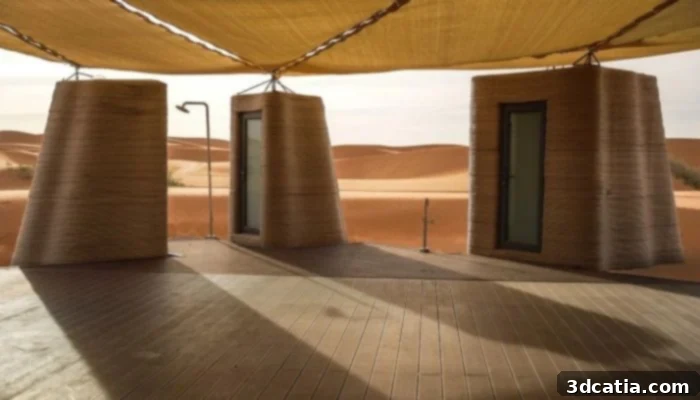
Each module has a different function: dining room, resting room, kitchen, etc., providing comprehensive facilities for volunteers.
The Ingenious Design and Engineering Behind Desert Ark’s Resilience
The construction of each individual module for Desert Ark utilizes cutting-edge robotic arm 3D printing technology. This sophisticated process involves a robotic arm precisely depositing successive layers of the specially formulated concrete mixture, building up the structure layer by layer with exceptional accuracy. Beyond the innovative manufacturing method, designRESERVE paid meticulous attention to the functional and aesthetic design of the modules, specifically tailoring them to the extreme desert environment. The studio purposefully opted for a distinctive corrugated design paired with a layered texture. This strategic choice is not merely for visual appeal; it significantly enhances the modules’ ability to withstand the region’s notoriously strong winds, which can pose a substantial challenge to any permanent or semi-permanent structure. Furthermore, a critical feature integrated into the design is a cleverly constructed cavity within the walls. This cavity serves as a highly effective insulation layer, a paramount requirement for maintaining comfortable interior temperatures in an environment characterized by dramatic thermal fluctuations. Thanks to this advanced insulation, each Desert Ark module is capable of comfortably withstanding a vast range of external temperatures, from a freezing -30°C to an intensely hot 45°C, ensuring the volunteers’ safety and well-being year-round. To cater to diverse functional needs and group sizes, the modules are available in three distinct dimensions: the compact small cabin measures 1.4 x 2 x 2.5 meters, the medium-sized module provides more space at 3 x 2.4 x 2.7 meters, and the largest unit offers ample room at 4.1 x 2.5 x 2.7 meters.
Seamless Installation and Sustainable Operation
Once the precision 3D printing of the modules was completed in the controlled factory environment, they were carefully transported to the designated reforestation sites within the Tengger Desert. A significant advantage of the Desert Ark’s design is its minimal environmental footprint and ease of deployment. The modules can be directly placed onto the sandy terrain, entirely circumventing the need for extensive, deep excavations typically associated with traditional construction. This not only speeds up the installation process but also minimizes disturbance to the fragile desert ecosystem. Following the swift on-site installation, the dedicated teams meticulously covered the central shared deck area with a robust, retractable awning. This awning provides much-needed shade, offering a comfortable outdoor space for volunteers to relax, socialize, and find respite from the intense desert sun. Powering these innovative shelters, and significantly reducing Desert Ark’s overall environmental impact, are integrated photovoltaic solar panels. These panels harness the abundant desert sunlight, converting it into clean, renewable energy to power lighting, essential appliances, and other operational needs of the modules. This commitment to solar energy underscores the project’s holistic approach to sustainable development, ensuring that the critical reforestation efforts are supported by an equally responsible and eco-conscious infrastructure.
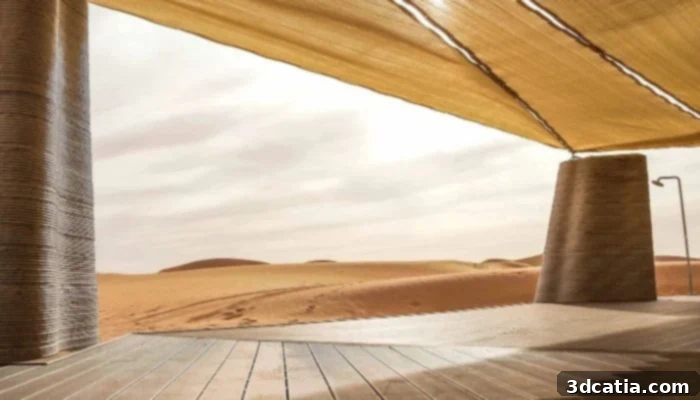
All the 3D-printed modules are strategically arranged to open onto a communal terrace, fostering interaction and providing a shared outdoor space.
Beyond Reforestation: A Blueprint for Future Remote Habitation
The Desert Ark project has fundamentally transformed the operational landscape for volunteers dedicating their time and energy to the arduous task of reforestation in this challenging region. They can now rely on practical, comfortable, and highly resilient spaces to rest, recharge, and prepare for their vital work. These shelters provide not just protection from the elements, but also a sense of community and support that is essential for long-term engagement in such demanding endeavors. However, designRESERVE envisions a future where the impact of these structures extends far beyond their current role. The architecture studio harbors ambitious hopes that, given their proven adaptability and robustness, these innovative structures can serve as viable, long-term dwellings in a multitude of other remote areas or extreme environments worldwide. Imagine their potential application in scientific research outposts in polar regions, as temporary housing in disaster-stricken zones, or even as off-grid residential solutions in other isolated landscapes. One thing is unequivocally certain: their mobile, modular, and rapidly deployable design represents a paradigm shift in how we approach construction in challenging locations. This inherent flexibility makes them incredibly practical and efficient for deployment where traditional building methods are either impractical, too costly, or environmentally destructive. The Desert Ark not only showcases the immediate benefits of 3D printing in humanitarian efforts but also opens up exciting possibilities for the future of sustainable and adaptable architecture across our planet. To explore more of designRESERVE’s pioneering and visionary projects, we encourage you to visit their portfolio HERE.
The successful deployment of Desert Ark underscores several critical advantages of integrating additive manufacturing into architectural solutions, especially for humanitarian and environmental projects. The speed of production, the ability to utilize local materials like sand for concrete mixtures, the inherent design flexibility to create highly optimized structures for specific environmental challenges, and the significantly reduced labor requirements on-site collectively position 3D printing as a frontrunner for sustainable development. This project demonstrates that sophisticated, comfortable, and ecologically responsible infrastructure can be rapidly established even in the most inhospitable conditions, providing crucial support for efforts vital to our planet’s health, such as combating desertification. The Desert Ark serves as a beacon of innovation, illustrating how advanced technology, thoughtful design, and a strong commitment to sustainability can converge to address pressing global challenges and empower those on the front lines of environmental restoration. Its impact resonates not only in the Tengger Desert but as a compelling model for future endeavors globally.
What are your thoughts on the groundbreaking Desert Ark project and its implications for the future of sustainable architecture and humanitarian aid?
*All Photo Credits: Rangers of Edge-locking Forest, Huaer Lin